By Robby Ching
Note: This is the second post in a series on ERWC’s rhetorical approach to language learning. For the first post, click here. Please see the teaching resource “Rhetorical Grammar in ERWC: A User’s Guide” in the ERWC Online Community for the full text from which the excerpt below was taken.
ERWC is designed to cultivate linguistic dexterity so students can read texts written for a variety of purposes critically and write texts tailored for their rhetorical situation. As educators charged with teaching our students how English works (California ELD Standards), we have to be mindful of the many languages and varieties of English that students bring to our classrooms.
The ERWC teaching resource “Essential Pedagogies for Integrated and Designated English Language Development in ERWC” advocates “teaching about the relationship between language and power” and “supporting the development of academic English while promoting pride in students’ home languages.” At the sentence level, a rhetorical approach to teaching English grammar invites us to take an assets-based approach as we value these languages and varieties of English while inviting students to further develop their ability to enter disciplinary conversations about topics that matter to them.
Encouraging students to use all the language—as well as other multimodal resources—available to them means keeping the focus on meaningful communication rather than correctness for its own sake. We can invite students to incorporate words, phrases, or entire sentences in their language or variety of English into their own writing while at the same time asking them to be clear about their rhetorical purpose for doing so. We can let them know that they are welcome to use translation apps and bilingual dictionaries and take notes or write early drafts in their home language. We can select texts that include other languages, such as The Distance Between Us, and consider Reyna Grande’s rhetorical purpose for using Spanish in a memoir intended for an audience of mainly English speakers.
We can introduce uncomfortable questions about whether the use of academic English is a way of performing “Whiteness,” an issue raised by Vershawn Ashanti Young in “Prelude: the Barbershop” in the 12th grade Language, Gender, and Culture module. We can draw on multilingual students’ own experiences moving among languages and identities tied to language and acknowledge their remarkable accomplishments. Approaching grammar from the rhetorical perspective rather than the traditional rules-based prescriptive approach is, Micciche asserts, “emancipatory teaching” (717).
ERWC encourages students to ask not what makes a sentence correct, but what makes it work and why.
The language of ERWC texts provide rich opportunities to explore the information-dense complex sentences that are typical of disciplinary English (Schleppegrell). ERWC encourages students to ask not what makes a sentence correct, but what makes it work and why. As students observe how skilled writers make use of these language resources—or choose to use simpler language—they can develop their capacity to better understand the arguments embedded in the language of the texts they are reading.
At the same time, they can observe how and why writers use more familiar language, other dialects, and other languages for rhetorical purposes. When students turn to their own writing, they can apply what they have learned to create varied sentences that are effective for their purposes. Most students who are learning to create complex texts will only be able to do this if we help them develop the tools of the craft.
Our job is to guide their inquiry into how English works and help them transfer what they have learned to their own writing with the questions “What did you observe? And how can you apply it to your own writing?”
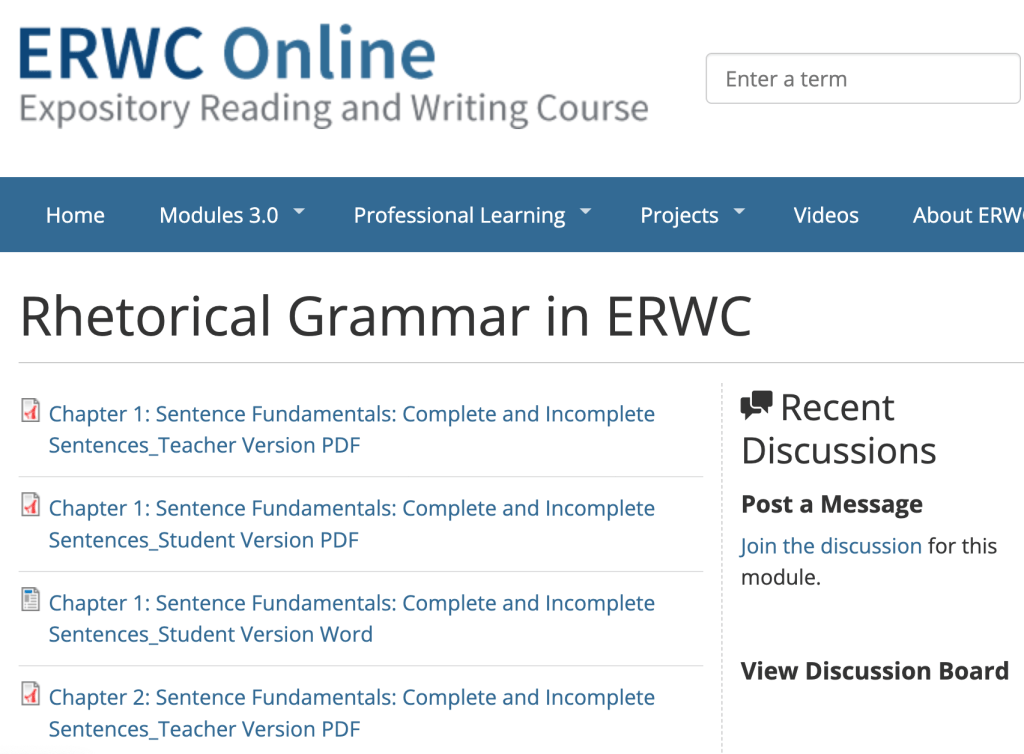
ERWC teachers can find activities and strategies for teaching language rhetorically, including 2.0 modules with rhetorical grammar lessons, by visiting the Rhetorical Grammar in ERWC section in the online community.
Click on “Modules 3.0” and select “Overview Documents.”

Then click on “Rhetorical Grammar in ERWC.”
Robby Ching is a professor emerita at Sacramento State in English and a member of the ERWC team since 2002. She has written many ERWC modules, most recently those with an ELD focus.