Extending the Pipeline: The ERWC-ELD Middle School Curriculum

By Robby Ching and Debra Boggs

  • Should technology be used as a solution to problems in nature?
  • What are some dangers of the metaverse, especially for young people?
  • What are the stories only I can tell the world? 
  • How is plastic pollution affecting us and our future as individuals, communities, and globally?
  • What is the role of a citizen in addressing the wrongs of their government? 
  • How can words and images work together to communicate information or tell a story?
  • How can stories help us deal with the problems we are facing?

These are a few of the compelling questions that students grapple with as they read, discuss, and view the texts that form the basis for the new ERWC-ELD middle school modules. The modules guide students in reading complex texts across a range of genres, including novels, memoirs, graphic novels, TED Talks, interviews, and articles.

These modules are being rolled out on June 23 at the ERWC Literacy Conference in Long Beach. After that, they will be available to teachers across the state who have participated in professional learning to guide their implementation.

These modules implement the vision of the California Framework for English Language Arts (ELA) and English Language Development (ELD) and support teachers in creating instruction that meets the California Common Core Standards (CCCS) and the California ELD Standards. The modules are designed for ELA with Integrated ELD classes linked to Designated ELD classes but are adaptable for ELA only or ELD only classes. They are also intended to be customized depending on the teaching situation and the place students are in their literacy development.

The modules include whole books and shorter texts that raise complex issues and employ complex language. Recognizing that students require guidance and support as they learn to make meaning of these texts, module writers have built in a variety of scaffolds to ensure that all students, including English learner (EL) students, build their reading stamina and productively with the texts that are central to the modules. Students practice applying the strategies of expert readers to understand and analyze these texts and then create texts of their own, producing many of the genres they have experienced as readers. They collaborate to produce a TED Talk, write a micro-memoir, produce a slide show with presenter notes, deliver a speech at a climate summit, and create an infographic.

The language-focused activities in the modules foster English Learner (EL) and Multilingual Learner (ML) students’ understanding of how English works at the word, phrase, clause, and text level while supporting disciplinary literacy growth for all students. The language-focused instruction is offered in the context of the texts students are reading as they participate in engaging and collaborative activities. Many activities implement high-impact strategies that have been shown to be especially effective in this literacy development, building students’ awareness of how writers and presenters make choices about the language they use depending on who their intended audience is and how they hope to impact that audience.

Analyzing Mentor Texts

As they experience these modules, middle school students are introduced to the foundation of a rhetorical approach to reading, writing, and language. As part of this approach, in each module, students analyze mentor texts that model the form, the rhetorical strategies, and the language required by the culminating task. During this analysis of mentor texts, students develop a shared understanding of what is required for a specific kind of text to be successful. The teacher provides or they work together to create success criteria they can use to guide their drafting, and which can be used for peer feedback as well as grading.

Although each module reflects the expertise of its individual writers, they take a common pedagogical approach reflected in “Essential Pedagogies for Integrated and Designated English Language Development in ERWC,” available in the ERWC Online Community. Best practices for English Language Development suggest that students learn best by collaborating with other students, an understanding reflected in the California ELD Standards. The ERWC-ELD middle school curriculum assumes student-centered classrooms where students are constantly interacting with each other around the texts and tasks of the modules.


These modules do not make up an entire curriculum.  Including assignment sequences from textbooks or other sources will be needed to create a full year-long curriculum. But the rhetorical approach embedded in these modules enables middle school teachers to apply a similar approach to all the texts they teach. The High Impact Strategies Toolkit, available on the home page of the ERWC online community, provides a rich source of proven protocols to craft instruction, following the full ERWC arc from the professional text to the student text, and from rhetorical reading to rhetorical writing.
Experiencing these ERWC-ELD modules in middle school invites students to cross the threshold to becoming rhetorical readers and writers as they discover that writers create texts in particular contexts, for particular audiences to achieve particular purposes. These students will leave middle school having acquired a portfolio of reading and writing strategies to apply in their high school ERWC classes, in other academic classes, and in the wider world.

Works Cited

California Department of Education, California Common Core State Standards: English Language Arts & Literacy in History/Social Studies, Science, and Technical Subjects. Sacramento, CA: Adopted by California State Board of Education August 2010 and modified March 2013.

California Department of Education (CDE), California English Language Development Standards: Kindergarten Through Grade 12. Sacramento, CA: Adopted by California State Board of Education November 2012, CDE 2014.

Fletcher, J. (2015). Teaching arguments: Rhetorical comprehension, critique, and response. Portland, ME: Stenhouse Publishers.

The Expository Reading and Writing Course, 3rd ed. (2019). California State University Press. Long Beach CA.

–Katz, M., Graff, N., Unrau, N., Crisco, G., and Fletcher, J. “The Expository Reading and Writing Course (ERWC) Theoretical Foundations for Reading and Writing Rhetorically” (2020).

–Ching, R., (2021). “Essential Pedagogies for Integrated and Designated English Language Development in ERWC.”

— Arellano A., Ching, R., Boggs, D., and Spycher, P. (2021) “The High Impact Strategies Toolkit to Support Students in ERWC Classrooms” in The Expository Reading and Writing Course (3.0). California State University Press. Long Beach CA.

About the Author:

Debra Boggs is a retired educator. She taught high school English and worked as a school and county office administrator. She is a member of the ERWC Steering Committee and part of the leadership team that created ERWC-ELD modules for grades 9-12. She is also currently a member of the team that created the new ERWC-ELD middle school modules for grades 6-8. 

Roberta Ching is a Professor Emerita in English at California State University, Sacramento. She coordinated the English as a Second Language program at CSUS before becoming chair of the Learning Skills Department. She was a member of the original 12th Grade Task Force and is currently a member of the team that created the new ERWC-ELD middle school modules for grades 6-8. She serves on the ERWC Steering Committee.


To learn more about ERWC or how to access this free curriculum, please visit https://writing.csusuccess.org/.

Editor’s Note: The 2025 ERWC Literacy Conference will be June 23rd in Long Beach, California. Our theme this year is “Leaning into Liminality: A Return to Language, Wonder, and Inspiration.” Registration is free! Please visit the ERWC Online Community for more information.

What Teachers Want to Know about the New ERWC Grant

By Anne Portferfield

As you may have heard, there’s a new ERWC grant opportunity! Through the Education Innovation and Research grant, California State University is developing yearlong ERWC courses for grades 9 and 10, and high school English teachers will pilot them beginning in the 2025–26 school year.

I have begun meeting with teachers to discuss the grant opportunity, and some teachers are overjoyed that the new curriculum is on the way! One teacher noted that implementing the ERWC will ensure that grade 9 and 10 English courses are rigorous–which is essential in this post-pandemic era. Several teachers noted that the ERWC will prepare students for the Advanced Placement English Language and Composition Course.

Teachers also have questions. I’ll start with an easy one. Almost every teacher I’ve spoken with has the same question: What will the curriculum include?

Each grade will have two thematic pathways for teachers in the grant to choose from. The grade 9 pathways will be identity and civic engagement, and the grade 10 pathways will be community and communication. The pathways will include all of the same types of modules as are available at the upper grades (i.e., portfolio, mini, issue, book, and drama). All modules will have integrated and designated ELD embedded. After the grant, grade 9 and 10 ERWC teachers will have the same flexibility to create their own DIY course design as grade 11 and 12 ERWC teachers.

Sample pathways for Grade 9 (actual course design may vary)

Yes, there will be a Romeo and Juliet module. No, you don’t have to teach it if you don’t want to! Some of the other texts being considered for the new curriculum include Born a Crime, Klara and the Sun, We Are Not Free, The Hate U Give, Funny in Farsi, Braiding Sweetgrass, Home is Not a Country, and Night. What the curriculum developers can guarantee is that texts will be highly engaging for students, which is a cornerstone of the ERWC.

Jennifer Fletcher, the Chair of the ERWC Steering Committee, shared, “The curriculum will be really good. We are going to be proud of it when we put it in front of teachers.” 

Teachers also want to know what the professional learning entails. ERWC teachers will engage in 20-25 hours of professional learning every year they participate in the grant. Below are descriptions of the professional learning components of the grant:

  • Summer workshops: ERWC teachers will attend a two-day summer workshop every summer they are participating in the grant. As a former teacher, I know that summers are coveted! If your school signs up for the grant, the Fresno County Superintendent of Schools will work with you to schedule the summer institute at a time that works well. The goal is for the workshops to be in-person, but there may be some virtual options.
  • Coaching: ERWC teachers will be assigned a coach to be a thought partner. The coaches will be professors, literacy specialists, experienced ERWC trainers, etc. Teachers will engage in five coaching sessions, which will include a pre-conversation, a classroom observation, and a reflection conversation. The coaching sessions will not be evaluative, and no information will be reported back to your district.
  • Community of practice meetings: ERWC teachers will attend five 1-hour community of practice meetings. These can take place at the school site during already-scheduled meeting time.

Teachers also have questions about stipends. As a former teacher, I remember spending countless hours doing work that I was not compensated for. We want teachers who are part of this grant to feel valued! Here’s more information about the stipends:

  • Each ERWC teacher will receive $4,000 total–$2,000 for the pilot year and $2,000 for the evaluation year. If a teacher teaches the ERWC in both grades 9 and 10, they will receive $8,000 total ($4,000 per grade).
  • Each traditional English teacher will receive $1,000 total during the evaluation year.
  • Each school will identify a site lead, who will be responsible for communicating information about the grant. They will receive $3,000 total–$1,000 for each year of the study.
  • The $20,000 school stipend is intended to be used to support ERWC teachers. In the past ERWC grants, schools have used this stipend to purchase copies of books for every student, pay teachers their hourly/daily rates for attending professional learning, provide subs for professional learning days, etc.
  • Districts usually keep the $5,000 stipend to offset the cost of providing WestEd with student-level data.

The ERWC and traditional teacher stipends will be paid directly to teachers by WestEd. The site lead stipend will be paid directly to site leads by the California State University. The school stipend will be paid to the district, and the district will make the money available to the schools.

In addition to these stipends, schools and teachers also receive all the materials they need to implement the new curriculum, including class sets of books for book modules.

There have also been some questions about scheduling throughout the grant. Schools need the following teachers in place each year of the grant:

 2025–262026–272027–28
Grade 9Pilot Year At least two teachers pilot the ERWC   At least one teacher continues to use the regular curriculumEvaluation Year The same two teachers as the previous year teach the ERWC   At least one teacher continues to use the regular curriculum 
Grade 10 Pilot Year At least two teachers pilot the ERWC   At least one teacher continues to use the regular curriculumEvaluation Year The same two teachers as the previous year teach the ERWC   At least one teacher continues to use the regular curriculum

And lastly, teachers want to know how they can sign their schools up for the grant. The first step is to meet with me! Please feel free to email me to set up a meeting (anne.porterfield@wested.org). We would discuss the details of the grant, and I would address any lingering questions. If it seems like the grant may work at your school, we would then share information about the grant with other teachers at your school, school administrators, and district administrators. If all parties agree to participate, then WestEd would set up a memorandum of understanding with your district.

You may also learn more about the grant in an upcoming webinar on Monday, October 21st at 4pm PT. You may register for the information session here.

Anne Porterfield is a Senior Program Associate with Research-Practice Partnerships. She serves as both a project manager and qualitative researcher for projects and evaluations.

The ERWC Portfolio

By Lori Campbell

Spring is the bittersweet season when our ERWC students prepare their portfolios for the transition to college. I have the privilege of keeping many of my students for two or more years in the Kern Learn blended program, so I have been able to track their growth through the two pathways in grades 11 and 12. I can see their accomplishments, but they don’t necessarily see what I see. The ERWC portfolio is an important benchmark for students rather than their teachers.

In Kern County, through the Building Bridges Conference, English and composition teachers from the Kern High School District, the various community colleges in our area, and Cal State Bakersfield come together to reflect on various issues in literacy for the students we serve. In one of the sessions, I attended an excellent presentation that explained the freshman composition requirements for these institutions and gave me insight into just how important that portfolio is. Here’s how I explained it to my seniors.

Students benefit most by having a basic understanding of rhetorical reading and writing when they enter college. The General Education composition requirement instructs students in effective research and report writing. However, having a toolkit of rhetorical strategies for tackling difficult academic texts aids tremendously in their courses to succeed in research.

This is what ERWC provides at the high school level. The portfolio shows students how these tools have helped them navigate and understand these texts over the past year (or two!). They have examples of rhetorical strategies and a record of how they work. At CSU Bakersfield, first-year college students who still feel they have not mastered these skills can take the “Stretch” course (English 1100), which lasts a full year and provides a booster of rhetorical strategies in their first semester. If they believe they have met their learning goals in ERWC, they can move with confidence directly into the single-semester course for research skills.

Grade 12 ERWC Portfolio Module Overview

ERWC is not just for students who are CSU-bound. Students engage in rhetorical reading and writing no matter the higher education venue they choose. Our community colleges provide practice in these skills in the first semester of their college composition classes (whether they have taken ERWC or not). Entering students can pay to take a challenge assessment to test out of that course, but they are still required to demonstrate the ability to engage in inquiry, read purposefully, and write rhetorically. Looking through the work they have completed throughout the modules, students can evaluate their preparedness for college reading and writing, regardless of their destination.

Working with seniors in spring is like herding kittens in a dust storm. They have become skittish, forgetful, and just a little terrified. The ERWC portfolio shows them concrete evidence of their college readiness like no other indicator. Scores on tests tell them how well they can take tests. The ERWC portfolio shows students what they are capable of doing. This important collection of documents serves as a resource students can consult as they navigate the next step in their academic journey.

The takeaway learning contained in the ERWC portfolio is too important to leave behind.

Lori Campbell is the English department chair for Kern High School District’s Kern Learn Program. This is a complete distance learning program that provides students the option to take their A-G required courses online. She has taught ERWC both face-to-face and through distance learning for over 10 years. Lori holds her master’s degree in Curriculum and Instruction.

A Visit to the Vaults: Opening the ERWC Archive

EDITOR’S NOTE: Registration for the 2023 ERWC Literacy Conference closes on Monday, May 22. Reserve your spot now before this event sells out!


By Jennifer Fletcher

Like In-N-Out Burger’s “secret” menu, the ERWC Module Archive offers special options for those in-the-know. Roughly 100 modules have been published over the 20 years of ERWC’s history as a nationally recognized literacy initiative, including dozens of modules in versions 1.0 and 2.0.

There are some terrific first and second edition ERWC modules still available for use. While these modules no longer include the module texts (copyright costs prevent Cal State from renewing permissions for all three editions of the curriculum), most of the reading selections can still easily be found online through their original publishers. For instance, “The Last Meow,” a module about the rising costs of veterinary care, uses a feature article in The New Yorker while “The Undercover Parent,” a module about spyware, uses an op-ed piece from The New York Times.

For those of us who have been working with ERWC since its inception in 2003, a visit to the ERWC module archive is a stroll down memory lane. We remember how deeply engaged our students were in analyzing images from an Abercrombie and Fitch marketing campaign, the powerful conversations students had over bell hook’s examination of love and justice, and the moving depiction of Roger Ebert’s transcendent joy following his life-changing battle with cancer. And what veteran ERWC teacher can forget “Bring a Text You Like to Class”?—a perennially popular module on bridging students’ in-school and out-of-school literacies that requires no copyright permissions (aside from those protecting the CSU’s own intellectual property rights).

Esquire, March 2010

English departments looking to build a full 9-12 ERWC vertical articulation may find the “secret menu” modules especially appealing, as these can fill gaps in grade 9 and 10 ELA courses. Teachers in other content areas such as social science or in academic preparation programs such as AVID who would like to try out ERWC’s inquiry-based, rhetorical approach to literacy learning may likewise find the older modules useful. Going to the archive could mean not having to compete with the English department for module selections.

While the first and second editions of the curriculum were designed using an older version of the ERWC Assignment Template, ERWC’s focus on developing transferable critical thinking and literacy skills ensures all iterations of the template are enduringly relevant. Each version of the template names the transferable competencies that promote postsecondary success in reading and writing. The recursive literacy process described by the template and enacted through the “ERWC Arc” is imagined in somewhat different ways in each edition of the curriculum, but the goal of the course design remains the same: To support students in developing and internalizing their OWN flexible process for understanding, analyzing, evaluating, and composing texts.

A caveat: Schools that have adopted ERWC grade 11 or 12 under UCOP program status are required to use the 3.0 course descriptions and modules for their approved ERWC courses. ERWC has full courses for grades 11 and 12 and resources for grades 7-10. The resources (i.e., modules and activities) can be used in existing courses such as English 9 without the UCOP restrictions, provided the teachers accessing the materials have been ERWC certified. All teachers must complete 20 hours of ERWC professional learning to gain access to the curriculum.

Jennifer Fletcher is a Professor of English at California State University, Monterey Bay and a former high school teacher. She serves as the Chair of the ERWC Steering Committee. You can follow her on Twitter @JenJFletcher.


2023 ERWC LITERACY CONFERENCE

June 20 in Sacramento & June 26 in Pomona

Conference registration closes May 22! The $75 registration fee includes continental breakfast and a buffet lunch. Administrators, literacy coaches, counselors, and CSU faculty get 50% off registration using the code ERWC50PERCENT. CSU students can register for free using the code ERWCSUFREE.

All are welcome! You don’t have to be an ERWC teacher to attend.

Featured Speakers
  • Carol Jago, author of The Book in Question
  • Matthew Johnson, author of Flash Feedback
  • Jen Roberts, author of Power Up
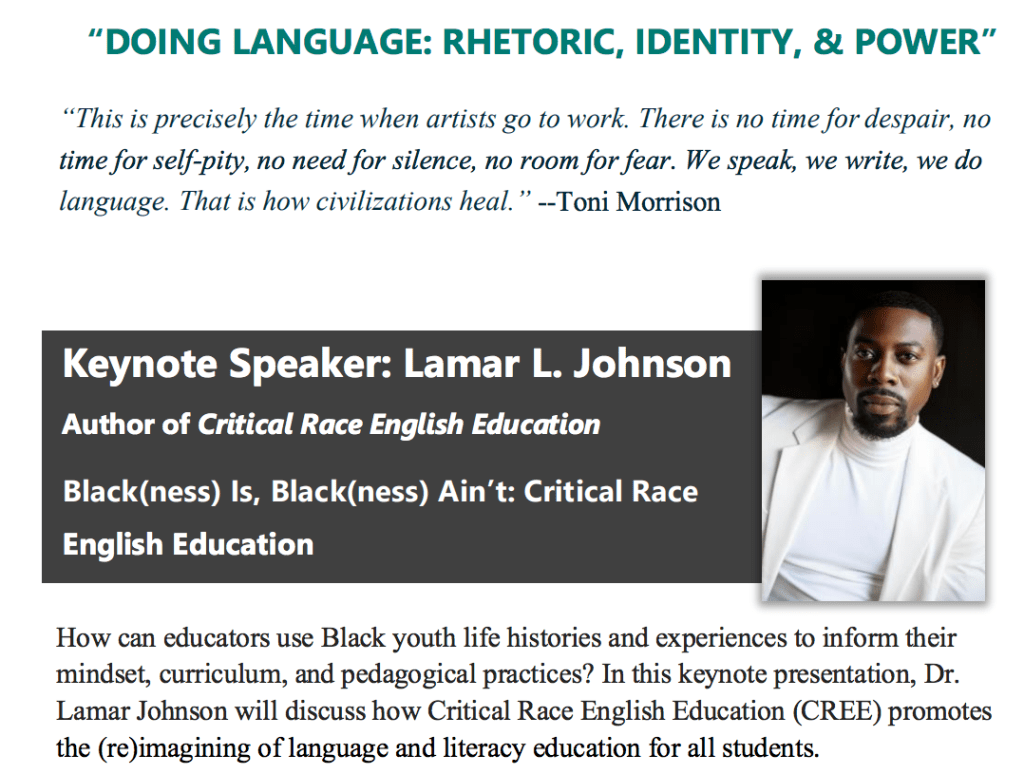
  • Lamar L. Johnson, author of Critical Race English Education
  • John Edlund, Professor Emeritus of Rhetoric and Founding Chair of the ERWC Task Force

Into, Through, and Beyond the High Impact Strategies Toolkit

By Robby Ching

Over the decades of my career, I’ve observed creative teachers devise multiple engaging and effective ways to support students in learning English, especially the English valued in academic settings. When the first ERWC middle school modules were written, I thought how valuable it would be to gather the strategies that appeared throughout those modules along with others that have become hallmarks of the ERWC approach so teachers could transfer them to whatever texts they were teaching. 

During the development of ERWC 3.0,  along with my ERWC-ELD colleagues, Adele Arellano, Pam Spycher, and Debra Boggs, I was given the opportunity to do just that. We identified strategies in the newly developed ERWC-ELD modules, focusing on the activities we recognized were especially high impact for English learners students but would be valuable for most students still developing disciplinary English. In consultation with the ERWC-ELD team, I organized these strategies using the same structure that provides the DNA of all ERWC modules, the Assignment Template. We also identified activities that could be used at any point across a module, for example, activities focused on goal setting or discussion strategies.

The result was the High Impact Strategies Toolkit to Support English Learners.

Later, we revised the Toolkit by adding even more activities and identifying the ELD Standards that students would meet when teachers employed the protocols. For ease of access, Debra Boggs created a searchable Table of Contents. We created a Word version so you can modify and adapt the student version of an activity for your own texts and teaching situation. Our final document (final for now, since new strategies could certainly be identified and added) is a 129-page treasure trove of inspiration for good teaching.

All ERWC modules can be adapted to include additional Integrated and Designated ELD, the vision of the California Framework for ELA and ELD. Beyond that, using the High Impact Strategies Toolkit means that whatever other texts or text sets you are teaching, you can move through the stages of the ERWC Template and draw on strategies that will ensure a student-centered and inquiry-based approach and the ongoing development of students’ disciplinary language. 

For example, Save the Last Word encourages students to engage with a text and discuss it in small groups. Charting Claims Across Multiple Texts transfers responsibility to students to track what they are reading so they have what they need at their fingertips when they are ready to do text-based writing. Sentence Unpacking guides students in understanding the writer’s craft at the word, phrase, and clause level so they can apply what they learn when they go to craft sentences of their own. Purpose Analysis prompts students to read their own writing rhetorically and revise accordingly. Students develop active listening and encounter key concepts as they work together to do Collaborative Text Reconstruction.

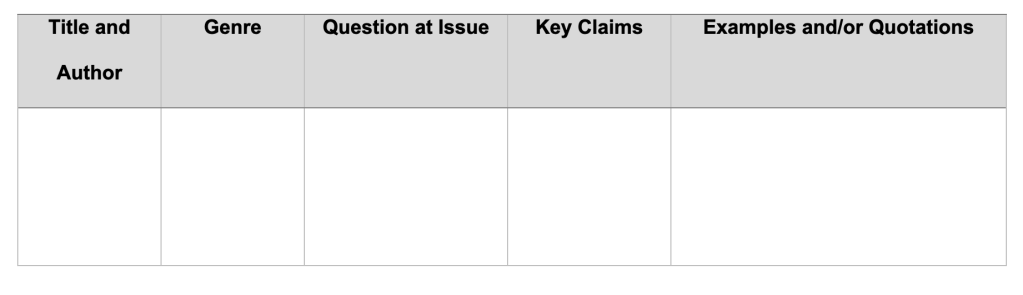
Charting Claims Across Multiple Texts

I’ve even observed schools adopt a strategy such as Annotation, Summary, Response to use across the disciplines in history and science classes, not just in English classes, a powerful way to truly make students college and career ready.

Early in my ERWC collaboration with high school teachers, an outstanding teacher told me the ERWC template kept him honest. Since then, the federal studies that supported the development of ERWC 2.0 and 3.0 have confirmed that students whose teachers are faithful to the Template—not teaching every activity in a module but guiding students as they move through each phase of Reading Rhetorically, Discovering What They Think, and Writing Rhetorically—are likely to be more successful than students whose teachers short-circuit it. 

Self-accountability is key—asking myself, am I making sure that my students experience a robust set of activities at each stage of the reading and writing process so that at the end of a module or assignment sequence, they can successfully contribute their authentic voices to an ongoing conversation of consequence? And to answer yes to that question, I can turn to the High Impact Strategies Toolkit in planning a module or a year-long pathway to support students as they practice the strategies of proficient readers and writers. And in the spirit of expansive framing, I can make sure my students reflect on how these strategies can be transferred to new situations in other modules, other classes, and in the world beyond school.

Robby Ching is a professor emerita at Sacramento State in English and a member of the ERWC team since 2002. She has written many ERWC modules, most recently those with an ELD focus.


2023 ERWC Literacy Conference

June 20 in Sacramento & June 26 in Pomona

Conference registration is now open! The $75 registration fee includes continental breakfast and a buffet lunch. Discounts available for administrators, literacy coaches, and counselors.

The Story Behind ERWC 3.0

By Jennifer Fletcher

This past weekend I had the joy and privilege of sharing a sneak preview of the forthcoming ERWC modules for grades 6-8 at the CATE Convention in Monterey, a few miles south of my home in Seaside, CA. I shared poems by Daniel B. Summerhill, Elizabeth Acevedo, Clint Smith, and Joshua Bennett and talked about how the module I’m writing, “Songs of Praise,” includes both integrated and designated English language development. I also offered a quick peek at some of the activities under construction:

Talking about my current work as a middle school module writer reminded me of the monumental effort it took to get the third edition of the high school curriculum out into the world. The development of ERWC 3.0 was unlike any other writing project I’ve been involved with. It was messy, overwhelming, and exhilarating. The project took on a creative life force of its own beyond anything we had anticipated that resulted in a product that exceeded our expectations (and, frankly, our copyright budget). What we now see as ERWC’s “equity upgrade” stretched my thinking and tested my commitment to flexibility in all kinds of ways. If you’ve ever wondered how the third edition came to be, here’s the story behind ERWC 3.0.

Expanding the Inquiry Space

With the third edition of the ERWC, we didn’t just expand the inquiry space; we blew it wide open. We made extensive room and time to leverage the talents and insights of people in our community and to recruit people who could bring additional expertise from throughout California and the State of Washington, our partner in the multimillion dollar federal grant that funded the new curriculum. We sought to bridge gaps in our own knowledge and to adapt and apply what we learned from the first two editions to the redesigned course.

And that meant our content creation team had to grow exponentially. We ballooned from an original task force of around ten members back in 2003 for the first edition of ERWC to a community of module writers that included scores of educators from two states for the third edition. We also sought to bring the ERWC to scale by expanding the curriculum to the 11th grade and the ERWC literacy network to the states of Washington, Hawaii, West Virginia, and New Mexico.

This time, the pool of module authors included high school teachers and college faculty with diverse backgrounds, experiences, and identities. Authors approached the task from various angles and perspectives, and we worked to learn from each other. Each module author thus opened a window into a particular facet of our literacy network. We were able to get a closer look at each others’ teaching lives and social worlds while working to achieve a shared vision of the future we want for our students.

We didn’t just tell potential contributors the budget and specs and send them off to complete their work alone. Instead, we kept our eyes on both the product and the process, knowing that in some ways the latter would have an even greater impact on the kind of relationships and community we built through this work. And we were open to change when the ERWC Assignment Template or a module took a direction we hadn’t tried before.

We also took extra care to expand the inquiry space during the early stages of project development. We took time to review our theoretical foundations, rethink our course and module design, and learn about current best practices in our profession, including Universal Design for Learning (UDL) and culturally sustaining pedagogies. We held workshops on the English Language Arts/English Language Development Framework for California Public Schools. We met in writers’ groups. We developed and reviewed module proposals, developed and reviewed module drafts. Then we piloted the drafts and followed up with more review and revision.

The ERWC’s evolving Theoretical Foundations, moreover, informed everything we did, even down to our smallest edits. For instance, as we revised the draft modules we worked to omit prescriptive or didactic language—words such as “should” or “must”—that was contrary to our rhetorical, assets-based approach.

While the process was at times more generative and serendipitous than we were perhaps prepared for (over 80 new modules were ultimately developed), we believe we have a stronger curriculum and community as a result.

Innovation in Instructional Design


The outcome of this process is a curriculum that offers teachers and students more choices, more literature, a greater diversity of authors and text types, more means of expression (using UDL), more support for English Language Learners, and more opportunities for analyzing visual rhetoric and new media. The third edition also includes mini-modules on key rhetorical concepts such as the rhetorical situation, genre, and kairos. We’re excited to further expand the curriculum and its pedagogies through the forthcoming collection of new language-focused modules for grades 6-8.

What is perhaps most promising about our practice as we approach the 20th anniversary of ERWC is what we’ve learned about the benefits of inquiry and collaboration. The features of ERWC 3.0 that move the course toward greater student agency and educational equity are those that developed out of some of our richest discussions and newest learning: UDL, teaching for transfer, learning goals and reflection, culturally and linguistically sustaining pedagogies, and the California English Language Development Standards. We had to be willing to approach this work with the same open mind and tolerance of confusion that we encourage students to bring to their work with texts. We had to learn to accept the mess and trust that it, too, is generative. We had to embrace the process of discovery.

Moving Forward


With the new middle school curriculum, we’re now hitting that pivot point after we’ve expanded the inquiry space and invited mess and complexity where we need to start making some decisions about the final form of the modules. Our task is to make sure we retain those protean structures–rhetoric and inquiry, the arc and the spiral–that allow us to have a shared vision and purpose. This is the piece that needs to be locked into place before we can publish any new iteration of ERWC.

But the other components of the ERWC—the network of over 15,000 teachers, the professional development programs, communities of practice, multi-state collaborations, online discussions and resources, webinars, and blog—will remain fluid and responsive. These are the places where teachers can continue to think through the extent to which ERWC 3.0 is helping students become better readers, writers, and thinkers and how instruction can be further improved. The lesson learned is the need for flexible components in literacy initiatives that remain plugged into the feedback loop, to the lived realities of individual students and teachers and the changing dynamics of particular classrooms.

We can’t wait to see what happens in the next chapters of ERWC’s story. 🙂

Jennifer Fletcher is a Professor of English at California State University, Monterey Bay and a former high school teacher. She serves as the Chair of the ERWC Steering Committee. You can follow her on Twitter @JenJFletcher.


NOTE: Please consider submitting a proposal to present at this year’s ERWC Literacy Conference, to be held June 20th in Sacramento and June 26th in Pomona. Cal State University pays travel costs for selected presenters. See the Call for Presenters here.

Conference registration is now open!

Question with No Answers

By Jonathon Medeiros

When does the river become the delta? When does the delta become the sea? Do fish see the water they breathe? Is that right, do fish breathe? When did the cavaquinho become the ukulele? Is dancing storytelling? Why is live music pleasurable?


I believe in questions, not answers. I believe in the power of curiosity. There is value in the work of being curious, in looking at or even imagining connections. I believe that we can build empathy by practicing curiosity, by examining the visible and invisible connections around us. Often, however, my students seem to think that empathy and curiosity and kindness are fixed personality traits; either we are or are not those things, in the way we are or are not 5ʻ9”. 

We can build the muscles of curiosity and questioning through practice, in the same way we can build our ability to run or climb or write. After all, we learn by asking and exploring the crevices of questions, especially those to which no answer is obvious. Finding correct answers is often not actually important to learning. Once an answer is deemed to be “correct,” we stop looking and consequently stop learning. The act of being curious, of following that curiosity, of following up answers with more questions, is key and this is what leads us to explore and expand our ideas.

While this may be true, convincing students of the importance of asking questions with no answers, and trying to make that kind of questioning second nature for students, can be difficult. Humans sometimes want to find an answer so they can stop working, but this mindset keeps us closed off from othersʻ ideas.

The ERWC mini-module “Introducing Inquiry Questions” is a wonderful way to introduce students to the simple but powerful idea that being curious is important. This mini unit makes explicit the benefits of asking questions without answers through a variety of activities and texts, including an engaging TED talk. Students investigate times that they have asked curious questions, reminding them that this was once natural for most of us, and then walks them through some texts that help clarify the power of picking that habit up again. Emma Chiappettaʻs new book Creating Curious Classrooms: The Beauty of Questions is another amazing resource focused on teaching us how to cultivate curiosity in our classrooms and with our students.

Jonathon Medeiros has been teaching and learning about Language Arts and rhetoric for seventeen years with students on Kauaʻi. He frequently writes poetry, memoir, and essays about education. He is the former director of the Kauaʻi Teacher Fellowship. Jonathon enjoys building things, surfing, and spending time with his wife and daughters. He believes in teaching his students that if you change all of your mistakes and regrets, you’d erase yourself. Follow Jonathon on Twitter – @jonmedeiros or at jonathonmedeiros.com.

Let Sleeping Teenagers Lie

By Lori Campbell

When I consulted our Associate Superintendent of Business for the Kern High School District, Dr. Mike Zulfa, about the plans for how our district would comply with SB 328, he wrote, “So I am blaming you for all of this disruption! 😊” You see, I am the one who wrote the Expository Reading and Writing Curriculum module: “Teenage Sleepers: Arguing for Your Right to Sleep In.” 

Module Background

In the early stages of ERWC 3.0 development, I had proposed the module after watching the TED Talk with sleep expert Dr. Wendy Troxel, “Sleepy Teens: A Public Health Epidemic.” Troxel argues that the hormonal changes in teens cause them to reach REM sleep later than in adults and are not fully out of the sleep cycle until 90 minutes after adults are normally “awake.” She along with the PAC Start Schools Later fought for legislation that requires schools to start later in the morning for both middle-schoolers and high school students. I thought this would be a great topic of discussion for English 11 courses. It addressed all the points of an engaging module: all students could identify with the topic, there were definitely two contested sides of the issue, and students could actually participate in the political discussion. This module also introduces students to the construction of arguments. I never expected it to work so well! 

The Start Schools Later bill was first passed in the California legislature in 2018, but then (to my great relief) Governor Jerry Brown vetoed it citing that individual districts should decide what to do with the information. In fact, our district already provided online instruction as an option for students who had a difficult time functioning before 9:00 am. Students began their day at in-person schools during third period and took two of their classes online through the Kern Learn program–an independent studies program that offers UC-approved A-G coursework at the same rigor as the in-person classes on our school sites. The majority of assignments our students submit are completed between the hours of 5:00 pm and 3:00 am. They are pretty good, too! 
A Changing Context

Well, someone decided to try again when Governor Gavin Newsom was elected, and we all know what happened next. 

With the signing of SB 328 on October 19, 2019 (the month after the 3.0 modules were officially launched) middle school districts and high school districts in the state of California were given three years to figure out a plan to start their instruction no earlier than 8:00 am and 8:30 am respectively. And we also know what happened after that. COVID-19 and the subsequent quarantine and teach-from-home nightmare placed this legislation at the back of the implementation line. Coming out of the stupor in winter of 2021, districts realized they really hadn’t thought about what was needed to completely shift the school day to 90 minutes later. I know that the Board of Trustees and KHSD Superintendent, Dr. Bryan Schaefer, petitioned the governor vehemently to at least delay the implementation of the new schedules but to no avail. 

Modifying the Module

In the meantime, I wanted to look at my module and see what could be salvaged. Just like all good ERWC module topics, this subject is still timely. As furious as I was with Governor Newsom for creating this chaos, I finally realized that the implementation of this plan would still allow students to find their civic voices. In our second week of late-start implementation, the students are grumbling about as loudly as the teachers and parents. Football games are STARTING at 8:30 at night. Buses without air conditioning are transporting students home at the hottest hours in Bakersfield with highs of 103-108. Parents are having to shift their days completely if they need to pick up their students later in the day. Teachers who turn into instant moms and dads when they arrive home are more exhausted and have less time to prepare dinner. It’s a hot mess in Kern County. I can only imagine what it is like in your neck of the California woods. 

The changes we are going through add a new dimension to this module, and we will be entering a period of data gathering. After a year or two, we will be in the position to look at the results: have attendance rates improved? Has the mental health of teens overall improved? Are students more successful in middle-schools and high schools? I think there is still plenty to argue with this module. I have revised some texts, the prompt, and some of the activities to reflect the passage of SB 328. This includes adding the bill itself to the module allowing teachers the opportunity to add the format of a foundational document to their instruction. This Google Doc provides the modifications that I have made. I would love to have feedback from teachers and their students. I think with all of us caught in the maelstrom, we may actually be able to work together to determine the benefits (or detriments) of SB 328. While I deny all culpability in the passage of this bill (I wrote letters to both governors telling them this was a bad idea!), I still believe we can teach our students about their civic voices and how to use them. This is exactly what ERWC is all about.

Lori Campbell is the English department chair for Kern High School District’s Kern Learn Program. This is a complete distance learning program that provides students the option to take their A-G required courses online. She has taught ERWC both face-to-face and through distance learning for 10 years. She holds her master’s degree in Curriculum and Instruction.

Wanna Teach Hawkeye? Get the Books Now!

By Meline Akashian

There are two main audiences for this post:

  • 12th grade ERWC teachers who want to teach the “Hawkeye: Working Class Hero” module but have been told by their district librarians that the books could not be found, like, anywhere in the world.
  • 12th grade ERWC teachers who say, “There’s a Hawkeye module?” or even “What’s a Hawkeye module?”

“Hawkeye: Working Class Hero” is an ERWC 3.0 module for twelfth grade that got a late release; it did not appear on early module lists, so some ERWC teachers probably don’t know it exists. The module is based (suspend your judgment) on two comic books, issues from Matt Fraction and David Aja’s Hawkeye series.

But for a year or more, many ERWC teachers who knew about the module and wanted to use it found it impossible to score class sets of the module’s core text, Hawkeye: My Life as a Weapon Vol.1 (ISBN: 978-0785165620). This has to do with comics publishing patterns and Covid-19 paper shortages. But once it got on ERWC HQ’s radar that school districts were unable to buy these books, our resident superhero, Gwen Stephens, started making calls.

So cutting straight to the good news, Marvel is sending My Life as a Weapon Vol. 1 back to print. They say the book will be available by May, but even as I write this, on Amazon you can finally buy the book again. If you want to teach Hawkeye next year, let your powers-that-be know immediately so they can order the books. In many districts, district librarians (or whoever orders class sets) compile book orders for the upcoming school year in Spring – like, right now.

If you’ve never considered teaching the Hawkeye module, I hope you’ll take a look.

In the planning stages, we thought about basing this module around Issue #11, in which the entire narrative is told from the perspective of Hawkeye’s dog. We thought about basing the module around Issue #19 (in which our hero Clint Barton permanently loses most of his hearing), written entirely in American Sign Language. Just to say, the series’ creators play with perspective, and there is plenty to talk about with this Hawkeye series.

Nowadays, Hawkeye has his own movie and a new Disney+ show, but when Derek Heid and I started writing this module, Clint Barton was the unsung and relatively unknown Avenger, just a normal human being with really good aim. Fraction and Aja took an unexpected new perspective on that, too. What would it be like for Clint Barton, a regular guy, to hold his own in company with supers like Captain America, Thor, and Iron Man? (Spoiler: He gets hurt. A lot.) And the personality traits that allow him to be Hawkeye the Avenger – how would they play out in his day-to-day life? (Spoiler: He’s kind of a– well, you’ll see.)

Taking on those questions, the “Hawkeye: Working Class Hero” module asks students to examine how the creators subvert archetype and genre conventions to tell a new story. Among other things, you can look forward to students using Burke’s Pentad as a new strategy for analyzing rhetorical situation and characterization; learning disciplinary language and new strategies for analyzing images; and applying their analysis of genre and audience to a culminating presentation assignment. So if you’re worried that spending class-time on a couple of comic books is a disservice to your students, please trust me – your students’ brains will be busy.

Will you avoid this module because you and/or your students aren’t comics people? Please don’t. In the end, we wrote the module around the first two issues from the series, because this is how Issue #1 opens: “Clint Barton, a.k.a. Hawkeye, became the greatest sharpshooter known to man. He then joined the Avengers. This is what he does when he is not being an Avenger. That’s all you need to know.” The sample answers in the module will help you when you need it, but honestly, part of the point of this module is to leverage your students’ visual literacy skills. Trust them.

The text message you see here is from my friend Cara. She is not a comics/graphic novel person, but she is an experienced ERWC teacher who happens to have her year-long course pathway published as a sample on the ERWC website. So if you’re interested to see how she fit the Hawkeye module into her year, take a look. It’s worth noting, she placed Hawkeye right in front of Hamlet because the work with Burke’s pentad (analyzing rhetorical situation to understand characters and their motivations) will transfer directly from one to the next.

Are you interested in using this module yet? Take a page from our guy Hawkeye: make the leap. But if that’s where you’re at, don’t forget, now is a good time to start the book order process. Marvel is sending the books back to press now, but, once they sell out this print run, we can’t be certain they’ll do the same again.

Meline Akashian is an experienced ERWC teacher with grades 7-12 and former Riverside County Teacher of the Year. She has co-written modules for ERWC and is a member of the ERWC Steering Committee.

Mini-Modules: Teaching for Transfer

Mini-Modules. What are they? How do they differ from full length centered on issues? And why are my students saying that these were the most fun out of all the modules I taught this past year?

All these questions are answered in this episode of The Teaching ERWC Podcast, where I talk with Nelson Graff of California State University, Monterey Bay. We clear up the purpose of Mini-Modules, how they can help us ERWC teachers stay accountable to teaching transferrable skills to our students, and why they are designed to be fun and memorable.

Want to contribute to the podcast?

The Teaching ERWC Podcast is produced, written, and developed by members of the ERWC Community, who is made up of many voices from many backgrounds. The community invites its members to be part of the content being produced here.

If you have any interest in contributing to the podcast, please fill out this Google Form.

Connect with ERWC on social media