Extending the Pipeline: The ERWC-ELD Middle School Curriculum

By Robby Ching and Debra Boggs

  • Should technology be used as a solution to problems in nature?
  • What are some dangers of the metaverse, especially for young people?
  • What are the stories only I can tell the world? 
  • How is plastic pollution affecting us and our future as individuals, communities, and globally?
  • What is the role of a citizen in addressing the wrongs of their government? 
  • How can words and images work together to communicate information or tell a story?
  • How can stories help us deal with the problems we are facing?

These are a few of the compelling questions that students grapple with as they read, discuss, and view the texts that form the basis for the new ERWC-ELD middle school modules. The modules guide students in reading complex texts across a range of genres, including novels, memoirs, graphic novels, TED Talks, interviews, and articles.

These modules are being rolled out on June 23 at the ERWC Literacy Conference in Long Beach. After that, they will be available to teachers across the state who have participated in professional learning to guide their implementation.

These modules implement the vision of the California Framework for English Language Arts (ELA) and English Language Development (ELD) and support teachers in creating instruction that meets the California Common Core Standards (CCCS) and the California ELD Standards. The modules are designed for ELA with Integrated ELD classes linked to Designated ELD classes but are adaptable for ELA only or ELD only classes. They are also intended to be customized depending on the teaching situation and the place students are in their literacy development.

The modules include whole books and shorter texts that raise complex issues and employ complex language. Recognizing that students require guidance and support as they learn to make meaning of these texts, module writers have built in a variety of scaffolds to ensure that all students, including English learner (EL) students, build their reading stamina and productively with the texts that are central to the modules. Students practice applying the strategies of expert readers to understand and analyze these texts and then create texts of their own, producing many of the genres they have experienced as readers. They collaborate to produce a TED Talk, write a micro-memoir, produce a slide show with presenter notes, deliver a speech at a climate summit, and create an infographic.

The language-focused activities in the modules foster English Learner (EL) and Multilingual Learner (ML) students’ understanding of how English works at the word, phrase, clause, and text level while supporting disciplinary literacy growth for all students. The language-focused instruction is offered in the context of the texts students are reading as they participate in engaging and collaborative activities. Many activities implement high-impact strategies that have been shown to be especially effective in this literacy development, building students’ awareness of how writers and presenters make choices about the language they use depending on who their intended audience is and how they hope to impact that audience.

Analyzing Mentor Texts

As they experience these modules, middle school students are introduced to the foundation of a rhetorical approach to reading, writing, and language. As part of this approach, in each module, students analyze mentor texts that model the form, the rhetorical strategies, and the language required by the culminating task. During this analysis of mentor texts, students develop a shared understanding of what is required for a specific kind of text to be successful. The teacher provides or they work together to create success criteria they can use to guide their drafting, and which can be used for peer feedback as well as grading.

Although each module reflects the expertise of its individual writers, they take a common pedagogical approach reflected in “Essential Pedagogies for Integrated and Designated English Language Development in ERWC,” available in the ERWC Online Community. Best practices for English Language Development suggest that students learn best by collaborating with other students, an understanding reflected in the California ELD Standards. The ERWC-ELD middle school curriculum assumes student-centered classrooms where students are constantly interacting with each other around the texts and tasks of the modules.


These modules do not make up an entire curriculum.  Including assignment sequences from textbooks or other sources will be needed to create a full year-long curriculum. But the rhetorical approach embedded in these modules enables middle school teachers to apply a similar approach to all the texts they teach. The High Impact Strategies Toolkit, available on the home page of the ERWC online community, provides a rich source of proven protocols to craft instruction, following the full ERWC arc from the professional text to the student text, and from rhetorical reading to rhetorical writing.
Experiencing these ERWC-ELD modules in middle school invites students to cross the threshold to becoming rhetorical readers and writers as they discover that writers create texts in particular contexts, for particular audiences to achieve particular purposes. These students will leave middle school having acquired a portfolio of reading and writing strategies to apply in their high school ERWC classes, in other academic classes, and in the wider world.

Works Cited

California Department of Education, California Common Core State Standards: English Language Arts & Literacy in History/Social Studies, Science, and Technical Subjects. Sacramento, CA: Adopted by California State Board of Education August 2010 and modified March 2013.

California Department of Education (CDE), California English Language Development Standards: Kindergarten Through Grade 12. Sacramento, CA: Adopted by California State Board of Education November 2012, CDE 2014.

Fletcher, J. (2015). Teaching arguments: Rhetorical comprehension, critique, and response. Portland, ME: Stenhouse Publishers.

The Expository Reading and Writing Course, 3rd ed. (2019). California State University Press. Long Beach CA.

–Katz, M., Graff, N., Unrau, N., Crisco, G., and Fletcher, J. “The Expository Reading and Writing Course (ERWC) Theoretical Foundations for Reading and Writing Rhetorically” (2020).

–Ching, R., (2021). “Essential Pedagogies for Integrated and Designated English Language Development in ERWC.”

— Arellano A., Ching, R., Boggs, D., and Spycher, P. (2021) “The High Impact Strategies Toolkit to Support Students in ERWC Classrooms” in The Expository Reading and Writing Course (3.0). California State University Press. Long Beach CA.

About the Author:

Debra Boggs is a retired educator. She taught high school English and worked as a school and county office administrator. She is a member of the ERWC Steering Committee and part of the leadership team that created ERWC-ELD modules for grades 9-12. She is also currently a member of the team that created the new ERWC-ELD middle school modules for grades 6-8. 

Roberta Ching is a Professor Emerita in English at California State University, Sacramento. She coordinated the English as a Second Language program at CSUS before becoming chair of the Learning Skills Department. She was a member of the original 12th Grade Task Force and is currently a member of the team that created the new ERWC-ELD middle school modules for grades 6-8. She serves on the ERWC Steering Committee.


To learn more about ERWC or how to access this free curriculum, please visit https://writing.csusuccess.org/.

Editor’s Note: The 2025 ERWC Literacy Conference will be June 23rd in Long Beach, California. Our theme this year is “Leaning into Liminality: A Return to Language, Wonder, and Inspiration.” Registration is free! Please visit the ERWC Online Community for more information.

Into, Through, and Beyond the High Impact Strategies Toolkit

By Robby Ching

Over the decades of my career, I’ve observed creative teachers devise multiple engaging and effective ways to support students in learning English, especially the English valued in academic settings. When the first ERWC middle school modules were written, I thought how valuable it would be to gather the strategies that appeared throughout those modules along with others that have become hallmarks of the ERWC approach so teachers could transfer them to whatever texts they were teaching. 

During the development of ERWC 3.0,  along with my ERWC-ELD colleagues, Adele Arellano, Pam Spycher, and Debra Boggs, I was given the opportunity to do just that. We identified strategies in the newly developed ERWC-ELD modules, focusing on the activities we recognized were especially high impact for English learners students but would be valuable for most students still developing disciplinary English. In consultation with the ERWC-ELD team, I organized these strategies using the same structure that provides the DNA of all ERWC modules, the Assignment Template. We also identified activities that could be used at any point across a module, for example, activities focused on goal setting or discussion strategies.

The result was the High Impact Strategies Toolkit to Support English Learners.

Later, we revised the Toolkit by adding even more activities and identifying the ELD Standards that students would meet when teachers employed the protocols. For ease of access, Debra Boggs created a searchable Table of Contents. We created a Word version so you can modify and adapt the student version of an activity for your own texts and teaching situation. Our final document (final for now, since new strategies could certainly be identified and added) is a 129-page treasure trove of inspiration for good teaching.

All ERWC modules can be adapted to include additional Integrated and Designated ELD, the vision of the California Framework for ELA and ELD. Beyond that, using the High Impact Strategies Toolkit means that whatever other texts or text sets you are teaching, you can move through the stages of the ERWC Template and draw on strategies that will ensure a student-centered and inquiry-based approach and the ongoing development of students’ disciplinary language. 

For example, Save the Last Word encourages students to engage with a text and discuss it in small groups. Charting Claims Across Multiple Texts transfers responsibility to students to track what they are reading so they have what they need at their fingertips when they are ready to do text-based writing. Sentence Unpacking guides students in understanding the writer’s craft at the word, phrase, and clause level so they can apply what they learn when they go to craft sentences of their own. Purpose Analysis prompts students to read their own writing rhetorically and revise accordingly. Students develop active listening and encounter key concepts as they work together to do Collaborative Text Reconstruction.

Charting Claims Across Multiple Texts

I’ve even observed schools adopt a strategy such as Annotation, Summary, Response to use across the disciplines in history and science classes, not just in English classes, a powerful way to truly make students college and career ready.

Early in my ERWC collaboration with high school teachers, an outstanding teacher told me the ERWC template kept him honest. Since then, the federal studies that supported the development of ERWC 2.0 and 3.0 have confirmed that students whose teachers are faithful to the Template—not teaching every activity in a module but guiding students as they move through each phase of Reading Rhetorically, Discovering What They Think, and Writing Rhetorically—are likely to be more successful than students whose teachers short-circuit it. 

Self-accountability is key—asking myself, am I making sure that my students experience a robust set of activities at each stage of the reading and writing process so that at the end of a module or assignment sequence, they can successfully contribute their authentic voices to an ongoing conversation of consequence? And to answer yes to that question, I can turn to the High Impact Strategies Toolkit in planning a module or a year-long pathway to support students as they practice the strategies of proficient readers and writers. And in the spirit of expansive framing, I can make sure my students reflect on how these strategies can be transferred to new situations in other modules, other classes, and in the world beyond school.

Robby Ching is a professor emerita at Sacramento State in English and a member of the ERWC team since 2002. She has written many ERWC modules, most recently those with an ELD focus.


2023 ERWC Literacy Conference

June 20 in Sacramento & June 26 in Pomona

Conference registration is now open! The $75 registration fee includes continental breakfast and a buffet lunch. Discounts available for administrators, literacy coaches, and counselors.

ERWC Designated English Language Development

By Chris Lewis, Ph.D.

How do the ERWC modules support the language and literacy development of students who are identified as English Learners?

In 2017, the California State Board of Education unanimously approved the English Learner Roadmap. This revolutionary language and literacy policy focuses on an assets-based approach that celebrates multilingualism. This policy shift occurred after the voters of CA passed Proposition 58 in 2016, repealing almost twenty years of restrictions on bilingual education. Each of the ERWC modules includes elements of Integrated ELD where students are engaged in language and literacy development aligned with the CA ELD Framework. The Designated-ELD modules add an additional layer of support through an emphasis on specific ELD standards. 

The “High Impact Strategies Toolkit to Support Students in ERWC Classrooms” is a helpful resource to review learning strategies that support multilingual students. These strategies appear throughout the ERWC modules, but they are essential practices within the modules focusing on Integrated and Designated ELD. I taught the 12th grade ERWC course for several years and adapted many of the module strategies, often adding texts to build more background knowledge or spending more time on during-reading strategies where students practiced meaning-making through speaking activities. Now that I am a Teacher on Special Assignment support English Learners, resources like the toolkit are imperative in my planning.

A few of the strategies in the toolkit have positively impacted my students’ learning include:

  • Concept Mapping where students build visual representations of key vocabulary demonstrating how words and their meanings are connected and inter-related;
  • Charting Multiple Texts where students document their reading of multiple texts by identifying the authors’ purpose, claims, and evidence in order to make connections across the texts;
  • Mentor Text Analysis where students complete a close-reading to identify how an author constructs an argument through a variety of sentences (e.g., opinions, facts, evidence, anecdotes, etc.) each used for a different purpose;
  • Guided Editing where students focus on selected writing skills in their own piece (e.g., claims, precise language, sentence length, transitions, punctuation, etc.) to emphasize how each piece is part of their overall purpose.

The Designated-ELD modules follow the same assignment template as the other ERWC modules. Each lesson is aligned with the CA ELD Framework allowing students to address the two main parts of the standards: “Interacting in Meaningful Ways” and “Learning About How English Works.” The texts and writing tasks in ERWC are challenging in all of the best ways. I loved teaching ERWC because of the complex content. Students continually impressed me with their reactions to the material and their reflections about the learning goals they identified. I was a better teacher, particularly for my multilingual students, because the modules empowered me to enjoy the intricacies and intersections of language and literacy. Planning with language in mind made each module more impactful.

Chris Lewis is currently a Teacher on Special Assignment supporting multilingual learners at Mountain View High School in El Monte, CA. He is also a part-time lecturer in Attallah College of Educational Studies at Chapman University. He serves as a board member for the California Council for the Social Studies. His research interests include youth voice, dystopian fiction, civic engagement, and LGBTQ literature and history. He wrote two chapters for the 2021 CHOICE Outstanding Academic Title, Pedagogies of With-ness: Students, Teachers, Voice and Agency. Follow Chris on Twitter at @chrislewis_10 or www.ateachersponderings.com.


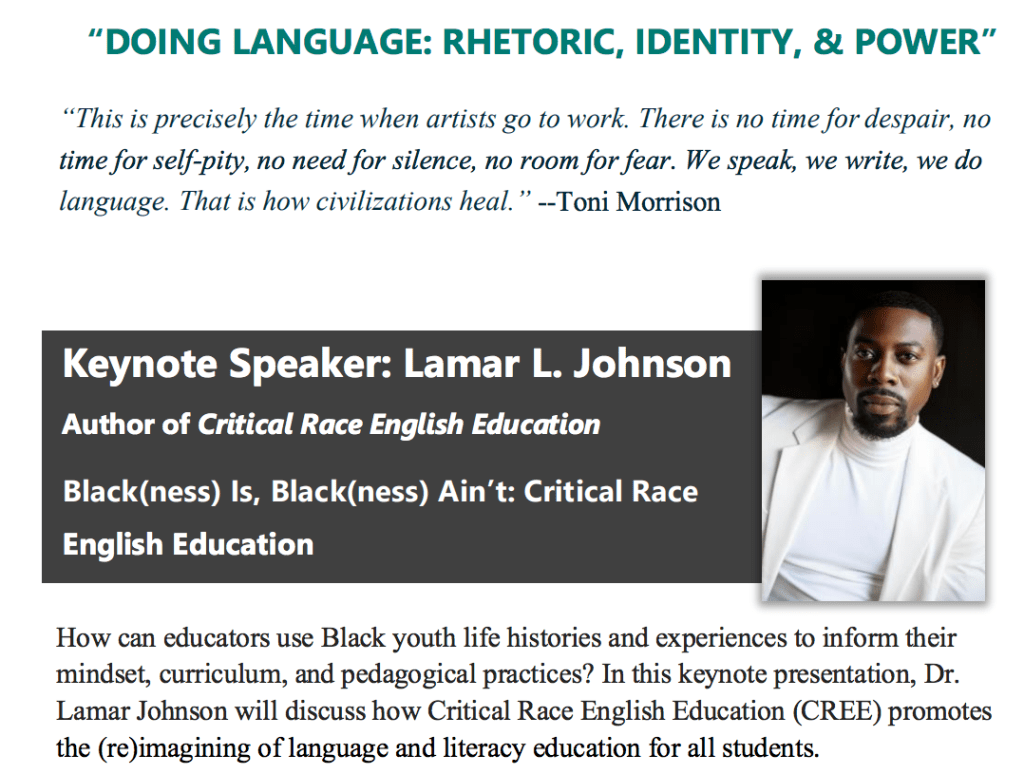
Editor’s Note: The theme of the 2023 ERWC Literacy Conferences, to be held June 20th in Sacramento and June 26th in Pomona, is “Doing Language: Rhetoric, Identity, and Power.” Plenary and concurrent sessions will explore ERWC’s approach to language learning and linguistic justice, including modules and resources for designated English language development. Please watch for a Call for Presenters in January.

Rhetorical Grammar in ERWC: Part 2

By Robby Ching

Note: This is the second post in a series on ERWC’s rhetorical approach to language learning. For the first post, click here. Please see the teaching resource “Rhetorical Grammar in ERWC: A User’s Guide” in the ERWC Online Community for the full text from which the excerpt below was taken.


ERWC is designed to cultivate linguistic dexterity so students can read texts written for a variety of purposes critically and write texts tailored for their rhetorical situation. As educators charged with teaching our students how English works (California ELD Standards), we have to be mindful of the many languages and varieties of English that students bring to our classrooms.

The ERWC teaching resource “Essential Pedagogies for Integrated and Designated English Language Development in ERWC” advocates “teaching about the relationship between language and power” and “supporting the development of academic English while promoting pride in students’ home languages.” At the sentence level, a rhetorical approach to teaching English grammar invites us to take an assets-based approach as we value these languages and varieties of English while inviting students to further develop their ability to enter disciplinary conversations about topics that matter to them.

Encouraging students to use all the language—as well as other multimodal resources—available to them means keeping the focus on meaningful communication rather than correctness for its own sake. We can invite students to incorporate words, phrases, or entire sentences in their language or variety of English into their own writing while at the same time asking them to be clear about their rhetorical purpose for doing so. We can let them know that they are welcome to use translation apps and bilingual dictionaries and take notes or write early drafts in their home language. We can select texts that include other languages, such as The Distance Between Us, and consider Reyna Grande’s rhetorical purpose for using Spanish in a memoir intended for an audience of mainly English speakers.

We can introduce uncomfortable questions about whether the use of academic English is a way of performing “Whiteness,” an issue raised by Vershawn Ashanti Young in “Prelude: the Barbershop” in the 12th grade Language, Gender, and Culture module. We can draw on multilingual students’ own experiences moving among languages and identities tied to language and acknowledge their remarkable accomplishments. Approaching grammar from the rhetorical perspective rather than the traditional rules-based prescriptive approach is, Micciche asserts, “emancipatory teaching” (717).

ERWC encourages students to ask not what makes a sentence correct, but what makes it work and why.

The language of ERWC texts provide rich opportunities to explore the information-dense complex sentences that are typical of disciplinary English (Schleppegrell). ERWC encourages students to ask not what makes a sentence correct, but what makes it work and why. As students observe how skilled writers make use of these language resources—or choose to use simpler language—they can develop their capacity to better understand the arguments embedded in the language of the texts they are reading.

At the same time, they can observe how and why writers use more familiar language, other dialects, and other languages for rhetorical purposes. When students turn to their own writing, they can apply what they have learned to create varied sentences that are effective for their purposes. Most students who are learning to create complex texts will only be able to do this if we help them develop the tools of the craft.

Our job is to guide their inquiry into how English works and help them transfer what they have learned to their own writing with the questions “What did you observe? And how can you apply it to your own writing?”


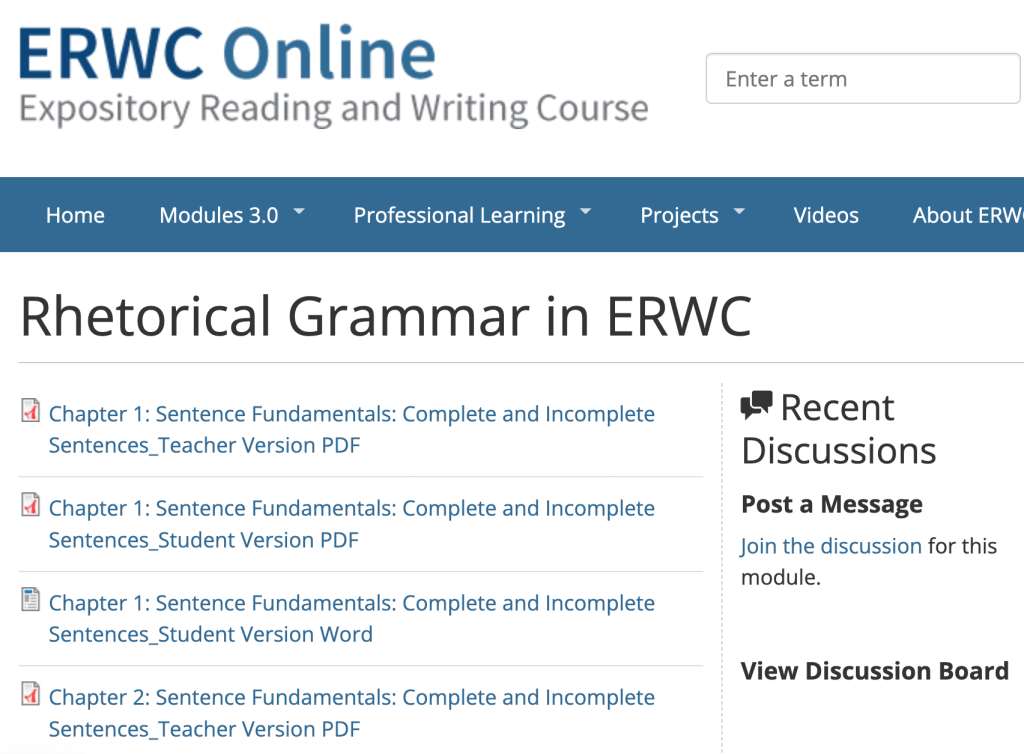
ERWC teachers can find activities and strategies for teaching language rhetorically, including 2.0 modules with rhetorical grammar lessons, by visiting the Rhetorical Grammar in ERWC section in the online community.

Click on “Modules 3.0” and select “Overview Documents.”

Then click on “Rhetorical Grammar in ERWC.”

Robby Ching is a professor emerita at Sacramento State in English and a member of the ERWC team since 2002. She has written many ERWC modules, most recently those with an ELD focus.

Rhetorical Grammar in ERWC: Part 1

By Robby Ching

NOTE: The following post is the first in a special series featuring excerpts from the new professional learning resource “Rhetorical Grammar in ERWC: A User’s Guide.” This resource can be found with the “Overview Documents” under the 3.0 tab in the ERWC Online Community.


Since Cicero, rhetoricians have recognized that the ability to craft effective sentences is a critical part of convincing an audience of an argument’s validity. How writers form sentences is part of their ethos. Even more important is logos. An argument is based on the logic and coherence of its sentences, and that logic and coherence depend to an important extent on grammar.

The sequence of events is conveyed through the verb tense system. The nuances of a writer’s position are presented through the use of active and passive verbs, modals, and qualifying words and phrases. The logical relationships among ideas are expressed through coordination, subordination, and the use of transitions and parallel structures. The logic of an argument can be strengthened by supplying additional information, and appeals can be made to pathos through the use of adjective clauses, participial phrases, appositives, dashes, and colons. Effectively and accurately integrating the texts of others into one’s writing provides evidence for the argument. Rhetorically effective verbs introduce evidence. And following the conventions of the intended discourse community provides clarity while contributing to the writer’s credibility (for more on this rhetorical approach to teaching grammar, see Kolln and Gray, and Micciche).

For grammar instruction to be worthwhile, you will want to make strategic decisions about what to teach and how to teach it. Writing that students do in your class can be used formatively to help you make these decisions. Some students may benefit from more basic instruction about sentence structure, subject-verb agreement, sentence boundaries, and verbs while all students can benefit from exploring more deeply the interface between grammar and rhetoric, including the ways writers qualify their assertions, logically connect their ideas, add information to sentences, and incorporate the texts of others into their writing.

California English Language Development Standards

California adopted the California English Language Development Standards: Kindergarten Through Grade 12 in 2014. These standards represent a shift in how teachers approach grammar from teaching “grammar as syntax, separate from meaning, with discrete skills at the center” to

“an expanded notion of grammar as encompassing discourse, text structure, syntax, and vocabulary and as inseparable from meaning” (164).

California English Language Development Standards

In ERWC modules, rhetorical grammar activities highlight the relationship between meaning and grammar and provide opportunities for students to learn how to use English to accomplish their rhetorical purposes. In ERWC modules, rhetorical grammar activities highlight the relationship between meaning and grammar and provide opportunities for students to learn how to use English to accomplish their rhetorical purposes.

Modules labeled ELA-ELD contain activities focused on language and aligned with the CA ELD Standards for ELA classes with Integrated ELD and for Designated ELD classes. They are designed to encourage students to notice and analyze particular grammatical features in the texts they read and then apply what they have learned to their own writing as they learn how English works at the word, phrase, and sentence level, and over stretches of discourse as specified in the ELD Standards

Multilingual students, whatever their level, are entitled to this language-focused instruction integrated into their ELA classes, and all students can benefit from attention to academic language. You may, therefore, decide that you want to supplement other ERWC modules with additional language-focused instruction to support your students’ development of academic literacy. ERWC offers a variety of resources to help you do this, including the rhetorical grammar instruction provided with ERWC 2.0 modules, the High Impact Strategies Toolkit to Support English Learners in ERWC Classrooms, and this User’s Guide.


For more information on ERWC’s rhetorical approach to language learning, please see “Essential Pedagogies for Integrated and Designated English Language Development in ERWC.”

Robby Ching is a professor emerita at Sacramento State in English and a member of the ERWC team since 2002. She has written many ERWC modules, most recently those with an ELD focus.

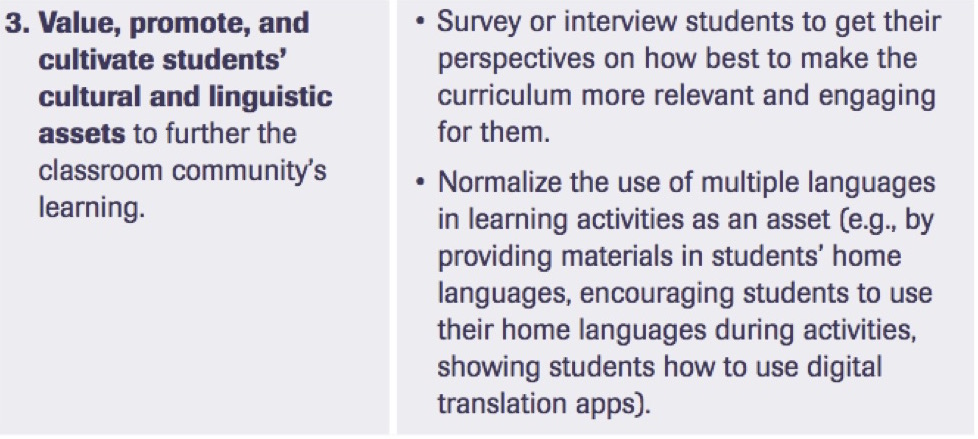
What Does It Mean to Value the Languages Students Bring with Them?

By Robby Ching

As teachers, we know in theory that we should value the languages that students use at home and in their communities, but what does that look like when we know that our task is to teach them to become proficient users of English? It turns out there are a number of ways to incorporate linguistically sustaining practices into ERWC classes, but teachers may not always realize what these practices are.  

Using Texts that Incorporate Other Languages

Perhaps most obviously, we can select texts for our students to read that reflect their experiences as users of other languages. Even better, some texts also incorporate those languages into the texts. Reyna Grande’s memoir, The Distance between Us, and the poetry of Diana Garcia in “On Leaving” and “On Staying Behind” both exemplify ERWC module texts where the use of Spanish is integral to the craft of the texts. 

However, we should not simply assume students will get the message that Spanish is a valuable resource that skilled writers use; in the spirit of an inquiry-based curriculum, we need to ask students to think about why Grande and Garcia used Spanish when their audience would include many English-only readers. What was their rhetorical purpose? How did they go about doing it so that English speakers were not excluded at the same time Spanish speakers were privileged (for a change!). And then the most important question–what can students learn from these examples about ways and reasons to incorporate their own languages and varieties of English (for example, African-American vernacular or Hawaiian Pidgin) into writing they do for school and beyond. 

Encouraging the Use of Other Languages in Class

Another strategy is to encourage students to use their dominant language as a tool in class. Although the days when students were physically disciplined for using their home languages in school are over, many teachers still believe students should leave their other languages at the door of their English classroom because how can they learn English if they spend time speaking and writing in Korean or Cambodian or Russian or whatever their primary language might be? But we now know that encouraging students to use that language strategically can actually facilitate their acquisition of academic English and not only because it strengthens their own sense of agency. 

Capitalizing on Multilingual Student Expertise

A recent document published by the California Department of Education, Educating Multilingual and English Learners: Research to Practice (Improving Education Publication – Resources (CA Department of Education)) makes this shift clear:

(Pamela Spycher, María González-Howard, and Diane August. “Chapter 6: Content and Language Instruction in Middle and High School: Promoting Educational Equity and Achievement Through Access and Meaningful Engagement,” 354)

Our multilingual students move among varieties of English and from one language to another constantly. Making them aware of this amazing capacity benefits them while using them as experts when questions of language and translanguaging emerge works to the benefit of every student in the class, whatever the varieties of English and other languages they have at the tips of their tongues. 

Robby Ching is a professor emerita at Sacramento State in English and a member of the ERWC team since 2002. She has written many ERWC modules, most recently those with an ELD focus.