A Visit to the Vaults: Opening the ERWC Archive

EDITOR’S NOTE: Registration for the 2023 ERWC Literacy Conference closes on Monday, May 22. Reserve your spot now before this event sells out!


By Jennifer Fletcher

Like In-N-Out Burger’s “secret” menu, the ERWC Module Archive offers special options for those in-the-know. Roughly 100 modules have been published over the 20 years of ERWC’s history as a nationally recognized literacy initiative, including dozens of modules in versions 1.0 and 2.0.

There are some terrific first and second edition ERWC modules still available for use. While these modules no longer include the module texts (copyright costs prevent Cal State from renewing permissions for all three editions of the curriculum), most of the reading selections can still easily be found online through their original publishers. For instance, “The Last Meow,” a module about the rising costs of veterinary care, uses a feature article in The New Yorker while “The Undercover Parent,” a module about spyware, uses an op-ed piece from The New York Times.

For those of us who have been working with ERWC since its inception in 2003, a visit to the ERWC module archive is a stroll down memory lane. We remember how deeply engaged our students were in analyzing images from an Abercrombie and Fitch marketing campaign, the powerful conversations students had over bell hook’s examination of love and justice, and the moving depiction of Roger Ebert’s transcendent joy following his life-changing battle with cancer. And what veteran ERWC teacher can forget “Bring a Text You Like to Class”?—a perennially popular module on bridging students’ in-school and out-of-school literacies that requires no copyright permissions (aside from those protecting the CSU’s own intellectual property rights).

Esquire, March 2010

English departments looking to build a full 9-12 ERWC vertical articulation may find the “secret menu” modules especially appealing, as these can fill gaps in grade 9 and 10 ELA courses. Teachers in other content areas such as social science or in academic preparation programs such as AVID who would like to try out ERWC’s inquiry-based, rhetorical approach to literacy learning may likewise find the older modules useful. Going to the archive could mean not having to compete with the English department for module selections.

While the first and second editions of the curriculum were designed using an older version of the ERWC Assignment Template, ERWC’s focus on developing transferable critical thinking and literacy skills ensures all iterations of the template are enduringly relevant. Each version of the template names the transferable competencies that promote postsecondary success in reading and writing. The recursive literacy process described by the template and enacted through the “ERWC Arc” is imagined in somewhat different ways in each edition of the curriculum, but the goal of the course design remains the same: To support students in developing and internalizing their OWN flexible process for understanding, analyzing, evaluating, and composing texts.

A caveat: Schools that have adopted ERWC grade 11 or 12 under UCOP program status are required to use the 3.0 course descriptions and modules for their approved ERWC courses. ERWC has full courses for grades 11 and 12 and resources for grades 7-10. The resources (i.e., modules and activities) can be used in existing courses such as English 9 without the UCOP restrictions, provided the teachers accessing the materials have been ERWC certified. All teachers must complete 20 hours of ERWC professional learning to gain access to the curriculum.

Jennifer Fletcher is a Professor of English at California State University, Monterey Bay and a former high school teacher. She serves as the Chair of the ERWC Steering Committee. You can follow her on Twitter @JenJFletcher.


2023 ERWC LITERACY CONFERENCE

June 20 in Sacramento & June 26 in Pomona

Conference registration closes May 22! The $75 registration fee includes continental breakfast and a buffet lunch. Administrators, literacy coaches, counselors, and CSU faculty get 50% off registration using the code ERWC50PERCENT. CSU students can register for free using the code ERWCSUFREE.

All are welcome! You don’t have to be an ERWC teacher to attend.

Featured Speakers
  • Carol Jago, author of The Book in Question
  • Matthew Johnson, author of Flash Feedback
  • Jen Roberts, author of Power Up
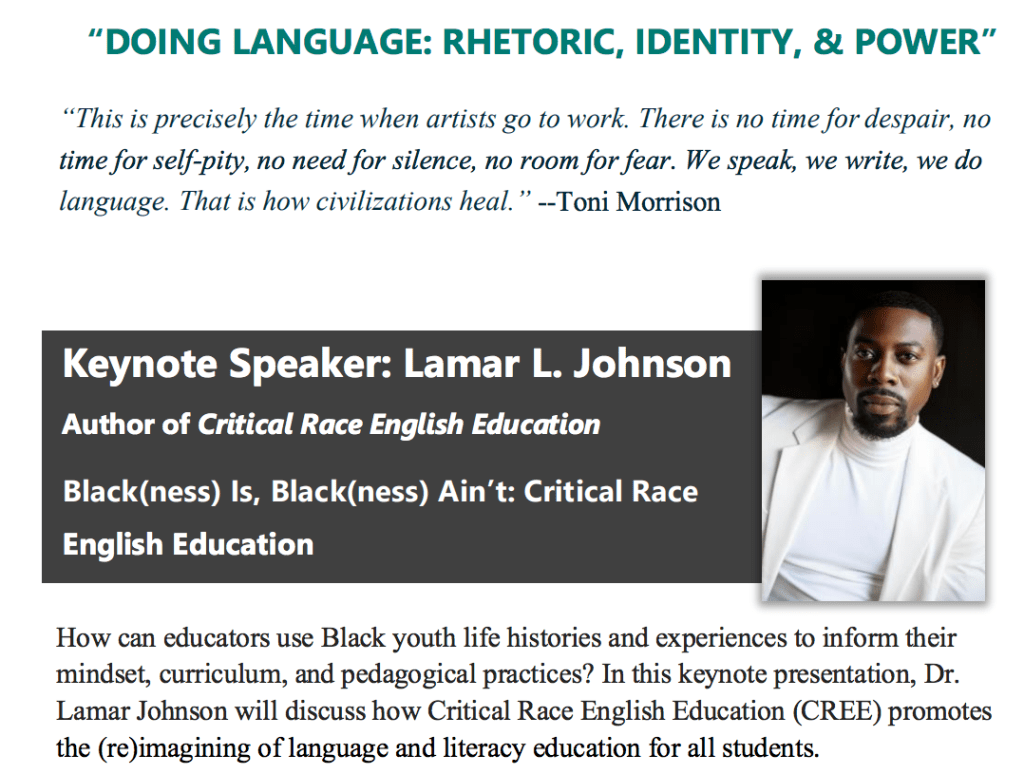
  • Lamar L. Johnson, author of Critical Race English Education
  • John Edlund, Professor Emeritus of Rhetoric and Founding Chair of the ERWC Task Force
Adopting a Mentoring Stance

By Christy Kenny-Kitchin

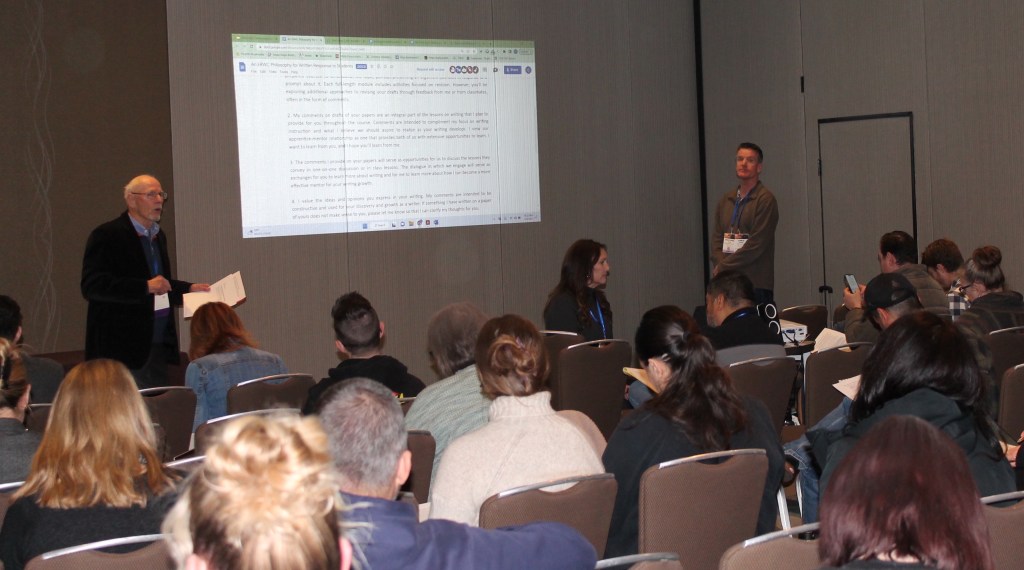
I recently presented at the CATE Convention in Monterey, California on taking a mentoring stance when responding to student writing. I worked with two professors from Cal State–Chris Street and Norm Unrau. We all shared on the importance of responding appropriately to student writing. We focused on how much our responses to our students affect our connection with them and, in turn, their ability, or perhaps desire to show up for us in class.

After Chris shared a less-than-kind comment he had received from a teacher when he was a student, we elicited responses from the audience about their experiences. Nearly every person had an experience in which one of their teachers had said something to them, perhaps a brief statement or a seemingly innocuous small, two-word response on a project that had changed the student’s perspective on their own learning.

I shared from the perspective of a secondary teacher that post pandemic, I had struggled greatly to connect with my students as I had done in the past and how classroom management was now a huge issue.

As if to prepare me for the presentation, the week prior to the conference, I decided to significantly change my approach to the teaching of writing. I had spoken to several colleagues at different schools and knew that the lack of skills–both academic and inter-personal–was what we might term “the new pandemic.” I could see that critical thinking and writing skills were seriously lacking and, when I considered that the last time my seniors had had an uninterrupted year of schooling face-to-face with a writing teacher, they were freshmen. Their skills reflected this.

My classes were in the middle of writing the speech for the “Language, Gender, and Culture” ERWC module. I decided to extend the amount of in-class time we spent on the assignment in order to provide daily instruction on every aspect of the writing process. I gave a mini-lesson each day and walked around the room to see each student’s progress. One after another said they did not need help or that they needed “time to think” through their writer’s block. I gave them space to write and continued to share lessons as a whole class, thinking they would absorb the information. By the second day, I had seen very little progress with any student in any class. So, I offered student-teacher writing conferences. Only a couple of people in each class approached. I then made it mandatory that they have a conference before moving on to their rough drafts.

As we sat in each conference, one on one, in front of the entire class, but talking softly, I was able to see what was lacking in their approach, and in their thinking about the topic. They saw me brainstorm with them, showing them the structure for their topic. They watched as I struggled with them to come up with the specifics of their topic then their issue, their question at issue, and finally their thesis statement for the speech. We worked on funneling down their ideas to something specific enough to be able to write a 2 to 3 page speech instead of what many of them had–a topic so broad that only a textbook could do it justice.

As each student sat before me, watching my thinking and hearing me say things such as, “This is definitely a topic that we can work with. Let’s narrow it down so it’s easy to approach,” and “I like where you’re going with this. You have some really good ideas!” I saw them light up. I continued in some conferences to say things like, “I am struggling to figure out where to take this topic. Give me a second. Let’s take a moment to brainstorm this one together.”

Not only did these conferences allow me to show each student a solid approach to their assignment, I could clearly see how each of them processed their thinking, which students had anxiety with either approaching a teacher or a big writing task, and who needed more support moving forward. But by responding kindly with my comments and showing them my thinking, we connected on a human level.

As I reflected on the conferences each day, I recalled how, prior to the pandemic, I had given each class an intro writing assignment in August in which they explained to me either a positive or a negative experience they had had in the past with an English class or teacher. With that assignment, I would call each of them up to have a brief conference to discuss their experience and answer any questions they had. I hadn’t had a classroom management issue in years. What I didn’t realize is that it was because they had seen me early in the year as a human who cared.

During this school year, the first full year of in-person learning, I had struggled with classroom management reminding me of my first few years as a teacher. I was ready to quit the profession.

However, in bringing back these student-teacher conferences, I noticed a significant shift in every one of my classes. Students were suddenly following every request and they are now more willing to show up–physically, mentally and emotionally. Some students are sharing their personal struggles with me rather than sitting in class, as Audre Lorde states, silently swallowing their tyrannies day by day until they “sicken and die of them still in silence.”

This connection is not only what had been lacking for my students, but it is the exact thing I needed as an educator to keep me enlivened in this profession.

Christy Kenny-Kitchin is an English teacher at Buena Park High School where she has also served as a Literacy Coach and Curriculum Specialist. She has taught English at the middle school, high school, and college levels. Having written one of the i3 modules (“The Daily Challenge”), she also worked as an academic coach to teachers for the i3 grant. Christy has been leading ERWC professional learning workshops for over a decade.


Editor’s Note: Please see the new ERWC teaching resource, “Adopting a Mentoring Stance with Student Writers,” for more strategies for cultivating students’ writing lives and identities.

2023 ERWC Literacy Conference

Please consider submitting a proposal to present at this year’s ERWC Literacy Conference, to be held June 20th in Sacramento and June 26th in Pomona. Cal State University pays travel costs for selected presenters. See the Call for Presenters here. 

The deadline for proposals has been extended to April 14, 2023.

Conference registration is now open! The $75 registration fee includes continental breakfast and a buffet lunch. Discounts available for administrators, literacy coaches, and counselors.

Let Sleeping Teenagers Lie

By Lori Campbell

When I consulted our Associate Superintendent of Business for the Kern High School District, Dr. Mike Zulfa, about the plans for how our district would comply with SB 328, he wrote, “So I am blaming you for all of this disruption! 😊” You see, I am the one who wrote the Expository Reading and Writing Curriculum module: “Teenage Sleepers: Arguing for Your Right to Sleep In.” 

Module Background

In the early stages of ERWC 3.0 development, I had proposed the module after watching the TED Talk with sleep expert Dr. Wendy Troxel, “Sleepy Teens: A Public Health Epidemic.” Troxel argues that the hormonal changes in teens cause them to reach REM sleep later than in adults and are not fully out of the sleep cycle until 90 minutes after adults are normally “awake.” She along with the PAC Start Schools Later fought for legislation that requires schools to start later in the morning for both middle-schoolers and high school students. I thought this would be a great topic of discussion for English 11 courses. It addressed all the points of an engaging module: all students could identify with the topic, there were definitely two contested sides of the issue, and students could actually participate in the political discussion. This module also introduces students to the construction of arguments. I never expected it to work so well! 

The Start Schools Later bill was first passed in the California legislature in 2018, but then (to my great relief) Governor Jerry Brown vetoed it citing that individual districts should decide what to do with the information. In fact, our district already provided online instruction as an option for students who had a difficult time functioning before 9:00 am. Students began their day at in-person schools during third period and took two of their classes online through the Kern Learn program–an independent studies program that offers UC-approved A-G coursework at the same rigor as the in-person classes on our school sites. The majority of assignments our students submit are completed between the hours of 5:00 pm and 3:00 am. They are pretty good, too! 

A Changing Context

Well, someone decided to try again when Governor Gavin Newsom was elected, and we all know what happened next. 

With the signing of SB 328 on October 19, 2019 (the month after the 3.0 modules were officially launched) middle school districts and high school districts in the state of California were given three years to figure out a plan to start their instruction no earlier than 8:00 am and 8:30 am respectively. And we also know what happened after that. COVID-19 and the subsequent quarantine and teach-from-home nightmare placed this legislation at the back of the implementation line. Coming out of the stupor in winter of 2021, districts realized they really hadn’t thought about what was needed to completely shift the school day to 90 minutes later. I know that the Board of Trustees and KHSD Superintendent, Dr. Bryan Schaefer, petitioned the governor vehemently to at least delay the implementation of the new schedules but to no avail. 

Modifying the Module

In the meantime, I wanted to look at my module and see what could be salvaged. Just like all good ERWC module topics, this subject is still timely. As furious as I was with Governor Newsom for creating this chaos, I finally realized that the implementation of this plan would still allow students to find their civic voices. In our second week of late-start implementation, the students are grumbling about as loudly as the teachers and parents. Football games are STARTING at 8:30 at night. Buses without air conditioning are transporting students home at the hottest hours in Bakersfield with highs of 103-108. Parents are having to shift their days completely if they need to pick up their students later in the day. Teachers who turn into instant moms and dads when they arrive home are more exhausted and have less time to prepare dinner. It’s a hot mess in Kern County. I can only imagine what it is like in your neck of the California woods. 

The changes we are going through add a new dimension to this module, and we will be entering a period of data gathering. After a year or two, we will be in the position to look at the results: have attendance rates improved? Has the mental health of teens overall improved? Are students more successful in middle-schools and high schools? I think there is still plenty to argue with this module. I have revised some texts, the prompt, and some of the activities to reflect the passage of SB 328. This includes adding the bill itself to the module allowing teachers the opportunity to add the format of a foundational document to their instruction. This Google Doc provides the modifications that I have made. I would love to have feedback from teachers and their students. I think with all of us caught in the maelstrom, we may actually be able to work together to determine the benefits (or detriments) of SB 328. While I deny all culpability in the passage of this bill (I wrote letters to both governors telling them this was a bad idea!), I still believe we can teach our students about their civic voices and how to use them. This is exactly what ERWC is all about.

Lori Campbell is the English department chair for Kern High School District’s Kern Learn Program. This is a complete distance learning program that provides students the option to take their A-G required courses online. She has taught ERWC both face-to-face and through distance learning for 10 years. She holds her master’s degree in Curriculum and Instruction.

ERWC Literacy Conference 2022: A Time for Post-Pandemic Reconnection

By Jyothi Bathina

We have all grown weary over the past two and a half years. It’s time to take advantage of the opportunity to reconvene and reconnect, person to person.

Until just a month ago, I was feeling resistant, unwilling to get on a plane and travel across the country to a conference in D.C. “Do you have an online option?” I asked. “Will most of the sessions be streamed or recorded?” The answer was that while some key sessions would be available for later viewing, they really hoped I would join them in person. I waited until the last minute. I bought a refundable ticket. I hesitated. Was it safe? Did I really want to leave my comfortable home and my semi hermit-like existence to get on a cramped plane? What was the big deal about in person anyway? We could achieve the same thing on Zoom and I could sit and watch from home.

At the last minute, half out of a sense of duty and half out of a nagging feeling I might be missing something, I boarded the plane to D.C. It was rainy and cold and gray. The fabled cherry blossoms were soaked and the one tour I managed to take left me drenched. But every morning as I put on my badge and grabbed my breakfast to take to our table, I felt myself coming back to life. I met lots of people, fellow educators, who were passionate about their projects. I felt the energy in the room as we heard about all the incredible work people were doing across the country and all the opportunities available for those who wanted to help students. I was inspired by the presentations by federal grant administrators who urged us to keep dreaming big and applying for funding to implement groundbreaking programs that would help teachers and students.

I’m so glad I went. After exchanging cards with some amazing innovators and boarding my return flight, I was reinvigorated, excited for the possibilities ahead, eager to share what I had learned with my colleagues.

I invite you to experience the same kind of heady collaborative excitement that only comes from gathering in a common space, seeing and hearing each other, feeling the warmth of instant human interaction. After a long hiatus, the annual CSU Expository Reading and Writing Curriculum conference is back, live and in person! We can’t wait to welcome you back, to meet and greet, applaud and encourage, teach and learn, and exchange ideas in real time, face-to-face. Register now to attend in San Jose or in Pomona, and come join us as we celebrate and strengthen our community. See you there!


Please see the registration links below. The $50 registration fee includes lunch and the morning plenary session with Dr. April Baker-Bell.

Sheraton Fairplex – Pomona, CA: June 21, 2022 Registration link: https://calstate.eventsair.com/2022-erwc-literacy-conference/event

OR

San Jose Marriott – San Jose, CA: June 27, 2022 Registration link: https://calstate.eventsair.com/2022-erwc-literacy-conference-san-jose/event

Extended Registration Deadlines: May 16 (Pomona) and May 23 (San Jose)

For questions, please contact  carinfo@calstate.edu.


Dr. Jyothi Bathina is Co-Director for the Center for the Advancement of Reading and Writing at the CSU Chancellor’s Office. She oversees ERWC in collaboration with the ERWC Steering Committee.

Kicked Me in the Gut: Picked Me Back Up

By Meline Akashian

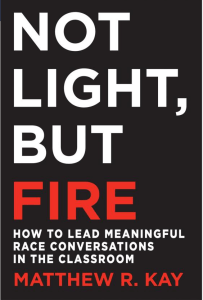
Maybe it’s rude in a blog post to tell you to read something else, but here it is: read Matthew Kay’s Not Light But Fire: How to Lead Meaningful Race Conversations in the Classroom.

And be ready. He says stuff like this:

Just as we cannot conjure safe spaces from midair, we should not expect the familial intimacy, vulnerability, and forgiveness needed for meaningful race conversations to emerge from traditional classroom relationships.

Frankly, that’s nothing compared to page twenty-seven. On page twenty-seven, my note in the margin is an expletive.

That’s where Kay chronicles an informal conversation between his poetry club students in the immediate aftermath of Ferguson–or, more specifically, in the immediate aftermath of a black student suffering through a class discussion about Ferguson.  Kay’s students offer raw revelation of what many students are probably thinking when teachers lead such discussions. 

My takeaways were layered, and they came in depressing waves, but here is a big one: Many kids wear masks during difficult classroom discussions. And during race conversations, some kids might wear the mask. I’m just going to leave that there for a second. For any teacher who wants to help students use their voices and activate their agency, it’s a crushing thought. But let’s be clear–the mask itself is not the problem. All of us disguise our vulnerabilities from most people, for good reason. All of us have public and private selves, and each of us alone decides who sees what. 

OK, so combine that reality with our reality, that nearly every ERWC module could be a touchy subject or tap into someone’s past trauma. ERWC teachers are routinely doing what Kay describes as opening “academic” discussions around topics that are “visceral” for some of our students. The whole course is designed around dialogue aimed at productive conflict.  But productive conflict requires openness and honesty.

For me, the practical implication is this: it doesn’t matter if I think I’m an ally; it doesn’t matter what’s in my heart; it definitely doesn’t matter what I do with my free time; it doesn’t even matter if my students love and respect me. What matters is that my students trust me with their bruised and battered insides. And trust not just me, but their classmates. Only then can I hope that students will decide, when they are ready, to be real–in front of me and everyone else in the room. 

Like–I was already a person who loses sleep the night before a touchy classroom discussion.  So around page twenty-seven, I was feeling pretty overwhelmed, doubting Kay’s ability to offer a workable solution, particularly one for me, an especially private person myself. But then he got down to it.

His first chapter offers specific protocols to build a safe space. Three simple discussion norms and three routine activities honor students as individuals and develop a classroom culture devoted to building and maintaining relationships. They require class time and commitment, and perhaps a mild restructuring of the value system driving instructional decision-making.

His second chapter introduces discussion moves designed, not to eliminate conflict, but to help make conflict productive. For example, “Surfacing the Conflict”: teachers figure out what category of conflict is at hand (around fact? process? purpose? values?) in order to determine their most useful next move directing discussion traffic. I’m pretty excited about this approach, because in an ERWC class, the rhetorical thinking involved with categorizing the conflict can be farmed out to students, giving me more time to figure out my next move. 

More value added in Chapter Two? It closes with protocols for discussion prep using hypothetical case studies. By imagining various scenarios, I can anticipate the more likely conflicts or diversions that could derail discussion and ready myself with some “next moves” in advance. Then I can go to bed and actually get some sleep.

Though there’s 24k gold in the rest of Kay’s book, I’ll start by trying to implement Chapters One and Two–or maybe just Chapter One.  Whatever my measured first step, I’m all in to take it. Because when students’ sincere and passionate engagement with a topic is perceived as a risk, it’s a gross, malignant irony. And because Matthew Kay shows us, guiding real talk about hard things isn’t about being a natural-born Mr. Keating; it’s about the groundwork we lay in advance and our ongoing commitment to the cause.

Meline Akashian is an experienced ERWC teacher with grades 7-12 and former Riverside County Teacher of the Year. She has co-written modules for ERWC and is a member of the ERWC Steering Committee.

Work Cited

Kay, Matthew. Not Light, But Fire: How to Lead Meaningful Race Conversations in the Classroom. Stenhouse, 2018.

Welcome!

by Jennifer Fletcher

Welcome to the ERWC blog! We envision this blog as a way for ERWC teachers to dig into the nuts and bolts of the curriculum: to share teaching tips and success stories, explore problems of practice together, and ground ourselves in the key principles and frameworks that make the curriculum work for all students.

Here you’ll find advice from colleagues on teaching signature ERWC activities, such as descriptive outlining and rhetorical analysis. You’ll also find strategies for designing a year-long course, teaching a particular module, or using the ERWC Assignment Template to create your own units. And we’ll share “think pieces” on some of the larger issues that impact our work as educators, including the importance of culturally sustaining pedagogies.

We hope these bite-sized bits of professional learning sustain your connection to the ERWC community (now over 15,000 educators strong!) and support your essential work in the classroom. We’d love to hear from you, too, about how you make ERWC work—and how you make it better.

ERWC has always been about more than the modules. Teacher collaboration and expertise are the magic ingredients that make the curriculum effective. We’re delighted to invite you to join us in spreading more of that magic around!

To subscribe to the ERWC blog, please click on the button that says, “Follow.” Submissions for blog posts may be sent to Jennifer Fletcher at jfletcher@csumb.edu. Please see the publication criteria on the “Writing for the ERWC Blog” page. For more information on the California State University’s Expository Reading and Writing Curriculum (ERWC), including how to register for an ERWC workshop, please visit the following websites:

ERWC Online Community:
https://writing.csusuccess.org/
CSU Center for the Advancement of Reading and Writing: https://www2.calstate.edu/CAR/Pages/erwc.aspx
ERWC Workshop Registration:
https://www2.calstate.edu/CAR/Pages/professional-learning-workshops.aspx

Jennifer Fletcher is a Professor of English at California State University, Monterey Bay and the Chair of the ERWC Steering Committee. You can follow her on Twitter @JenJFletcher.

Scaffolding Student Writing Using Mentor Texts

By Robby Ching

We all need scaffolds when we face an unfamiliar writing task. As a brand new ESL coordinator, I was asked by my boss to write a memo to a university administrator. I’d been a graduate student working in dusty library stacks and a college ESL teacher. I’d never seen a memo, let alone written one. So I wrote what I thought was a memo but failed to copy him on it. When he asked to see what I’d written, he yelled at me so fiercely for not copying him that I left his office shaking. What I now know I needed was a mentor text–a model of what a memo is and what it looks like. Then I would have seen the cc: line–problem solved.

A perennial question for teachers working with students who are developing academic literacy is how to provide scaffolding for academic writing while preparing them to become independent writers by the time they leave our classes. How much is too much? And how can I teach my students to find their own scaffolds? Mentor texts are an inquiry-based way to help students learn how to create their own scaffolds. 

When students analyze a professional text or a well-written student text, you can guide them as they discover what makes that text successful. For example, in the Juvenile Justice 12th grade module, which I wrote, students write an open letter about juvenile sentencing as their culminating writing task. I received feedback from teachers who piloted the module that students were unsure how to write their own open letters, so I built in an activity that engages them in looking at an open letter of the teacher’s choosing As an example,I suggested one about Colin Kaepenick’s decision to take the knee before a game but proposed that they find one with currency when they teach the module). Students work in a group to analyze the key rhetorical features of the letter (Who is it written to? Where was it published? What caused the writer write it? How is it structured? What rhetorical appeals does it make to its readers?).

Students identify success criteria for an open letter–several characteristics that they think all effective open letters should have. The teacher then guides the whole class in compiling a set of criteria that can guide their writing. This last step gives her a chance to shape the criteria that she will use to grade their work while ensuring that students have ownership of what those criteria are.

While it’s tempting to tell students directly what form their letter should take and what each part of their letter should do, and how it should do it, students can end up like me–utterly perplexed when confronted with a new genre and what the expectations are for it. If somebody had taught me how to figure out for myself the answers to those questions, I could have avoided a painful experience. And now when mentor texts for every conceivable genre are only a few key strokes away, how empowering it is to teach our students how to make use of them instead of relying on us.   

Robby Ching is a professor emerita at Sacramento State in English and a member of the ERWC team since 2002. She has written many ERWC modules, most recently those with an ELD focus.

Getting Ahead of Falling Behind

By Carol Jago

Carol Jago

In a recent poll by Common Sense Media, 59% of teenagers said that online learning is “worse” than in-school learning. Although it is always difficult to know what students mean by “worse” and “much worse,” it seems they prefer learning in-person to learning on a screen. Along with missing the social aspects of school, 61% of respondents report that they are worried about falling behind academically.

I wondered how these students calculated what it meant to “fall behind” and how many of them were doing anything on their own to prevent academic stagnation.

I don’t want to pretend that many students possess the creative genius of Pratchett or Westover’s tenacity, but I do believe students’ capacity for independent learning can be and needs to be nurtured.  Too many teenagers equate learning with seat time, believing that as long as they take the quizzes, turn in the papers, and earn credit for a course, they are acquiring an education. Unfortunately, we teachers are substantially responsible for this false assumption. When all we demand is compliance, students fail to develop the intellectual muscles they need to learn on their own.

An autodidact is a person who is largely self-taught. Such individuals typically possess an enormous thirst for learning and often find school tedious, confident as they are in their ability to learn on their own. Terry Pratchett, whose fantasy novels have sold over eighty-five million copies never attended university and said he felt sorry for anyone who had. Ray Bradbury insisted that his education took place in the library reading, reading, reading. The late great playwright August Wilson dropped out of school in ninth grade but continued to learn by spending long hours reading in the Pittsburgh public library. And then there is Tara Westover’s story from Educated.

What if the educational chaos of the current school year could be turned to education’s long-term advantage? What if we embraced the goal of building students’ independent learning muscles? What if students began to realize that they actually enjoyed reading about what interested them? What if they felt the desire to write about what they were reading? You probably think I am in cloud cuckoo-land, but we find ourselves in circumstances ideally suited to independent study.

I have always found that when students want or need to know something their inner autodidact springs to life. Consider the technological skills today’s teenagers possess, the complicated video games they play, the song lyrics they know by heart, none of which they learned in class. Students are able. They are just not practiced at initiating the process of learning when it comes to schoolwork. Let’s turn the tables on young people worried about falling behind by challenging them to accept responsibility for their own education.

Resources for organizing an inquiry-based classroom abound, but maybe the simplest and best approach is to ask:

  • What do you want to learn?
  • How can I help?

At a time when traditional classroom protocols seem to be in constant flux, let’s work toward nurturing the autodidact within ourselves and in our students. Learning shouldn’t stop when the bell rings or the Zoom meeting ends.

Carol Jago is a long-time high school English teacher and past president of the National Council of Teachers of English. She is the author of The Book in Question: Why and How Reading Is in Crisis. You can contact her at cjago@caroljago.com.

Reading Like an Author

By Chris Street

Have you ever tried to explain to someone else why you liked a particular piece of writing? It can be difficult to find the language needed to explain exactly why a particular piece resonated with you. Trying to discern how authors make their writing powerful, beautiful, emotional, or descriptive is tough to do.

Yet when we demystify authors’ styles we can learn how writers accomplish the incredible things they do with words. For example, by looking at how writers use active verbs, sentence variety, precise nouns, rhythms of language, vocabulary, organizational schemes, sensory details, repetition, parallel structures, and punctuation—we can begin to acquire the language needed to discuss the ways in which their writing appeals to us.

Another way to consider this is to ask yourself a question: If you were going to replicate the style of a piece of writing that you admire without copying the exact words, how would you do it? It’s not easy to focus your attention to look at a piece of writing this way, but this is what careful readers do when they are trying to learn the craft of writing.

Reading like an author is a skill that all aspiring writers learn to do. Reading like an author helps you to discover different stylistic devices, find various ways to engage readers, and leaves you with a greater awareness of how to target your writing for specific audiences.

As teachers you are all already accomplished readers. Now, I’d invite you to try reading like an author.

For teachers interested in learning to write articles for publication in professional journals this would mean reading the kinds of journals that might publish one’s work. For teachers more interested in writing successful grant proposals this might mean reading previously funded grant proposals as a way to internalize the features of writing that separate the successful from the unsuccessful proposals. The same would be true of aspiring bloggers or web site developers. The models are all around us. All we need to do is read them carefully—as potential authors—and we will surely learn important lessons about the craft of writing.

Since part of our work as English teachers is to support students as they strive to make connections between the texts they read and the writers we want them to appreciate, we can apprentice students in the task of reading like an author by modeling for them how this text-based task is performed. As with all complex literacy tasks, learning to read like an author takes time and guidance. The strategic guidance we can offer students is that much more powerful when we are able to model for students what it means to “think rhetorically,” as an author would. As we uncover the power of an author’s craft for students, we enable students to feel that they are personally part of a larger discourse community, or conversation. And when we help unlock the power behind an author’s words, we allow students to feel they have increased power over the texts they read. Reading like an author can indeed be a transformative event for developing writers, allowing them to see themselves as rhetorical writers who can apply their newly learned skills as they write with increased confidence, skill, and power.

But students are not likely to learn to read like an author unless we model for them what this looks like. As an example, here’s one of my favorite pieces of writing and a few words describing why I like it:

“When I stepped out into the bright sunlight from the darkness of the movie house, I had only two things on my mind: Paul Newman and a ride home.” (The Outsiders)

The opening words to S.E. Hinton’s short novel immediately ensnare me in her world—the world of a teenager coming to grips with a gritty reality. The crisp words offer a glimpse of the main character and narrator while hinting at the struggle of good versus evil that will occupy the mind of the young story teller.

Hers is a book that tells the truth about life through a teenager’s eyes. The eyes that adjust to the bright sun are Hinton’s eyes, the eyes of a teenager who wrote The Outsiders “because I wanted to read it.”

Using just 29 words, she makes me feel the same way.

Chris Street is a Professor of Secondary Education at California State University, Fullerton, where he also directs the masters program in secondary education. He helps lead the statewide implementation of ERWC as a professional learning facilitator, module author, and member of the ERWC Steering Committee.