By Rachel Roberson
Note from the Editor: In this post, we welcome a contribution from a kindred literacy initiative: KQED’s education program. Like ERWC, KQED offers free curriculum and instructional resources to classroom teachers. The Nor Cal nonprofit’s latest offering is a 15-lesson unit that develops students’ “narrative agency”–their power to tell stories that matter to them. If you’re teaching one of ERWC’s many modules that focus on narrative writing (including new middle school modules such as Booked, They Called Us Enemy, When You Trap a Tiger, and Living Beyond Borders), this is the post for you! Read on to learn about a special opportunity to help field test these lessons.
What if AI literacy started by focusing on the human in the loop rather than the machine?
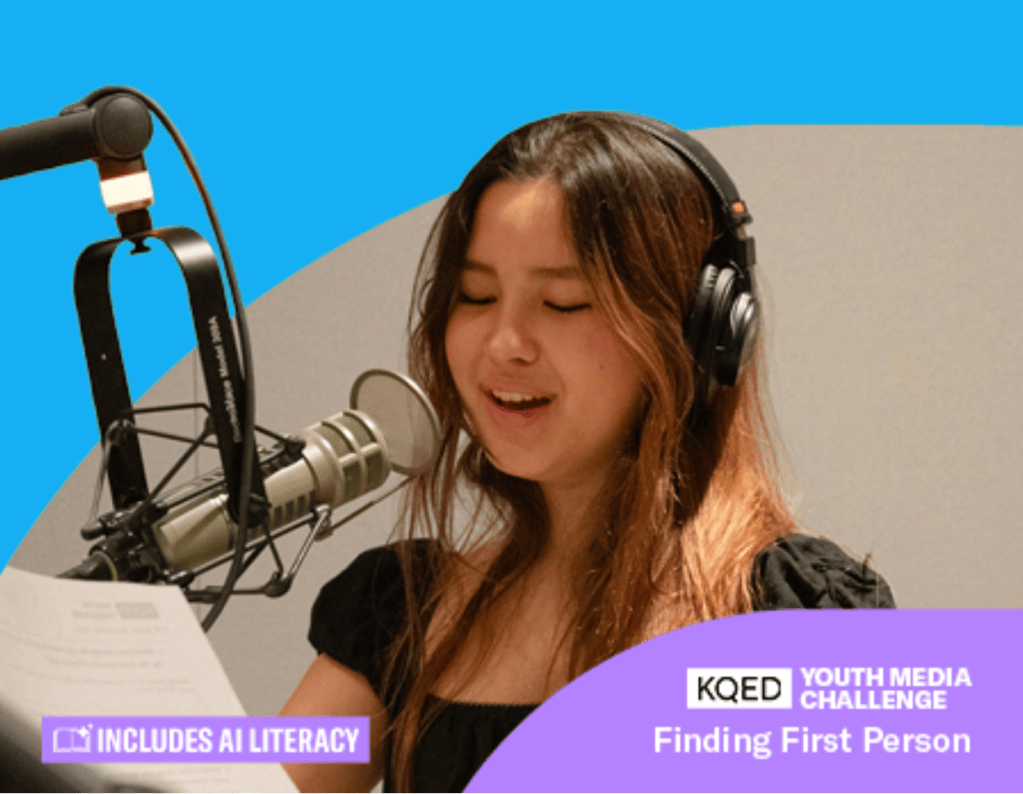
KQED, the PBS and NPR member station in the San Francisco Bay Area, has long championed student voice through our Youth Media Challenge and online showcase. When thinking about how to meet the AI moment with youth voice at the center, we started with the importance of putting process back into learning. Process too often gets pushed aside despite our best intentions. But now AI can create any product we ask students to do, allowing students to circumvent the process of creation entirely. Concerns around academic integrity and AI use are valid. At the same time, this “process crisis” is also an opportunity to return our focus to centering the writing and creation process in a way that’s meaningful to students. The Finding First Person curriculum models one way to do this with daily process reflections and by asking students to apply their learning by reflecting on narrative agency themes and recording their actual voices in an audio or video personal narrative project.
Co-created by high school students and KQED, the unit centers the concept of narrative agency, which we define as the human ability to make choices based on the uniqueness and importance of our individual experiences, values, ideas, perspectives and knowledge, especially when working with AI chatbots designed to simulate our voices in ways that could take over the creative process.
In the unit, students unpack the concept of narrative agency and the intersection of self and AI through values and identity exploration, as well as reading, writing and discussing relevant AI topics. The unit is neither pro- nor anti-AI. Instead, it seeks to openly discuss AI in society and affirm students’ voices and viewpoints. Students apply their learning with a multimedia personal narrative media project, writing a script and creating an audio essay or short film related to AI, agency or voice.
Usually, AI literacy is taught by focusing on AI tools and how to use them. But in a world where AI can increasingly imitate human expression, it makes just as much sense to start with the human using the tool, especially in the humanities. The Finding First Person unit is KQED’s response to the question: How do we as English teachers help students recognize, value, and retain ownership of their own unique voices in our AI world?
The Finding First Person unit and teacher toolkit is available publicly. If you are interested in participating in the field test next semester, complete the application by Nov. 30.
You are welcome to explore and use the unit materials, even if you choose not to apply for the field test. All resources are in Google docs and can be modified for use in your classroom or educational setting.
KQED’s education team is seeking high school English teachers to field test a 3-week, project-based curriculum unit titled “Finding First Person: Telling My Story in the Age of AI.” This opportunity includes a $800 stipend for participating teachers.
Apply by November 30.
Rachel Roberson, KQED Education’s senior program manager, is an experienced teacher leader and curriculum content developer who has served as a classroom teacher and administrator at public, charter and international schools. Rachel specializes in professional learning facilitation and curriculum development, strategy and implementation. At KQED, she works to connect educators and students to KQED online education sites, KQED Teach and the Youth Media Challenge, by creating humanities curriculum and professional learning content, supporting product development; championing youth-created media in and out of the classroom, and leading projects and partnerships focused on teachers and classroom learners. Rachel is a graduate of Northwestern University Medill School of Journalism and has a Master of Arts in Teaching Leadership from St. Mary’s College of California. Before she was a teacher, she was a newspaper reporter in the Bay Area.