Over the decades of my career, I’ve observed creative teachers devise multiple engaging and effective ways to support students in learning English, especially the English valued in academic settings. When the first ERWC middle school modules were written, I thought how valuable it would be to gather the strategies that appeared throughout those modules along with others that have become hallmarks of the ERWC approach so teachers could transfer them to whatever texts they were teaching.
During the development of ERWC 3.0, along with my ERWC-ELD colleagues, Adele Arellano, Pam Spycher, and Debra Boggs, I was given the opportunity to do just that. We identified strategies in the newly developed ERWC-ELD modules, focusing on the activities we recognized were especially high impact for English learners students but would be valuable for most students still developing disciplinary English. In consultation with the ERWC-ELD team, I organized these strategies using the same structure that provides the DNA of all ERWC modules, the Assignment Template. We also identified activities that could be used at any point across a module, for example, activities focused on goal setting or discussion strategies.
Later, we revised the Toolkit by adding even more activities and identifying the ELD Standards that students would meet when teachers employed the protocols. For ease of access, Debra Boggs created a searchable Table of Contents. We created a Word version so you can modify and adapt the student version of an activity for your own texts and teaching situation. Our final document (final for now, since new strategies could certainly be identified and added) is a 129-page treasure trove of inspiration for good teaching.
All ERWC modules can be adapted to include additional Integrated and Designated ELD, the vision of the California Framework for ELA and ELD. Beyond that, using the High Impact Strategies Toolkit means that whatever other texts or text sets you are teaching, you can move through the stages of the ERWC Template and draw on strategies that will ensure a student-centered and inquiry-based approach and the ongoing development of students’ disciplinary language.
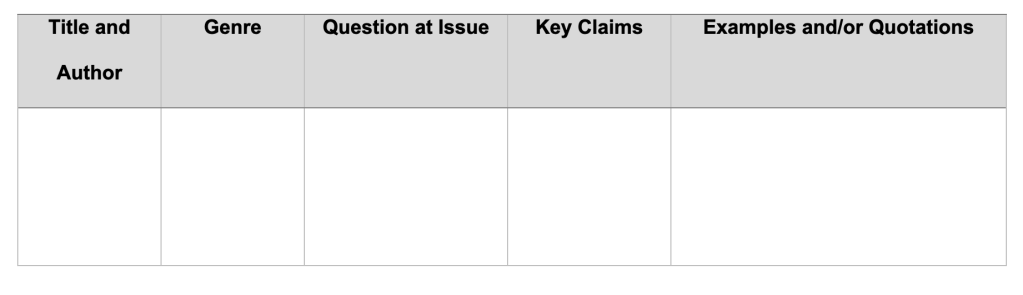
For example, Save the Last Word encourages students to engage with a text and discuss it in small groups. Charting Claims Across Multiple Texts transfers responsibility to students to track what they are reading so they have what they need at their fingertips when they are ready to do text-based writing. Sentence Unpacking guides students in understanding the writer’s craft at the word, phrase, and clause level so they can apply what they learn when they go to craft sentences of their own. Purpose Analysis prompts students to read their own writing rhetorically and revise accordingly. Students develop active listening and encounter key concepts as they work together to do Collaborative Text Reconstruction.
Charting Claims Across Multiple Texts
I’ve even observed schools adopt a strategy such as Annotation, Summary, Response to use across the disciplines in history and science classes, not just in English classes, a powerful way to truly make students college and career ready.
Early in my ERWC collaboration with high school teachers, an outstanding teacher told me the ERWC template kept him honest. Since then, the federal studies that supported the development of ERWC 2.0 and 3.0 have confirmed that students whose teachers are faithful to the Template—not teaching every activity in a module but guiding students as they move through each phase of Reading Rhetorically, Discovering What They Think, and Writing Rhetorically—are likely to be more successful than students whose teachers short-circuit it.
Self-accountability is key—asking myself, am I making sure that my students experience a robust set of activities at each stage of the reading and writing process so that at the end of a module or assignment sequence, they can successfully contribute their authentic voices to an ongoing conversation of consequence? And to answer yes to that question, I can turn to the High Impact Strategies Toolkit in planning a module or a year-long pathway to support students as they practice the strategies of proficient readers and writers. And in the spirit of expansive framing, I can make sure my students reflect on how these strategies can be transferred to new situations in other modules, other classes, and in the world beyond school.
Robby Ching is a professor emerita at Sacramento State in English and a member of the ERWC team since 2002. She has written many ERWC modules, most recently those with an ELD focus.
2023 ERWC Literacy Conference
June 20 in Sacramento & June 26 in Pomona
Conference registration is now open! The $75 registration fee includes continental breakfast and a buffet lunch. Discounts available for administrators, literacy coaches, and counselors.
How do the ERWC modules support the language and literacy development of students who are identified as English Learners?
In 2017, the California State Board of Education unanimously approved the English Learner Roadmap. This revolutionary language and literacy policy focuses on an assets-based approach that celebrates multilingualism. This policy shift occurred after the voters of CA passed Proposition 58 in 2016, repealing almost twenty years of restrictions on bilingual education. Each of the ERWC modules includes elements of Integrated ELD where students are engaged in language and literacy development aligned with the CA ELD Framework. The Designated-ELD modules add an additional layer of support through an emphasis on specific ELD standards.
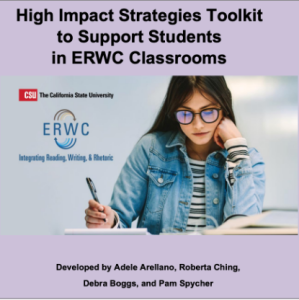
The “High Impact Strategies Toolkit to Support Students in ERWC Classrooms” is a helpful resource to review learning strategies that support multilingual students. These strategies appear throughout the ERWC modules, but they are essential practices within the modules focusing on Integrated and Designated ELD. I taught the 12th grade ERWC course for several years and adapted many of the module strategies, often adding texts to build more background knowledge or spending more time on during-reading strategies where students practiced meaning-making through speaking activities. Now that I am a Teacher on Special Assignment support English Learners, resources like the toolkit are imperative in my planning.
A few of the strategies in the toolkit have positively impacted my students’ learning include:
Concept Mapping where students build visual representations of key vocabulary demonstrating how words and their meanings are connected and inter-related;
Charting Multiple Texts where students document their reading of multiple texts by identifying the authors’ purpose, claims, and evidence in order to make connections across the texts;
Mentor Text Analysis where students complete a close-reading to identify how an author constructs an argument through a variety of sentences (e.g., opinions, facts, evidence, anecdotes, etc.) each used for a different purpose;
Guided Editing where students focus on selected writing skills in their own piece (e.g., claims, precise language, sentence length, transitions, punctuation, etc.) to emphasize how each piece is part of their overall purpose.
The Designated-ELD modules follow the same assignment template as the other ERWC modules. Each lesson is aligned with the CA ELD Framework allowing students to address the two main parts of the standards: “Interacting in Meaningful Ways” and “Learning About How English Works.” The texts and writing tasks in ERWC are challenging in all of the best ways. I loved teaching ERWC because of the complex content. Students continually impressed me with their reactions to the material and their reflections about the learning goals they identified. I was a better teacher, particularly for my multilingual students, because the modules empowered me to enjoy the intricacies and intersections of language and literacy. Planning with language in mind made each module more impactful.
Chris Lewis is currently a Teacher on Special Assignment supporting multilingual learners at Mountain View High School in El Monte, CA. He is also a part-time lecturer in Attallah College of Educational Studies at Chapman University. He serves as a board member for the California Council for the Social Studies. His research interests include youth voice, dystopian fiction, civic engagement, and LGBTQ literature and history. He wrote two chapters for the 2021 CHOICE Outstanding Academic Title, Pedagogies of With-ness: Students, Teachers, Voice and Agency. Follow Chris on Twitter at @chrislewis_10 or www.ateachersponderings.com.
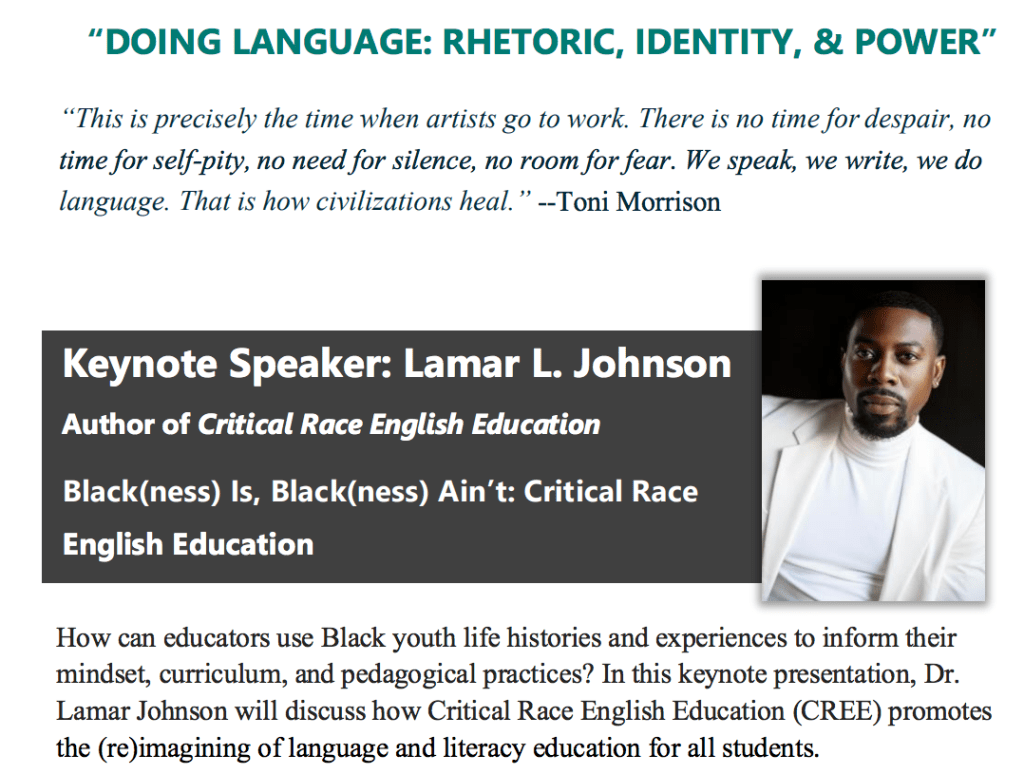
Editor’s Note: The theme of the 2023 ERWC Literacy Conferences, to be held June 20th in Sacramento and June 26th in Pomona, is “Doing Language: Rhetoric, Identity, and Power.” Plenary and concurrent sessions will explore ERWC’s approach to language learning and linguistic justice, including modules and resources for designated English language development. Please watch for a Call for Presenters in January.




 Teaching ERWC