
By Carol Jago
It may sound counter-intuitive to suggest that bots will show us the way to better learning, but what if the proliferation of artificial intelligence could help us to break some bad habits? For example, valuing the product over the process. Or correctness over resourceful original thinking.
Pause for a moment. Did the English teacher in you just want to fix those two sentence fragments?
Rather than passing rules restricting students’ use of AI or returning to pen and paper–both of which seem reactive rather than responsive–we need to think hard about:
- What are we trying to achieve in our “assignments”?
- What kind of learning does our pedagogy foster?
- What are the values this instruction instills in students?
I would argue that we need to do this thinking in community with other teachers, parents, and students. And we need to prepare ourselves for what those teenagers tell us about our curriculum.
Employing every rhetorical move we have at our disposal, we must persuade young people that learning requires effort, that intellectual growth doesn’t just happen. Knowledge is a return on the investment of years of reading, writing, and thinking. In his book The New Dark Ages: The Death of Reading and the Dawn of the Post-Literate Society, James Marriott argues that the widespread literacy which occurred in the late 18th and 19th centuries heralded a more logical, evidence-based manner of thinking. He credits this development, often called the Age of Enlightenment, with the advent of democracy. Marriott also warns that continued progress in this direction is not a given: “Mass literacy is a recent phenomenon. So is mass democracy. We simply don’t know if one can survive without the other” (153).
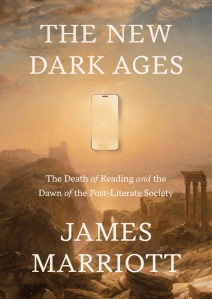
What if we invited students into this conversation? It would require them to read James Marriott’s book or if that is a bridge too far, his Substack article that was the precursor to the book. Students might also be interested in watching an interview with Marriott where he talks about how his thinking regarding the decline in reading scores and literacy in general developed. It is titled “We’re Entering the New Dark Ages.” He is a very engaging speaker.
Many students are keen to think (and argue!) about the screen age and how it is impacting their lives. What if you proffered the following quote from Marriott’s book with the simple instruction: Discuss.
“If our politicians seem lightweights, our public discourse trivial to the point of dysfunction, and our culture stale and repetitive, it is in large part because books and newspapers have been replaced by ubiquitous screens. I believe we haven’t yet fully grasped the consequences of this transformation. As the age of print gives way to the age of the screen, the world we once knew is vanishing” (13).
Maybe it is time to own up to the fact that too much of our instruction has been school for school’s sake: “Write this paper the way I taught you, get a good grade, score well on your AP exam, get into a great college, get a good job, live a comfortable life.” Maybe we need to confront the fact that this traditional sequence–the story we have sold students–doesn’t work for many.
AI might just be the interrupter and stimulus we need to recenter our curriculum around reading, writing, thinking, and talking with one another. It is time for a change of plan.
Carol Jago is a longtime English teacher and past president of the National Council of Teachers of English. She is a member of the ERWC Steering Committee and associate director of the California Reading and Literature Project at UCLA.
Work Cited
Marriott, James. The New Dark Ages: The Death of Reading and the Dawn of the Post-Literate Society. Doubleday, 2026.