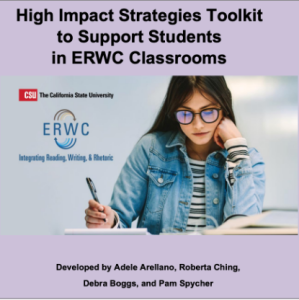
Over the decades of my career, I’ve observed creative teachers devise multiple engaging and effective ways to support students in learning English, especially the English valued in academic settings. When the first ERWC middle school modules were written, I thought how valuable it would be to gather the strategies that appeared throughout those modules along with others that have become hallmarks of the ERWC approach so teachers could transfer them to whatever texts they were teaching.
During the development of ERWC 3.0, along with my ERWC-ELD colleagues, Adele Arellano, Pam Spycher, and Debra Boggs, I was given the opportunity to do just that. We identified strategies in the newly developed ERWC-ELD modules, focusing on the activities we recognized were especially high impact for English learners students but would be valuable for most students still developing disciplinary English. In consultation with the ERWC-ELD team, I organized these strategies using the same structure that provides the DNA of all ERWC modules, the Assignment Template. We also identified activities that could be used at any point across a module, for example, activities focused on goal setting or discussion strategies.
Later, we revised the Toolkit by adding even more activities and identifying the ELD Standards that students would meet when teachers employed the protocols. For ease of access, Debra Boggs created a searchable Table of Contents. We created a Word version so you can modify and adapt the student version of an activity for your own texts and teaching situation. Our final document (final for now, since new strategies could certainly be identified and added) is a 129-page treasure trove of inspiration for good teaching.
All ERWC modules can be adapted to include additional Integrated and Designated ELD, the vision of the California Framework for ELA and ELD. Beyond that, using the High Impact Strategies Toolkit means that whatever other texts or text sets you are teaching, you can move through the stages of the ERWC Template and draw on strategies that will ensure a student-centered and inquiry-based approach and the ongoing development of students’ disciplinary language.
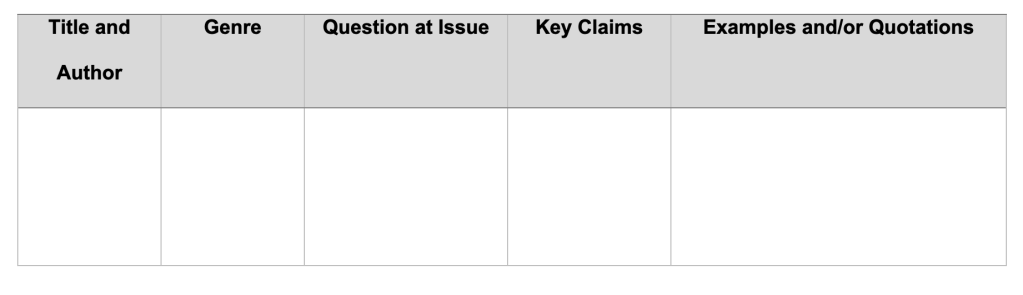
For example, Save the Last Word encourages students to engage with a text and discuss it in small groups. Charting Claims Across Multiple Texts transfers responsibility to students to track what they are reading so they have what they need at their fingertips when they are ready to do text-based writing. Sentence Unpacking guides students in understanding the writer’s craft at the word, phrase, and clause level so they can apply what they learn when they go to craft sentences of their own. Purpose Analysis prompts students to read their own writing rhetorically and revise accordingly. Students develop active listening and encounter key concepts as they work together to do Collaborative Text Reconstruction.
Charting Claims Across Multiple Texts
I’ve even observed schools adopt a strategy such as Annotation, Summary, Response to use across the disciplines in history and science classes, not just in English classes, a powerful way to truly make students college and career ready.
Early in my ERWC collaboration with high school teachers, an outstanding teacher told me the ERWC template kept him honest. Since then, the federal studies that supported the development of ERWC 2.0 and 3.0 have confirmed that students whose teachers are faithful to the Template—not teaching every activity in a module but guiding students as they move through each phase of Reading Rhetorically, Discovering What They Think, and Writing Rhetorically—are likely to be more successful than students whose teachers short-circuit it.
Self-accountability is key—asking myself, am I making sure that my students experience a robust set of activities at each stage of the reading and writing process so that at the end of a module or assignment sequence, they can successfully contribute their authentic voices to an ongoing conversation of consequence? And to answer yes to that question, I can turn to the High Impact Strategies Toolkit in planning a module or a year-long pathway to support students as they practice the strategies of proficient readers and writers. And in the spirit of expansive framing, I can make sure my students reflect on how these strategies can be transferred to new situations in other modules, other classes, and in the world beyond school.
Robby Ching is a professor emerita at Sacramento State in English and a member of the ERWC team since 2002. She has written many ERWC modules, most recently those with an ELD focus.
2023 ERWC Literacy Conference
June 20 in Sacramento & June 26 in Pomona
Conference registration is now open! The $75 registration fee includes continental breakfast and a buffet lunch. Discounts available for administrators, literacy coaches, and counselors.
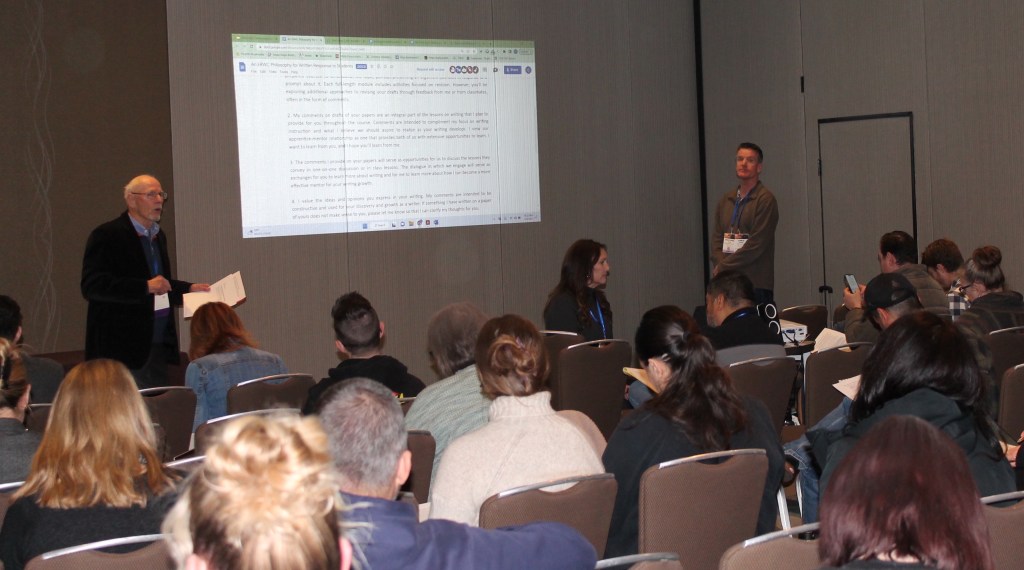
I recently presented at the CATE Convention in Monterey, California on taking a mentoring stance when responding to student writing. I worked with two professors from Cal State–Chris Street and Norm Unrau. We all shared on the importance of responding appropriately to student writing. We focused on how much our responses to our students affect our connection with them and, in turn, their ability, or perhaps desire to show up for us in class.
After Chris shared a less-than-kind comment he had received from a teacher when he was a student, we elicited responses from the audience about their experiences. Nearly every person had an experience in which one of their teachers had said something to them, perhaps a brief statement or a seemingly innocuous small, two-word response on a project that had changed the student’s perspective on their own learning.
I shared from the perspective of a secondary teacher that post pandemic, I had struggled greatly to connect with my students as I had done in the past and how classroom management was now a huge issue.
As if to prepare me for the presentation, the week prior to the conference, I decided to significantly change my approach to the teaching of writing. I had spoken to several colleagues at different schools and knew that the lack of skills–both academic and inter-personal–was what we might term “the new pandemic.” I could see that critical thinking and writing skills were seriously lacking and, when I considered that the last time my seniors had had an uninterrupted year of schooling face-to-face with a writing teacher, they were freshmen. Their skills reflected this.
My classes were in the middle of writing the speech for the “Language, Gender, and Culture” ERWC module. I decided to extend the amount of in-class time we spent on the assignment in order to provide daily instruction on every aspect of the writing process. I gave a mini-lesson each day and walked around the room to see each student’s progress. One after another said they did not need help or that they needed “time to think” through their writer’s block. I gave them space to write and continued to share lessons as a whole class, thinking they would absorb the information. By the second day, I had seen very little progress with any student in any class. So, I offered student-teacher writing conferences. Only a couple of people in each class approached. I then made it mandatory that they have a conference before moving on to their rough drafts.
As we sat in each conference, one on one, in front of the entire class, but talking softly, I was able to see what was lacking in their approach, and in their thinking about the topic. They saw me brainstorm with them, showing them the structure for their topic. They watched as I struggled with them to come up with the specifics of their topic then their issue, their question at issue, and finally their thesis statement for the speech. We worked on funneling down their ideas to something specific enough to be able to write a 2 to 3 page speech instead of what many of them had–a topic so broad that only a textbook could do it justice.
As each student sat before me, watching my thinking and hearing me say things such as, “This is definitely a topic that we can work with. Let’s narrow it down so it’s easy to approach,” and “I like where you’re going with this. You have some really good ideas!” I saw them light up. I continued in some conferences to say things like, “I am struggling to figure out where to take this topic. Give me a second. Let’s take a moment to brainstorm this one together.”
Not only did these conferences allow me to show each student a solid approach to their assignment, I could clearly see how each of them processed their thinking, which students had anxiety with either approaching a teacher or a big writing task, and who needed more support moving forward. But by responding kindly with my comments and showing them my thinking, we connected on a human level.
As I reflected on the conferences each day, I recalled how, prior to the pandemic, I had given each class an intro writing assignment in August in which they explained to me either a positive or a negative experience they had had in the past with an English class or teacher. With that assignment, I would call each of them up to have a brief conference to discuss their experience and answer any questions they had. I hadn’t had a classroom management issue in years. What I didn’t realize is that it was because they had seen me early in the year as a human who cared.
During this school year, the first full year of in-person learning, I had struggled with classroom management reminding me of my first few years as a teacher. I was ready to quit the profession.
However, in bringing back these student-teacher conferences, I noticed a significant shift in every one of my classes. Students were suddenly following every request and they are now more willing to show up–physically, mentally and emotionally. Some students are sharing their personal struggles with me rather than sitting in class, as Audre Lorde states, silently swallowing their tyrannies day by day until they “sicken and die of them still in silence.”
This connection is not only what had been lacking for my students, but it is the exact thing I needed as an educator to keep me enlivened in this profession.
Christy Kenny-Kitchin is an English teacher at Buena Park High School where she has also served as a Literacy Coach and Curriculum Specialist. She has taught English at the middle school, high school, and college levels. Having written one of the i3 modules (“The Daily Challenge”), she also worked as an academic coach to teachers for the i3 grant. Christy has been leading ERWC professional learning workshops for over a decade.
Please consider submitting a proposal to present at this year’s ERWC Literacy Conference, to be held June 20th in Sacramento and June 26th in Pomona. Cal State University pays travel costs for selected presenters. See the Call for Presenters here.
The deadline for proposals has been extended to April 14, 2023.
Conference registration is now open! The $75 registration fee includes continental breakfast and a buffet lunch. Discounts available for administrators, literacy coaches, and counselors.
The question of whether ERWC “works”–i.e., measurably improves student learning outcomes–is one that we’re asked continually. Administrators, in particular, understandably would like to know if there is evidence that Cal State University’s Expository Reading and Writing Curriculum is effective.
Over the years, we’ve had numerous evidence-based ways to respond to this question. In the early days, a qualitative pilot study by Dr. Mira-Lisa Katz, a literacy researcher at Sonoma State University, documented the ways ERWC promoted student engagement and success. Survey data collected from teachers who participated in ERWC workshops and taught at least two ERWC modules were evaluated against surveys from a comparison group of teachers. The pilot study also examined student assessment data. The findings indicated ERWC offered a significant boost in rigor, engagement, and student performance (Pilot Study Evaluation of the Early Assessment Program’s Professional Development in English, 2004-05).
The Turning Point
Then came the big breakthrough in terms of valid and reliable data: a 2015 report by WestEd evaluating the efficacy of the grade 12 ERWC 2.0 curriculum. WestEd’s study, which included more than 5,000 12th graders in 24 high schools across California, found that ERWC had a statistically significant impact on student achievement. ERWC received an additional mark of distinction when WestEd’s study was recognized by the U.S. Department of Education’s What Works Clearinghouse (WWC): a repository of nationally recognized interventions verified to improve student learning. A branch of the Institute of Education Sciences, the WWC reviews high-quality research to help educational leaders make evidence-based decisions.
The positive findings from the 2015 report led to ERWC’s expansion to grade 11.
There are also two reports by WestEd focusing specifically on ERWC curriculum with designated English language development (see the 2022 report here). While all ERWC 3.0 modules include integrated English language development and address California ELD standards, many modules also include language-focused activities for designated ELD instructional time and settings. These modules are marked in the ERWC Online Community by a special “ELA-ELD” tag.
The news that ERWC’s ELA-ELD modules likewise boost student interest and achievement was further validation that ERWC “works” for California’s diverse students.
Validation for ERWC 3.0
And now there’s a new feather in ERWC’s cap: A second evaluation by WestEd (this time, on ERWC 3.0) that has been verified without reservation by the What Works Clearinghouse. After reviewing WestEd’s 2022 report, “Expanding the Expository Reading and Writing Curriculum: An Evaluation of an Investing in Innovation Validation Grant,“ the WWC determined that the study met their rigorous standards and that there is strong evidence that ERWC was effective. The ERWC is also cited in a WWC Practice Guide on proven strategies for helping secondary students to write effectively.
Dr. Jyothi Bathina, Co-Director for the CSU Center for the Advancement of Reading and Writing, says of the new WWC recognition of ERWC, “This is a remarkable achievement for any educational initiative. It speaks to the dedication and persistence of the ERWC steering committee, CSU faculty, teachers, and workshop leaders, who work tirelessly to continuously improve and disseminate ERWC to California students.”
Dr. Shireen Pavri, Assistant Vice Chancellor for Educator and Leadership Programs in the CSU Chancellor’s Office, likewise commended the WWC’s recognition of ERWC, calling it a “strong testament to the deep and rich work of the ERWC steering committee, the CSU faculty, and so many middle and high school teachers who have worked collectively over the past 20 years to enhance expository reading and writing.”
We in the Department of Educator and Leadership programs in the California State University, Chancellor’s Office are thrilled about the national What Works Clearinghouse’s strong endorsement of our college preparatory Expository Reading and Writing Curriculum (ERWC). This salient recognition is a strong testament to the deep and rich work of the ERWC steering committee, the CSU faculty, and so many middle and high school teachers who have worked collectively over the past 20 years to enhance expository reading and writing.
Dr. Shireen Pavri, Assistant Vice Chancellor, Educator and Leadership Programs, California State University Office of the Chancellor
Building on the rigor of the 2015 study, the 2022 study used the gold standard for evaluating literacy interventions, including a student-level Randomized Controlled Trial (RCT). ERWC 3.0 can now join its predecessors in being a nationally recognized literacy initiative that measurably improves teaching and learning.
The accumulation of evidence and accolades for ERWC’s efficacy is an achievement shared by the entire ERWC literacy network. Special gratitude is due to the thousands of students and hundreds of teachers in the States of California and Washington who participated in the i3 Validation Study.
What’s In a Name?
ERWC has always been more than the modules. The living community of over 15,000 certified ERWC educators who continue to transform the curriculum and its pedagogies far beyond the CSU’s early aspirations is the heartbeat of this work. For those of us who have made ERWC a labor of love, the external validation is the icing on the cake.
So the next time someone asks you if ERWC works, you can point them to ERWC’s recognition by the What Works Clearinghouse. The answer is in the name. 🙂
Jennifer Fletcher is a Professor of English at California State University, Monterey Bay and a former high school teacher. She serves as the Chair of the ERWC Steering Committee. You can follow her on Twitter @JenJFletcher.
NOTE: Please consider submitting a proposal to present at this year’s ERWC Literacy Conference, to be held June 20th in Sacramento and June 26th in Pomona. Cal State University pays travel costs for selected presenters. See the Call for Presenters here. Sessionproposals are due March 31, 2023.
Conference registration is now open! The $75 registration fee includes continental breakfast and a buffet lunch. Discounts available for administrators, literacy coaches, and counselors.
ERWC Research, Evaluation, and Scholarship
2022
Jaquet, K., Fong, A., Reade, F., Chen-Gaddini, M., Skoldhorne, S., & Zhu, N. (2022). Evaluation of the Expository Reading and Writing Curriculum with respect to English language development. WestEd.
Fong, A., Porterfield, A., Skjoldhorne, S., & Hadley, L. (2022). Expanding the Expository Reading and Writing Curriculum: An Evaluation of an Investing in Innovation Validation Grant. WestEd. https://www.wested.org/resources/expanding-the-erwc-evaluation/
2018
Boulay, B., Goodson, B., Olsen, R., McCormick, R., Darrow, C., Frye, M., Gan, K., Harvill, H., & Sarna, M. (2018). The Investing in Innovation Fund: Summary of 67 Evaluations: Final Report (NCEE 2018-4013). Washington, DC: National Center for Education Evaluation and Regional Assistance, Institute of Education Sciences, U.S. Department of Education. https://ies.ed.gov/ncee/pubs/20184013/pdf/20184013.pdf [See pages A-23-24, C-4, D-10, and H-3.]
Katz, M.L., Brynelson, N., and Edlund, J.R. (2013). “Enacting Rhetorical Literacies: The Expository Reading and Writing Curriculum in Theory and Practice.” Commissioned Chapter about the ERWC for the 6th Edition of Theoretical Models and Processes of Reading, D. Alvermann, N. Unrau and R. Ruddell (Eds.). Newark, DE: International Reading Association (pp. 978-1014).
2010
Graff, Nelson. “Teaching Rhetorical Analysis to Promote Transfer of Learning.” Journal of Adolescent & Adult Literacy 53.5 (2010): 376–385.
Hafner, Anne, Rebecca Joseph, and Jennifer McCormick. “College readiness for all: Assessing the impact of English professional Development on teaching practice and student learning.” Journal of Urban Learning, Teaching and Research 2.3 (2010): 23-45.
Hafner, A. L., Joseph, R., & St. Germain, M. (2010). Assessing the impact of English professional development on teaching practices, student learning, and readiness for college: An evaluation of the Expository Reading and Writing Course, FIPSE. Los Angeles, CA: California State University, Los Angeles.
Rowlands, Kathleen Dudden and Jennifer Fletcher. “Reconcilable Differences.” California English 15.3 (2010): 28-31.
2008
Bernasconi, Loretta. “The Jewels of ERWC Instruction.” California English 14.1 (2008): 16-18.
Brynelson, Nancy. (Provided data) “High School to Community College New Efforts to Build Shared Expectations.” Ed Source Nov. (2008): 1-24.
Cline, Zulmara, Kim Flachmann, and Chris Street. “Reading, writing, and ready!” Leadership 37.5 (2008): 25-27.
Edlund, John. “Using the ERWC Assignment Template.” California English 14.1 (2008): 6.
Fletcher, Jennifer and Marcy Merrill. “Rhetoric Rising: New Directions in Teaching High School English.” California English 14.1 (2008): 12-14.
Program Evaluation and Research Collaborative. (2008). Evaluating the impact or reading and writing professional development on student reading and writing outcomes: Evaluation report. Los Angeles, CA: California State University, Los Angeles.
Street, Chris, Marcy Merrill, Jennifer Fletcher, Mira-Lisa Katz and Zulmara Cline. “The Expository Reading and Writing Curriculum (ERWC): Preparing All Students for College and Career.” The California Reader 42.1 (2008): 34-41.
2007
Brynelson, Nancy. Updates on the Early Assessment Program. CISC Newsletter: ELA Updates 1.6 (2007): 1-2.
Cline, Zulmara and Bissell Joan. “Joint Project aims to send K-12 students to college prepared” EdCal (2007): 5.
Cline, Zulmara, Joan Bissell, Anne Hafner, and Mira-Lisa Katz. “Closing the College Readiness Gap.” Leadership 37.2 (2007): 30-33.
CSU Chancellor’s Office Staff. “Handbook focuses on early college assessment program” EdCal Education California 27.20 (2007): 1.
Fletcher, Jennifer, and Marcy Merrill. “Reaping the Rewards: Two Views of the Early Assessment Program.” California English 13.1 (2007): 26-28.
2005
California State University, Teacher Education and Public School Programs. (2005). Pilot study evaluation of the Early Assessment Program’s professional development in English, 2004-05: Report. Long Beach, CA: Author. Retrieved from http://www.calstate.edu/teacherED/docs/EAP_ReportFinalA.pdf
Why the Work that Early Assessment Program (EAP) Coordinators Do Is So Relevant to ERWC and its Stakeholders
By Faye Wong
Let us start with a little history of ERWC and EAP. It all began in the early 2000’s when the California State University (CSU) recognized that first-time students were “lacking” college readiness to be successful. In 2003 with the support of the CSU Chancellor’s Office, a contingent of CSU faculty, high school teachers, and high school administrators began developing and creating the first ERWC instructional modules. The CSU Center for the Advancement of Reading and Writing soon joined the project in order to provide administrative support for implementing and evaluating the pilot curriculum.
In October 2003, the CSU made the Early Assessment Program (EAP) a reality. EAP is a collaborative effort between the California State University (CSU), the California Department of Education (CDE), and the State Board of Education (SBE). The EAP educates and collaborates with districts and high school administrators, counselors, students, and parents on college readiness, academic preparation, and promoting the connection and importance of ERWC and 4th year quantitative reasoning math.
While the CSU has evolved over the years to become a student-ready university system that rejects deficit views of learning and learners, the goal of EAP has remained the same: to provide all entering CSU students with the opportunity and support needed to be successful in college-level coursework.
“Good academic preparation in high school is paramount for the success of a student in college, especially during their first year. It heavily influences college persistence, engagement, success, and ultimately timely graduation for students.”
Lesley Davidson-Boyd, Ph.D. Associate Vice President Academic Success & Undergraduate Advising California State University, San Bernardino
A Small Glimpse into the Work that EAP Coordinators Do Behind-the-Scenes that Helps Make ERWC Happen
All 23 CSU EAP coordinators work tirelessly promoting the ERWC curriculum and workshops that are offered in each region. EAP coordinators are the backbone/cornerstone for ERWC information/resources and workshops for districts and high schools. We provide the direct link for districts and high schools as they move towards adopting ERWC and student success.
“EAP coordinators play a vital role both on campus and in the K-12 arena disseminating information on ERWC and other CSU initiatives that focus on student success. They are crucial in creating a pipeline of college bound students who will thrive at the CSU.”
Jyothi Bathina, Ph.D. Co-Director CSU Center for the Advancement of Reading and Writing (CAR/W)
EAP coordinators can also work in partnership with the ERWC County Office of Education (COE) Regional Leads, except for LA County CSU campuses, to host ERWC workshops. Each region’s collaboration is unique, depending on the amount of involvement EAP coordinators and County Regional Leads have.
For instance, in my region, CSU San Bernardino (Inland Empire), an agreement was made with the COE as to who will set-up workshop dates with high school districts and trainers, find locations to host workshops, determine main contacts for questions and concerns, promote ERWC workshops, and recruit English teachers to attend the professional learning sessions. From there, planning with the workshop trainers for each day of the workshop begins.
Handouts and materials need to be confirmed and made ready for each workshop day. On the day of each workshop, arrival time is 1-2 hours earlier. This early arrival time will ensure that the facility is set-up and ready for trainers and teachers, that books and materials are ready, food has arrived, and we’re ready to trouble shoot during workshop. At the end of each workshop day, clean-up begins, and then we start this cycle again for the next workshop.
“Asking an ERWC workshop facilitator to describe the role her EAP coordinator plays is like asking Space Shuttle Astronauts what role the Launch Director plays.
While I am no NASA astronaut, I do believe Faye can run a small country. As an English teacher, I struggle with titles that don’t adequately encompass the purpose and scope of a job, so it took me a few years of well-oiled workshops to fully grasp the role of ‘EAP Coordinator’; Faye organizes and coordinates the launch, the pilots and the shuttle, ensuring a smooth mission from start to end so that we can, in her words, focus on a high-quality workshop, facilitated with fidelity.”
Cara Ramsay M.A. Rhetoric and Composition English Instructor ERWC Facilitator
In addition to ERWC workshops, EAP coordinators also work endlessly to support districts and high schools in adopting the 11th and 12th grade ERWC curriculum, ensuring that all ERWC adopted high schools UC Doorways CMP course name and transcript abbreviations are correct and that CALPADS code is listed correctly.
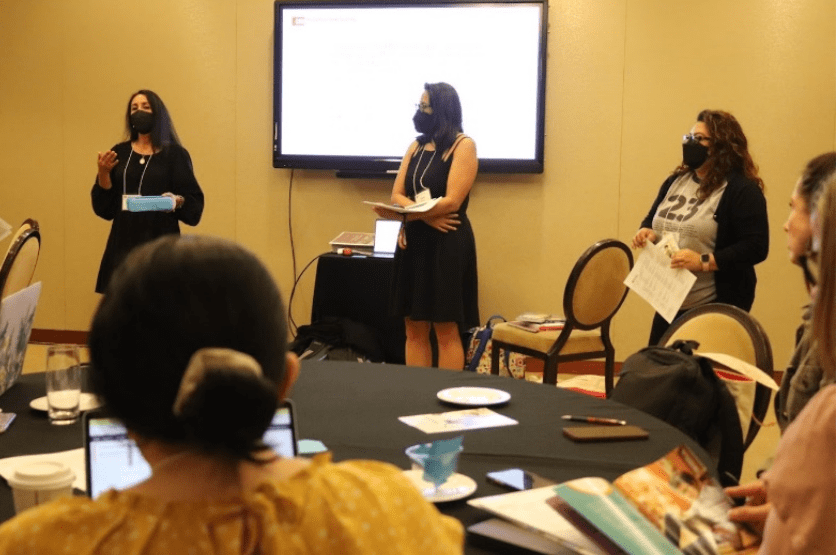
EAP Coordinators Rosie Villafana-Hatcher-SDSU (L), Faye Wong-CSUSB (C), Xiomara Melendez-CCP (R) presenting at the 2022 ERWC Literacy and Leadership Conference
This is just the beginning of what EAP coordinators provides for ERWC and stakeholders. Again, each region might operate slightly different, but every region has the same goal–college readiness and academic preparation for students to succeed in college and life. To say that EAP coordinators work has a huge impact on ERWC is just the tip of the iceberg…they should be acknowledged for the 20 plus years of diligent work they do daily for ERWC and stakeholders.
Faye Wong is the Early Assessment Program (EAP) Coordinator at California State University San Bernardino. EAP promotes college readiness, academic preparation, and success. For the past 17 years, Faye has provided information on academic preparation, college readiness, Expository Reading and Writing Course (ERWC), 4th year math, Early Start Program (ESP), CSU Placement, and Multiple Measures to administrators, counselors, teachers, students, and parents in over 40 high school districts throughout the Riverside and San Bernardino Counties. Faye holds a Bachelor’s degree in Child Development from California State University Fullerton and was previously a Program Administrator in the Orange County Department of Education. She has presented at the Hawaii International Conference on Education on school-related issues.
NOTE: Please consider submitting a proposal to present at this year’s ERWC Literacy Conference, to be held June 20th in Sacramento and June 26th in Pomona. Cal State University pays travel costs for selected presenters. See the Call for Presenters here.
Powerful forces are gathering to demand control over what is taught, what students read, and what can and cannot be spoken.
A recent report from PEN America called “Banned in the U.S.A.” reports an astonishing 1,586 book bans in 86 school districts and 26 states. California is not one of these states. Yet. Overwhelmingly, the majority of books being targeted explore issues of race, racism, sexual orientation, and gender identity.
“It is not just the number of books removed that is disturbing, but the processes–or lack thereof–through which such removals are being carried out,” the report states. “Objections and challenges to books available in school are nothing new, and parents and citizens are within their rights to voice concerns about the appropriateness and suitability of particular books. In order to protect the First Amendment rights of students in public schools, though, procedural safeguards have been designed to help ensure that districts follow transparent, unbiased, established procedures, particularly when it comes to the review of library holdings.”
The American Library Association, which has been tracking book challenges for 20 years, reports a surge the like of which they have never seen before. “What we’re seeing right now is an unprecedented campaign to remove books from school and public libraries that deal with the lives and experiences of people from marginalized communities,” said Deborah Caldwell-Stone, the director of the American Library Association’s office for intellectual freedom.
The struggle to control what students read seems to be driven by fear: parents’ fear that their children will be brainwashed. They want to protect their babies. But keeping young people ignorant of reality, particularly when it’s harsh, won’t keep them safe. In fact, blinders can prevent children from understanding what they see in the world around them and what they feel within themselves. Not talking about Bruno won’t make him disappear.
The danger is silence. Classroom discussion is essential to educating tomorrow’s citizens. And teachers, in concert with their school communities, are in the best position to make decisions regarding what to teach and how to approach controversial subjects in age-appropriate ways. Controversial readings and topics always make for the most engaging classes and most engaged students. “Argue the point, not the person!” I reminded my students again and again.
Teachers find themselves crippled by curricular caution. And self-censorship may ultimately have more of an impact than school board bans. Results of a survey conducted by School Library Journal suggest that censorship attempts are likely to have a long-lasting insidious effect on school library collections. Removed books can be counted. What about the books that are never purchased?
Terry Stout Anderson, a district coordinator for secondary English in a large Midwestern school district, writes: “I don’t want teachers in my district to play it safe, but I do want English teachers across our district to feel safe when engaging students in adventurous thinking and free inquiry.”
No book worth teaching is neutral or without troubling moments. And even the most perfect book adoption process still cannot protect us from a potentially raucous school board meeting. Professional communities like the National Council of Teachers of English, the California Association of Teachers of English, and ERWC can help us navigate these difficult times. Educators committed to bringing great literature into classrooms do not need to go it alone.
Carol Jagois a long-time California public school teacher and past president of the National Council of Teachers of English. She is associate director of the California Reading and Literature Project at UCLA and currently serves on the executive board of the International Literacy Association. Carol is the author of numerous books including The Book in Question: Why and How Reading Is in Crisis.
Looking for ways to promote civil discourse and facilitate meaningful conversations on sensitive topics in ERWC classrooms? Please see the recording of Matt Kay’s webinar: “Hitting for Contact: Consistent Success in Race Conversations” and.” The ERWC Theoretical Foundations for Rhetorical Reading and Writing, ERWC UCOP-approved course descriptions, and Introduction to ERWC 3.0 also offer rationales and research for ERWC’s inquiry-based approach to civil discourse.
Save the Date! The 2024 ERWC Literacy Conferences will be held June 17th in Sacramento and June 25th in Pomona.
This past weekend I had the joy and privilege of sharing a sneak preview of the forthcoming ERWC modules for grades 6-8 at the CATE Convention in Monterey, a few miles south of my home in Seaside, CA. I shared poems by Daniel B. Summerhill, Elizabeth Acevedo, Clint Smith, and Joshua Bennett and talked about how the module I’m writing, “Songs of Praise,” includes both integrated and designated English language development. I also offered a quick peek at some of the activities under construction:
Talking about my current work as a middle school module writer reminded me of the monumental effort it took to get the third edition of the high school curriculum out into the world. The development of ERWC 3.0 was unlike any other writing project I’ve been involved with. It was messy, overwhelming, and exhilarating. The project took on a creative life force of its own beyond anything we had anticipated that resulted in a product that exceeded our expectations (and, frankly, our copyright budget). What we now see as ERWC’s “equity upgrade” stretched my thinking and tested my commitment to flexibility in all kinds of ways. If you’ve ever wondered how the third edition came to be, here’s the story behind ERWC 3.0.
Expanding the Inquiry Space
With the third edition of the ERWC, we didn’t just expand the inquiry space; we blew it wide open. We made extensive room and time to leverage the talents and insights of people in our community and to recruit people who could bring additional expertise from throughout California and the State of Washington, our partner in the multimillion dollar federal grant that funded the new curriculum. We sought to bridge gaps in our own knowledge and to adapt and apply what we learned from the first two editions to the redesigned course.
And that meant our content creation team had to grow exponentially. We ballooned from an original task force of around ten members back in 2003 for the first edition of ERWC to a community of module writers that included scores of educators from two states for the third edition. We also sought to bring the ERWC to scale by expanding the curriculum to the 11th grade and the ERWC literacy network to the states of Washington, Hawaii, West Virginia, and New Mexico.
This time, the pool of module authors included high school teachers and college faculty with diverse backgrounds, experiences, and identities. Authors approached the task from various angles and perspectives, and we worked to learn from each other. Each module author thus opened a window into a particular facet of our literacy network. We were able to get a closer look at each others’ teaching lives and social worlds while working to achieve a shared vision of the future we want for our students.
We didn’t just tell potential contributors the budget and specs and send them off to complete their work alone. Instead, we kept our eyes on both the product and the process, knowing that in some ways the latter would have an even greater impact on the kind of relationships and community we built through this work. And we were open to change when the ERWC Assignment Template or a module took a direction we hadn’t tried before.
We also took extra care to expand the inquiry space during the early stages of project development. We took time to review our theoretical foundations, rethink our course and module design, and learn about current best practices in our profession, including Universal Design for Learning (UDL) and culturally sustaining pedagogies. We held workshops on the English Language Arts/English Language Development Framework for California Public Schools. We met in writers’ groups. We developed and reviewed module proposals, developed and reviewed module drafts. Then we piloted the drafts and followed up with more review and revision.
The ERWC’s evolving Theoretical Foundations, moreover, informed everything we did, even down to our smallest edits. For instance, as we revised the draft modules we worked to omit prescriptive or didactic language—words such as “should” or “must”—that was contrary to our rhetorical, assets-based approach.
While the process was at times more generative and serendipitous than we were perhaps prepared for (over 80 new modules were ultimately developed), we believe we have a stronger curriculum and community as a result.
Innovation in Instructional Design
The outcome of this process is a curriculum that offers teachers and students more choices, more literature, a greater diversity of authors and text types, more means of expression (using UDL), more support for English Language Learners, and more opportunities for analyzing visual rhetoric and new media. The third edition also includes mini-modules on key rhetorical concepts such as the rhetorical situation, genre, and kairos. We’re excited to further expand the curriculum and its pedagogies through the forthcoming collection of new language-focused modules for grades 6-8.
What is perhaps most promising about our practice as we approach the 20th anniversary of ERWC is what we’ve learned about the benefits of inquiry and collaboration. The features of ERWC 3.0 that move the course toward greater student agency and educational equity are those that developed out of some of our richest discussions and newest learning: UDL, teaching for transfer, learning goals and reflection, culturally and linguistically sustaining pedagogies, and the California English Language Development Standards. We had to be willing to approach this work with the same open mind and tolerance of confusion that we encourage students to bring to their work with texts. We had to learn to accept the mess and trust that it, too, is generative. We had to embrace the process of discovery.
Moving Forward
With the new middle school curriculum, we’re now hitting that pivot point after we’ve expanded the inquiry space and invited mess and complexity where we need to start making some decisions about the final form of the modules. Our task is to make sure we retain those protean structures–rhetoric and inquiry, the arc and the spiral–that allow us to have a shared vision and purpose. This is the piece that needs to be locked into place before we can publish any new iteration of ERWC.
But the other components of the ERWC—the network of over 15,000 teachers, the professional development programs, communities of practice, multi-state collaborations, online discussions and resources, webinars, and blog—will remain fluid and responsive. These are the places where teachers can continue to think through the extent to which ERWC 3.0 is helping students become better readers, writers, and thinkers and how instruction can be further improved. The lesson learned is the need for flexible components in literacy initiatives that remain plugged into the feedback loop, to the lived realities of individual students and teachers and the changing dynamics of particular classrooms.
We can’t wait to see what happens in the next chapters of ERWC’s story. 🙂
Jennifer Fletcher is a Professor of English at California State University, Monterey Bay and a former high school teacher. She serves as the Chair of the ERWC Steering Committee. You can follow her on Twitter @JenJFletcher.
NOTE: Please consider submitting a proposal to present at this year’s ERWC Literacy Conference, to be held June 20th in Sacramento and June 26th in Pomona. Cal State University pays travel costs for selected presenters. See the Call for Presenters here.
This year’s CATE Convention is set in beautiful Monterey, and the theme for 2023 is “Sea Changes: Traditions and Transformations in California English Language Arts.” If you have not yet registered for the conference (Friday, March 3rd through Sunday, March 5th), please see your registration options. And if you will be attending the conference, check out this helpful video before you arrive: Know Before You Go .
CATE 2023 provides a special opportunity to engage with ERWC teacher leaders, steering committee members, and your ERWC colleagues as we all look forward to an exciting series of ERWC-focused sessions. This year, we have a record 11 sessions in the ERWC strand. Consider attending some of the ERWC sessions, all of which exemplify the ways in which equitable learning opportunities are nurtured and sustained through ERWC’s rhetorical approach to literacy and language learning.
Please join our ERWC community in Monterey as we embrace this opportunity to learn from one another, share best practices, and engage in professional learning together in this beautiful seaside setting. Watch for an announcement about a Saturday evening ERWC reception, too.
And new this year will be the addition of an ERWC booth in the exhibit hall. Join us at the ERWC booth to connect with ERWC Steering Committee members, teacher leaders, and your colleagues for the latest ERWC information, give aways, and more!
Please share the save-the-date flyer and Call for Presenters for this summer’s annual ERWC literacy conferences with interested colleagues.
Chris Street is a Professor of Secondary Education at California State University, Fullerton. He helps lead the statewide implementation of ERWC as a professional learning facilitator, module author, and member of the ERWC Steering Committee.
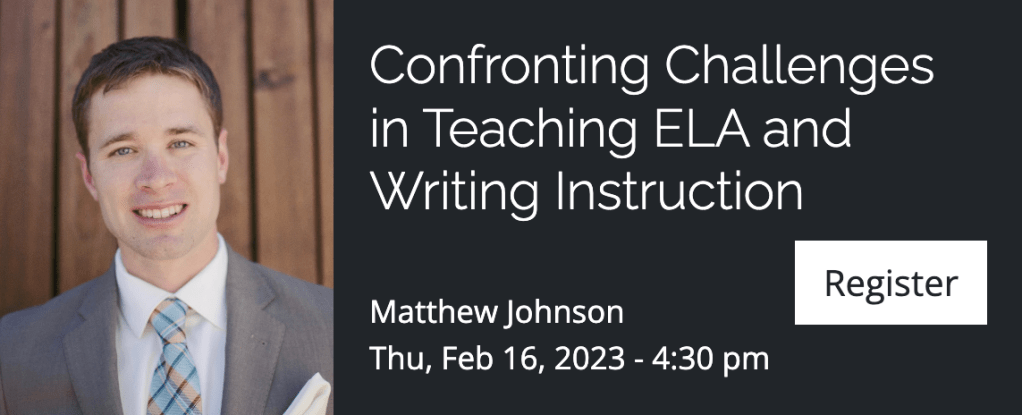
Editor’s Note: This post was first published on Matthew Johnson’s blog and is republished here with the author’s permission. The ERWC community is excited to announce that Matt will be the featured speaker for our February 16th webinar at 4:30 p.m. PST. Registration is free!
By Matthew Johnson
Regular readers of my blog know that Matt Kay, one of my co-authors of Answers to Your Biggest Questions About Teaching Middle and High School ELA, is on my pantheon of great writing teachers. I’m not sure there is a more remarkable and inspirational educator anywhere, and, if given the choice, he is probably the first teacher in the country whose class I would put my own children in.
At NCTE 2022 Matt Kay once again proved why he is one of the all-time greats when he made an argument for writing teachers to approach community building as thoughtfully as they approach designing a lesson or crafting a writing prompt. His reasoning went like this: The primary audience for students–especially in a modern classroom that is full of group work, discussion, projects, and choice–is not the teacher; it is each other. As adolescents, they are constantly and somewhat obsessively watching, comparing and contrasting with, and performing for each other. If they have strong community and relationships, or in other words, their relationship with their primary classroom audience is strong, everything done in the classroom will benefit.
I have a hunch that most teachers reading this will likely know this already at some level. They will know how smoothly discussions and peer response and projects go in that section that has truly gelled and how difficult those things can be in the class that hasn’t quite come together yet. What makes Kay’s point different and important from the general argument that community is important is that he points out that even when we know that community is important, we also tend to quietly and often unconsciously downgrade it as a second tier concern. It is something to focus on during the first few weeks of the year or after the lessons are planned, email is cleared, and all papers have responses.
At NCTE Kay sought to remind us that community building is a top-tier concern, one that we should loudly proclaim as important and keep our eye on, not just during the first week, but throughout the whole school year.
Kay also gave a simple, effective recipe for how to build a strong, supportive community all year long:
First, explain directly why community building matters. Don’t assume that students know why sharing good news or engaging in a silly competition or having a cookie contest before winter break will help them.
Then systematize it. Community-building is often the first thing to get bumped and it can be scattershot. Kay argues that when community building is dropped in favor of content or done haphazardly, the message is clear to students: it doesn’t matter as much as other aspects of the classroom, which can cause them to disinvest from it. Kay’s suggestion to avoid this is to ritualize it: “[When building community], make sure there is an every Monday we do this. Every Tuesday we do this. Every Wednesday we do this…” By systematizing it and pinning specific community building elements to specific days we can show its value and protect against dropping it when things get busy.
Then keep it up all year. Community building in the first few weeks is expected, but continuing it once the crush of our class’s content comes upon us is not always easy. If we want community to run deep though our classes, we need to have the same commitment in week 34 that we have in week 1.
I have written a lot about community over the years because I feel that it is the secret sauce for what makes a learning community–and especially a writing learning community–truly great. And yet, truth be told, I’m not sure I explain its value enough after the first week, have it as organized as it could be, or am as dogged as I could be about ensuring it doesn’t get bumped as the year pushes forward.
Kay’s reminder was just what I needed, as I have a feeling that community will be critically important when we face the challenges of 2023, ranging from making it through this tripledemic winter of illness to the rise of AIs like ChatGPT.
Yours in Teaching,
Matt
If you liked this…
Join my mailing list and you will receive a thoughtful post about finding balance and success as a writing teacher each week along with exciting subscriber-only content. Also, as an additional thank you for signing up, you will also receive a short ebook on how to cut feedback time without cutting feedback quality that is adapted from my book Flash Feedback: Responding to Student Writing Better and Faster – Without Burning Out from Corwin Literacy.
Matthew M. Johnson is a teacher, author, and literacy leader whose books include Flash Feedback and Answers to Your Biggest Questions About Teaching Middle and High School ELA with Matthew R. Kay and Dave Stuart Jr. You can follow Matt @a2matthew and chat with him live during the ERWC webinar on February 16th at 4:30 PST.
Watch the recording of the ERWC webinar with Matt Kay here.
SAVE THE DATE! The annual ERWC Literacy Conference will be June 20th in Sacramento and June 26th in Pomona. Registration opens in March. Watch for a Call for Presenters to be issued soon!
My earliest memory of ERWC dates back to the fall of 2004. I’m not even sure if I knew the curriculum by the name ERWC at that time, but I was aware that California State University was developing a new partnership with high school teachers and I wanted to be a part of it. I remember going to a workshop at Cal Poly Pomona, one of the first professional learning sessions I attended following the birth of my son who was about a year old at that time. I had been teaching high school English for around eight years and was ready for a new challenge.
It was exciting to be back in a room full of colleagues talking about ideas. There was a sense that something special was happening. There were tables around the periphery of the room on which were displayed intriguing reading selections from college English courses, and we browsed the selections while discussing the ways they differed from the traditional literature textbooks we used in our high school English classes. The texts and topics were fresh and provocative. The facilitators (one of whom I’m sure must have been John Edlund although I hadn’t met him yet) talked about rhetorical reading and writing–literacy practices I didn’t know much about. I also didn’t know my life was about to change.
A year later, after learning more about ERWC and helping to facilitate some of the earliest ERWC workshops, I was invited to join “Task Force 12,” the first iteration of what is now the ERWC Steering Committee. This time, I was returning to work after the birth of our second child. I joke that I’ve been in a committed relationship with ERWC ever since. My own kids are roughly the same age as ERWC, and I look back on those early years with a sense of overwhelming gratitude for the gifts and transformations that followed.
Celebrating 20 years of ERWC!
Two decades later, we’re now preparing to celebrate 20 years as an ERWC community. While the first edition of the curriculum wasn’t officially published until 2007 (ERWC oldtimers remember the “DRAFT” modules released in 2004), the roots of our multi-state literacy network date back to the summer of 2003, when John Edlund, a professor of rhetoric at Cal Poly Pomona, assembled a task force to create an instructional intervention that would prepare more high school students for college reading and writing. That original task force evolved into an advisory board and, later, a steering committee that now helps design and implement ERWC curriculum and professional learning experiences in five states: California, Washington, Hawaii, New Mexico, and West Virginia. In California alone, ERWC grade 11 and 12 courses have been adopted by almost 1,000 high schools. Our work has helped two generations of students (see the WestEd reports from 2015 and 2022 for the positive impact ERWC has had on students and teachers).
We couldn’t have reached these milestones without you, our ERWC family. The ERWC story has always been a story of community and collaboration. We pride ourselves on being a grass-roots initiative sustained by local educational leaders. We’re grateful and honored that so many of you have found a professional home in the ERWC literacy network, and we look forward to gathering as a community in June to celebrate all that we’ve accomplished together.
2023 ERWC Literacy Conference: The Anniversary Edition
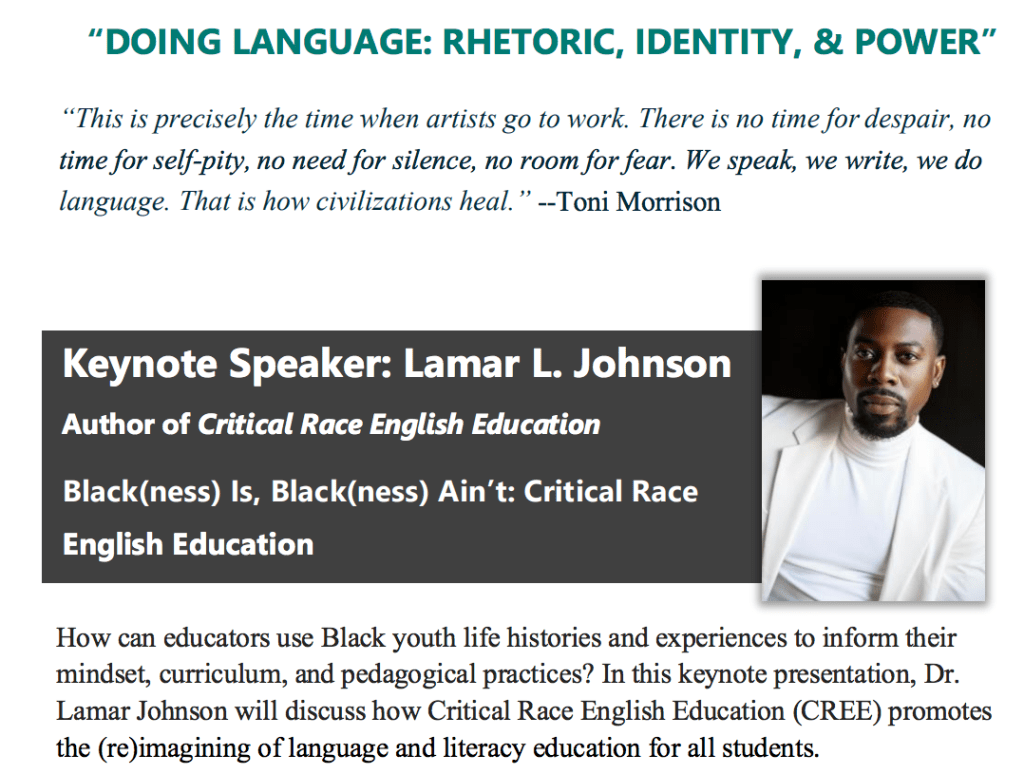
This year’s “platinum edition” of the ERWC Literacy Conference will be a special opportunity to reflect on where we’ve been and continue working toward the equitable learning outcomes we’ve pursued all along. The theme for 2023 is “Doing Language: Rhetoric, Identity, and Power.” We’re thrilled to announce Lamar L. Johnson, author of Critical Race English Education, as our keynote speaker. Please save the date for the conference in your region (June 20th for Northern California and June 26th for Southern California) and watch for the Call for Presenters and registration links to open soon. See the preview of the CFP below.
So happy anniversary, ERWC colleagues! We’re thankful to be on this journey together.
Please share the save-the-date flyer with interested colleagues.
Preview of Call for Presenters for the 2023 ERWC Literacy Conference
June 20, Sacramento
June 26, Pomona
“This is precisely the time when artists go to work. There is no time for despair, no time for self-pity, no need for silence, no room for fear. We speak, we write, we do language. That is how civilizations heal.”
–Toni Morrison
Theme: “Doing Language: Rhetoric, Identity, and Power”
What is an ERWC approach to language learning? Language teaching is an opportunity to be culturally sustaining while also developing students’ abilities with new forms of language in new contexts for new purposes. Our profession is engaged in an ongoing conversation about ways of “doing language” in the classroom and beyond inspired by the following kinds of questions:
How can educators work toward linguistic justice?
How can we help all students adapt and apply the rhetorical ways of “doing language” they bring to our classrooms to diverse contexts?
What are the relationships among language, social identity, and power?
How are language and learning connected?
How is language development related to literacy development?
How do language choices create particular kinds of connections between rhetor and audience?
How does rhetorical knowledge help students understand social identity and power relations?
The 2023 ERWC Literacy Conference will address such questions by showcasing best practices for fostering students’ language development through a rhetorical approach to texts. We especially invite teachers who are using ERWC 3.0 modules with integrated and designated English language development to share what they’ve learned about how to make the curriculum and its culturally and linguistically sustaining pedagogies work for their students. Sessions on specific language-focused activities aligned with California’s ELD Standards, multimodal composition, or course design are particularly welcome. Proposals may address any of the following topics:
Languaging, translanguaging, identity, and audience
Linguistic justice
Teaching language for transfer (including success on the ELPAC)
Language building through collaborative discussions
Language, UDL, and multiple means of expression and representation
Planning lessons with language in mind
Language, communication, and authenticity in the age of AI
Concurrent break-out sessions will be 75 minutes long.
Jennifer Fletcher is a Professor of English at California State University, Monterey Bay and a former high school teacher. She serves as the Chair of the ERWC Steering Committee. You can follow her on Twitter @JenJFletcher.
Editor’s Note: California State University is hosting its annual in-person literacy conferences June 20th in Sacramento and June 26th in Pomona. The theme for this year’s event is “Doing Language: Rhetoric, Identity, and Power.” All are welcome! Sessions feature strategies for integrated and designated English language development, fostering linguistic and rhetorical agility, and promoting equity and inclusion. The $75 registration fee includes lunch and a choice of location and date.
By Jennifer Fletcher
Happy New Year, ERWC colleagues! 2023 marks the 20th anniversary of the inception of Cal State University’s Expository Reading and Writing Curriculum, a milestone we’ll be marking in multiple ways in the coming months. We hope you’ll join us for our spring webinars and June conference as we celebrate two decades as a community of practice dedicated to the success of all students.
We’re also continuing to celebrate the expansion of ERWC through the third edition of the curriculum. We think of ERWC 3.0 as the equity upgrade: the version of the curriculum that gets us closer to fulfilling our commitment to inclusive learning experiences, relevant issues, and representative texts. To paraphrase a certain organization for retirees that keeps contacting me now that I’m in my 50s, if you don’t know ERWC 3.0, you don’t know ERWC.
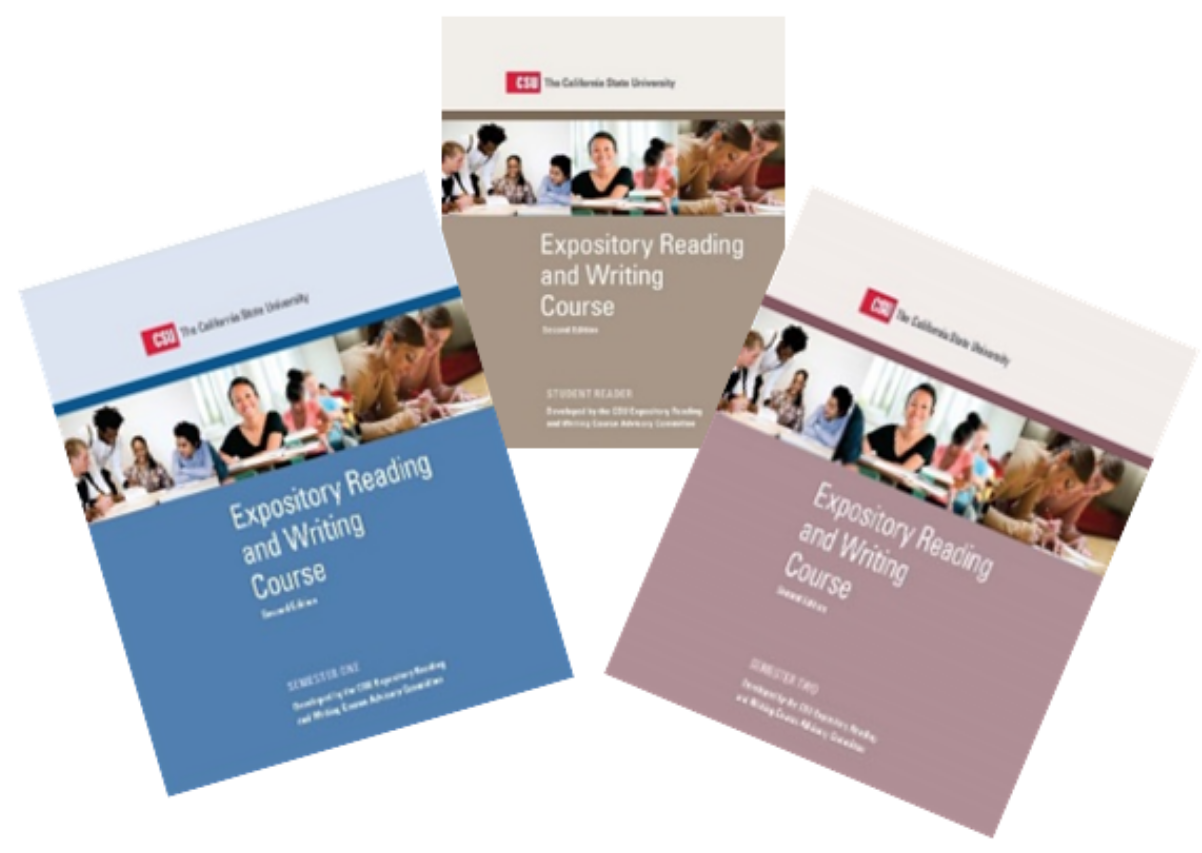
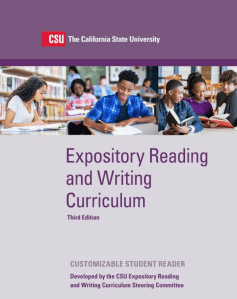
Here’s a quick test to see if an update session is right for you: Which of the following images represents the version of the curriculum you know best? (And if your idea of ERWC doesn’t go beyond a set of modules with “DRAFT” watermarked all over them, then we’d really love to see you in an update session!)
If you’re already team purple, you can probably stop reading here. But if you’re team blue/taupe, then we have some updates we’d like to share with you. For instance, did you know that ERWC has published new sample student essays with scores and commentary, new resources on writing and transfer, and new modules for grades 9-12? Or a new mini-module reader and customizable reader? If not, it might be time for an ERWC 3.0 tune-up.
What’s New?
In addition to dozens of new modules (including some just published in 2022), our professional resources for teachers have also been revised and expanded for the third edition to explicitly address integrated and designated English language development, Universal Design for Learning, culturally and linguistically sustaining pedagogies, and rhetorical knowledge needed for transfer. A new “Theoretical Foundations” resource was likewise created for the third edition.
Some more things that are new about ERWC:
A redesigned website
New student essays with scores and commentary for ERWC 3.0 modules
Newly released 3.0 modules, such as “Community Activism”
The return of in-person June literacy conferences
Expanded ERWC strand at CATE
New resources for writing instruction (Rhetorical Concepts & Adopting a Mentoring Stance)
New rubrics for assessment
New edition of They Say, I Say
Increasing focus on strategies for expert learners in modules
More tools (and flexibility) for semester- and year-long planning
Attending an ERWC 3.0 update session is a great way for teachers and administrators to give their curriculum the “equity upgrade” enacted by ERWC’s expanded frameworks, curriculum, and resources. We hope you’ll consider registering (or encouraging a colleague to register) for one of ERWC’s free update sessions soon if you haven’t already heard about all the changes to ERWC in the past few years. We’d love to connect with you in person or online and hear what’s new with you, too!
PS to folks in Monterey County, Santa Cruz County, and San Benito County: I’m super excited to be facilitating my first in-person ERWC update session since 2019 next month. If you know teachers and administrators who might be interested in joining us for two Saturday workshops at CSU Monterey Bay, please help spread the word. Registration closes February 10, 2023.
Jennifer Fletcher is a Professor of English at California State University, Monterey Bay and a former high school teacher. She serves as the Chair of the ERWC Steering Committee. You can follow her on Twitter @JenJFletcher.











 Teaching ERWC