
By Jennifer Fletcher
We’re at a “This I Believe” moment as literacy educators. The rapid spread of generative artificial intelligence (GenAI) across our schools and our world is causing us to revisit our beliefs about best practices for teaching reading, writing, and thinking. What still matters in the age of AI?
Like many teachers, I have more questions than answers when it comes to the issue of how, when, and why (or why not) to use AI.
But I do know this: We don’t have to be agnostic about AI. Our ERWC frameworks offer a principled approach to AI use or resistance. We can continue to engage our students with the work that has always mattered in ERWC classrooms–shared inquiry, meaningful social interaction, analytical reading, authentic writing, and productive struggle. The ERWC approach to AI is the same ERWC approach to any question at issue or communication challenge: an inquiry-based, rhetorical, and student-centered approach that fosters critical thinking, learner agency, and metacognition. As always, how we enact this approach as teachers depends on our instructional context and expert professional judgment. ERWC’s built-in flexibility is a mark of its developers’ trust in teachers and respect for human decision-making.
Consider the extent to which the ERWC Key Principles remain relevant and valuable in the age of AI:
- The integration of interactive reading & writing processes
- A rhetorical, inquiry-based approach that fosters critical thinking & engagement through a relentless focus on the text
- Materials & themes that engage student interest
- A student-centered approach that emphasizes student agency & metacognition
- Classroom activities designed to model & foster successful practices of fluent readers & writers
- Research-based methodologies with a consistent relationship between theory & practice
- Built-in flexibility to allow teachers to support students’ development as expert learners & respond to instructional contexts
- Alignment with California Standards for English Language Arts & English Language Development
Do any of these principles strike you as dated or obsolete? Aside from perhaps the reference to the Common Core (which admittedly has a shelf life), I’m guessing that the ERWC key principles still describe the kind of learning experiences you and your students value. These principles are evergreen. Centering student agency, interest, and metacognition will continue to be an important practice for fostering expert learners regardless of how much the world changes around us.
From Key Principles to Key Questions
If you’re wondering if a particular AI app is the right tool for the job in your classroom, you can use the ERWC Key Principles to put that tool to the test:
- Does it help students read like writers and write like readers?
- Does it expand the inquiry space and foster rhetorical thinking? Does it build reading stamina? Does it cultivate independent writers?
- Does it give students opportunities to make connections to their own lives, experiences, and interests?
- Does it develop students’ ability to make choices and take deliberate actions related to their personal learning goals? Does it encourage reflection and self-knowledge?
- Does it model how real writers and readers do their work in the world? Does it teach students the processes experts use to make meaning?
- Is it consistent with your professional knowledge and pedagogical values?
- Does it enhance your ability to customize learning for students’ individual needs? Does it support students in making choices as learners?
- Is it compatible with a rigorous instructional approach that prepares students for success in college and the workplace?
These questions offer a quick gut check for the motives behind our methods. If we find ourselves answering “no” to these questions but we still want to use AI (because it’s fun/new/fast), we might need to rethink our approach.
Grounding AI Literacy in What Matters
We can also use the “ERWC Theoretical Foundations for Reading and Writing Rhetorically” as a guide to what matters in the age of AI. What’s still important in a world in which machines generate human-sounding texts at the click of a button? How about these literacy practices and teacherly moves?
- Culturally Sustaining Pedagogies (CSP)
- Reading and Writing as Social Practices
- Broadening Notions of “Reading,” “Composing,” and “Literacy”
- Thinking Rhetorically
- Supporting Literacy through Student-Centered Discussion
- Expanding the Inquiry Space
- Supporting Productive Struggle and Goal Setting
- Universal Design for Learning (UDL)
- The Roles of Engagement and Motivation
- Transfer of Learning
If you’re familiar with the “ERWC Theoretical Foundations,” you recognize the preceding list as the section headings from this document. These foundations ground ERWC’s overarching purpose and pedagogies in equity-minded and transfer-focused educational theories.
ERWC is a research-based curriculum. This base of rhetorical theory, literacy research, linguistics, UDL, and CSP supports “young people’s development of deep literacies and literate identities” (“ERWC Theoretical Foundations” 9). As the “Theoretical Foundations” notes, these are “the skills, dispositions, and habits of mind that will expand [students’] opportunities to engage fully and meaningfully in the twenty-first century” (9).
ERWC’s foundations are more than a research base; they also represent fundamental beliefs–like the belief that students can do challenging work–associated with effective ERWC implementation.
The “Theoretical Foundations” resource is ERWC’s “This I Believe” statement. We believe in the value of culturally sustaining teaching, the importance of productive struggle, the essential roles of motivation and engagement, and the benefits of open-ended inquiry. We see reading and writing as social and rhetorical practices fostered through student-centered discussion. We believe in student choice, goal setting, and educational justice.
For a while now, the ERWC Steering Committee has been kicking around the idea of developing a white paper or set of guidelines on GenAI. But I’ve been wondering if we already have this guidance in the “Theoretical Foundations.”
Using the “ERWC Theoretical Foundations” as a guide for making decisions about AI in the classroom helps us prioritize equity and agency over expediency. Whether we use AI or avoid it, we can ask ourselves, “Am I teaching for transfer or task completion? Am I expanding or contracting the inquiry space? Am I supporting productive struggle or taking the hard work away from students?”
Take, for instance, one section in particular from the “Theoretical Foundations”: Culturally Sustaining Pedagogies (CSP). Drawing on the work of Django Paris and H. Samy Alim, the “Theoretical Foundations” explains that in this pedagogical approach, students’ strengths and assets “are valued and enriched, not treated as deficits to be denied or remediated” (2).
While AI-augmented learning can be culturally and linguistically sustaining, it takes a discerning teacher to ensure a consistent relationship between theory and practice. AI-generated feedback on student writing is likely to “correct” language choices that diverge from standardized academic English, regardless of rhetorical situation or cultural context. Large Language Models (LLMs) tend toward “mechanized convergence” (i.e, increasingly similar outputs caused by heavy AI use). Over time, GenAI tools that use LLMs produce less diverse texts. This means that over-reliance on AI for writing tasks can pressure students into assimilating with dominant norms rather than developing their own linguistic dexterity.
For a deeper dive into ERWC’s frameworks for instructional decision making, consider such additional resources as “Essential Pedagogies,” “Transfer and Engagement: From Theory to Enhanced Practice,” “Engaging English Learner Students in Challenging Reading,” and “ERWC Scaffolds, Modifications, and Accommodations for Writers.”
Adapting to a Changing World
ERWC’s library of teaching resources helps us identify foundational beliefs that can weather any storm, including the tsunami of change triggered by new developments in AI. The recent waves of agentic AI plug-ins hitting our shores is a sign of more disruption to come, even for the most enthusiastic early adopters. As OpenAI retires its custom chatbots and replaces them with plugins, AI users are being told to archive old models and adapt to the new.
One thing we’ve learned in ERWC: If you design for transfer of learning, you don’t have to revise the curriculum every time the world shifts. ERWC modules have stood the test of time through the launch of the Common Core, the retirement of the CSU English Placement Test (remember that?), a global pandemic, and now the onset of GenAI precisely because ERWC targets transfer of learning as the ultimate measure of student success. In other words, students’ ability to adapt and apply their literacy and language learning in new situations–some of which may be radically different from their prior experience–is the primary goal of ERWC. This is a big part of why ERWC still matters.
When the world we know suddenly seems to tilt on its axis, our ability to adapt becomes an essential survival skill. It’s also the skill that helps us move on from surviving to thriving as we adjust to new ways of thinking, working, and living.
If ERWC had been built for narrow, short-term goals, the advent of the Common Core or the elimination of Cal State’s English Placement Test would have been its undoing. New standards or a new test would have necessitated a new curriculum. But because ERWC has never been about mere test-prep or compliance with ephemeral mandates, it has repeatedly transcended its historical moment, providing students and teachers with a North Star of enduring knowledge, skills, and habits of mind.
More Important Than Ever
Today, ERWC is more important than ever. And it’s continuing to expand. ERWC is developing several new modules that directly engage students in exploring ethical and practical aspects of AI. These include forthcoming grade 9 and 10 modules such as Klara and the Sun, “AI and Creativity,” and “AI Rising.” John Edlund’s new grade 9 and 10 mini-module, “Beginning with Blobs: Freewriting, Thinking, and Expressing,” also includes an article by John on AI and writing. The new curriculum will afford teachers multiple opportunities to engage in shared inquiry with their students around questions at issue related to AI use and misuse. Watch for these modules in Summer of 2028.
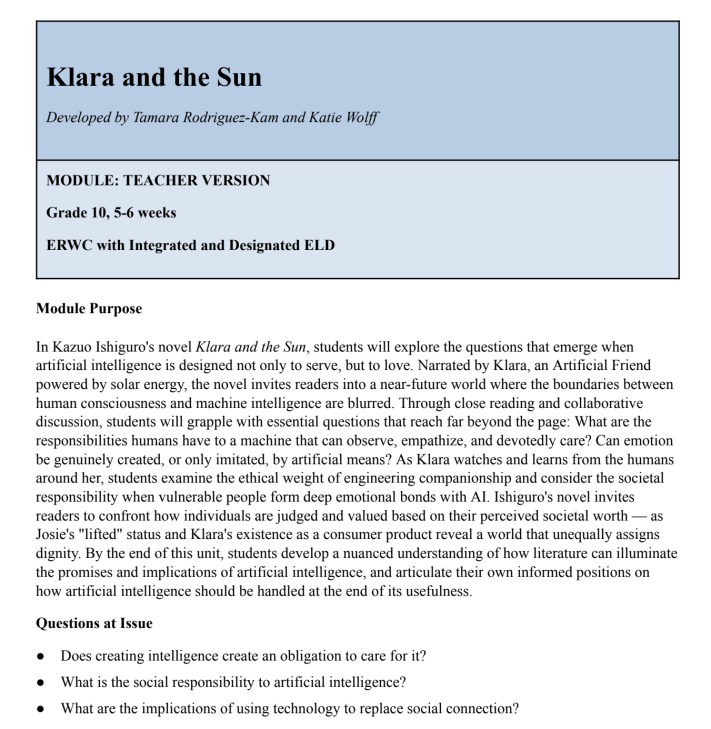
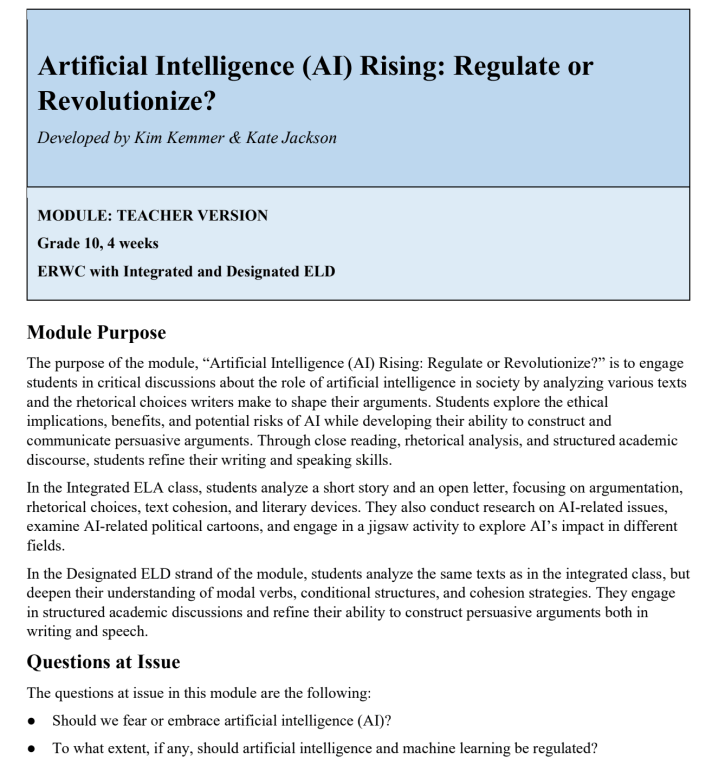
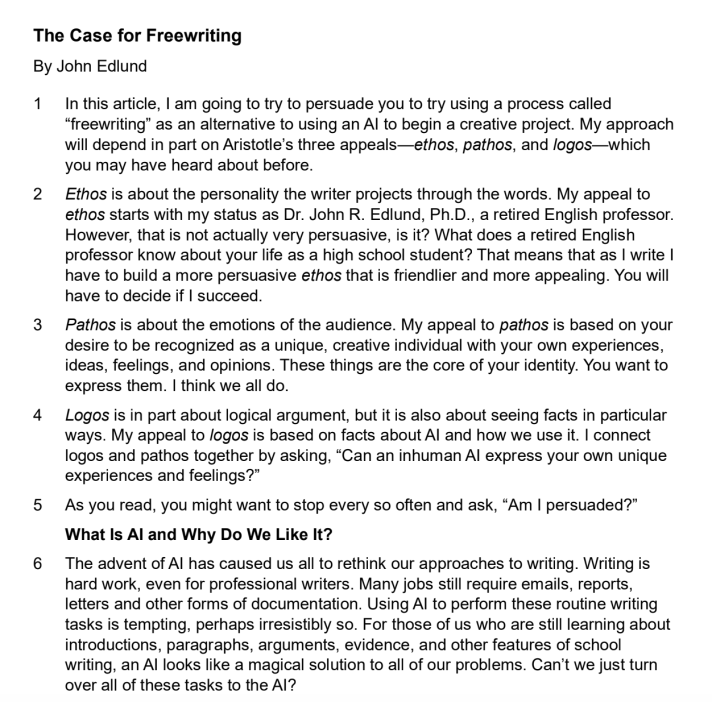
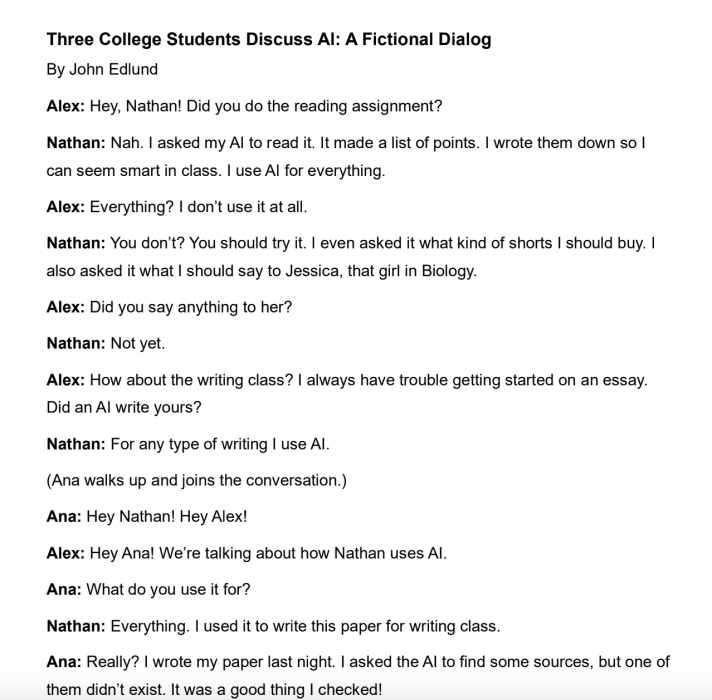
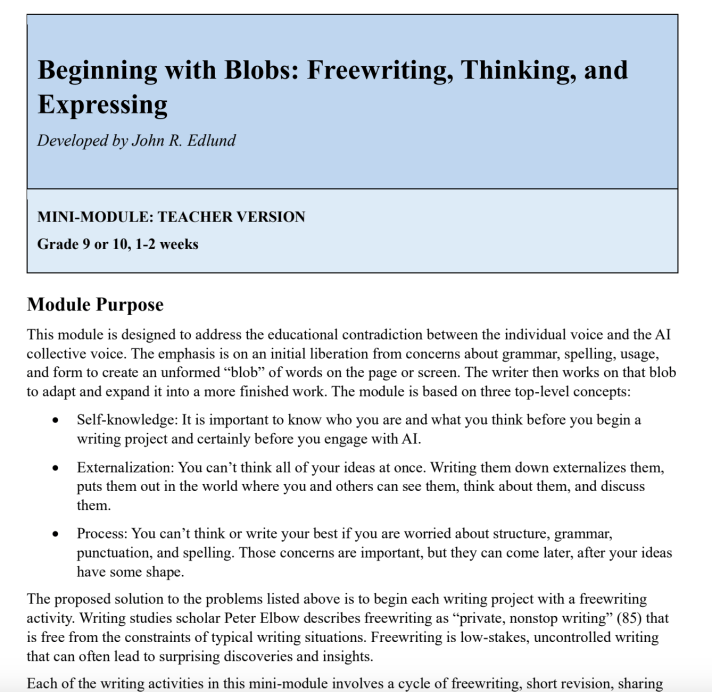
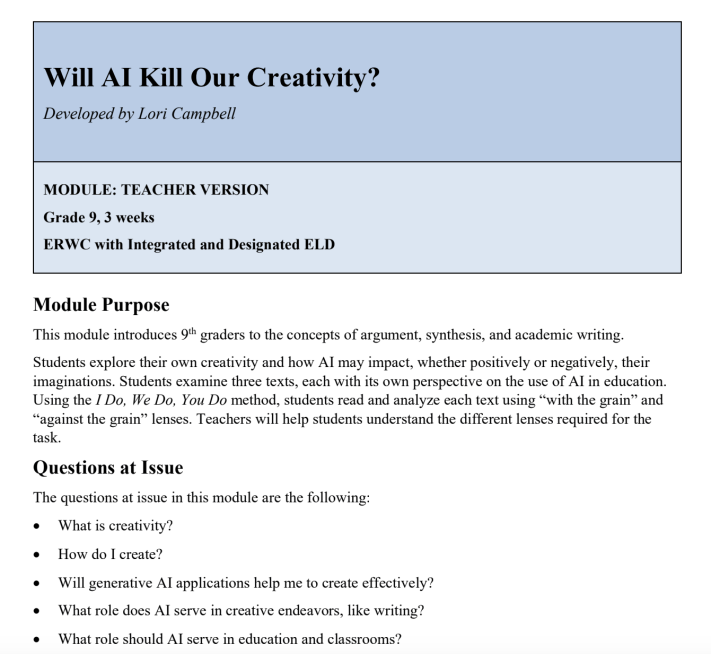
Note: Images show screenshots of draft modules. Modules may be revised prior to publication.
Putting Our Principles into Practice
ERWC may not yet have a white paper on AI, but we do have a community and teaching resources that can help us figure out an approach that’s consistent with our beliefs. My own working guidelines for AI use look like this at the moment:
- Trust humans, not chatbots.
- Practice radical transparency–be an open book when it comes to AI use. Fully disclose any applications you use in your work as a reader and writer (including as a reader of student work and writer of lesson plans) and encourage students to do the same. Celebrate honesty.
- Center human relationships and human communication.
- Engage in shared inquiry with students. Try using stasis theory to identify current questions at issue regarding GenAI.
- Read arguments about AI with and against the grain.
While we can’t know the future lives we’re preparing our students for, we can hold fast to our hope for their success and our clarity of purpose. The final sentence of the “ERWC Theoretical Foundations” is a reminder of the goal we’re pursuing together: “It is our greatest hope that all ERWC students will be well prepared to navigate the diverse contexts and challenges of their future lives” (9). This is something we can all believe in.
Resources on AI-Aware Teaching:
Jennifer Fletcher is a Professor of English at California State University, Monterey Bay, where she coordinates the undergraduate program for future English teachers. She also teaches writing courses for first-year college students. Jennifer is a member of the ERWC Steering Committee.