Unmuting Potential: Rethinking Speaking Opportunities Within ERWC to Unleash Student Voices

By Grace Adcock and Cristy Kidd

October 20, 2025 
Picture a student in your classroom who has mastered speaking and listening. You probably saw someone who is actively listening, speaking with confidence, informed with facts and ideas, knows when to speak up and when to make space for others, considers counterarguments, and has audience awareness. 

We know, however, that there are barriers keeping students from growing into their potential: anxiety, practice (or lack thereof), past experiences, low confidence and devaluation of their ideas. We must break down these barriers so students can find and use their voice.

Creating Norms and Expectations
The first step is creating norms and expectations around speaking in your classroom. In the HIST (High Impact Strategy Tool Kit) many options already exist.
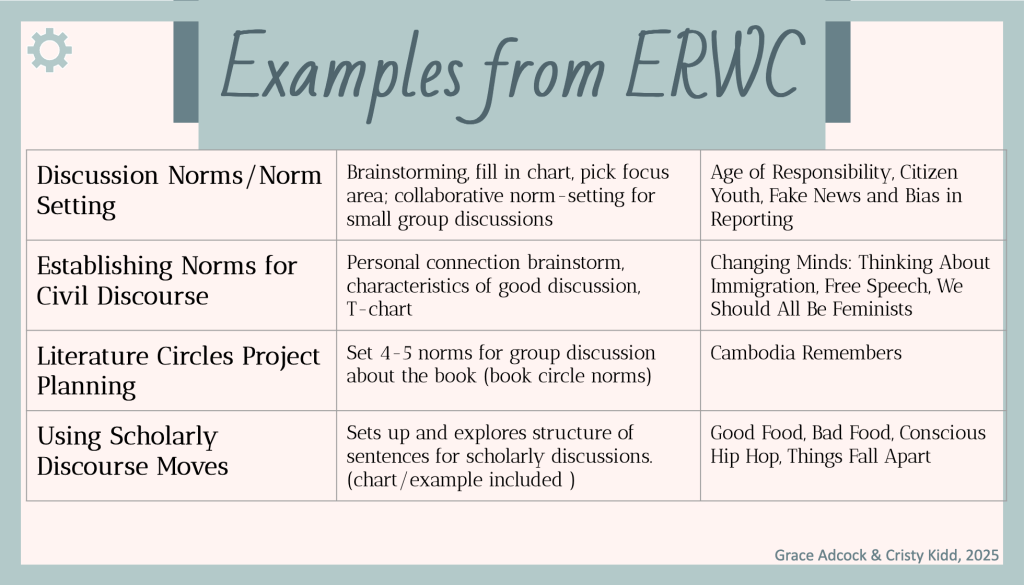
We found success in using one strategy, โ€œDiscussion Norms/Norm Setting,” as a cornerstone in our classrooms throughout the year to establish all speaking and listening norms. It provides space for students to share in the decision-making process around how discussions will work. Choose the norm setting activity that works best for you, use it early in the year as a foundation for your classroom discussions – revisit and reference it often. 


Responding and Modeling

Revisiting norms allows space and time to respond to situations where they have been broken and to model the expected behaviors.  It is important to shut down the harmful behaviors that impede a studentโ€™s ability to participate through reframing. Making sure students have had a say in the norms makes them easier to uphold. Reminding students their feelings and experiences are shared by others in the room helps build confidence. Modeling that even teachers get nervous or that speaking is not always easy for us helps to reinforce this. There are many examples in ERWC modules where teachers are asked to model and frontload expectations because it works and supports student learning. 

“Reminding students their feelings and experiences are shared by others in the room helps build confidence.”

Intentionally Planning

When we think about speaking opportunities we offer students we identify reports, speeches, presentations, and class or group discussions. As ERWC teachers, we spend time considering the activities we will keep or cut, the order in which we will present modules to our students, and when we will teach certain skills, but we donโ€™t often consider how we spiral a progression of speaking and listening. 

Once we have set our norms, made efforts to conscientiously break down barriers, the next step is intentionally planning opportunities in the classroom. This starts with the low risk activities we already do: pair share, whip around, single word answers, etc. Not all speaking activities need to be formal; it is imperative to remember that speaking is something students do every day. We must make planned, intentional spaces to support their growth. Just as ERWC modules spiral and follow the arc, we need to spiral and scaffold speaking in our classrooms.   

Like Bloomโ€™s taxonomy shows us a progression of complexity of tasks, the image below illustrates a continuum of low-risk speaking opportunities to high-risk ones. 
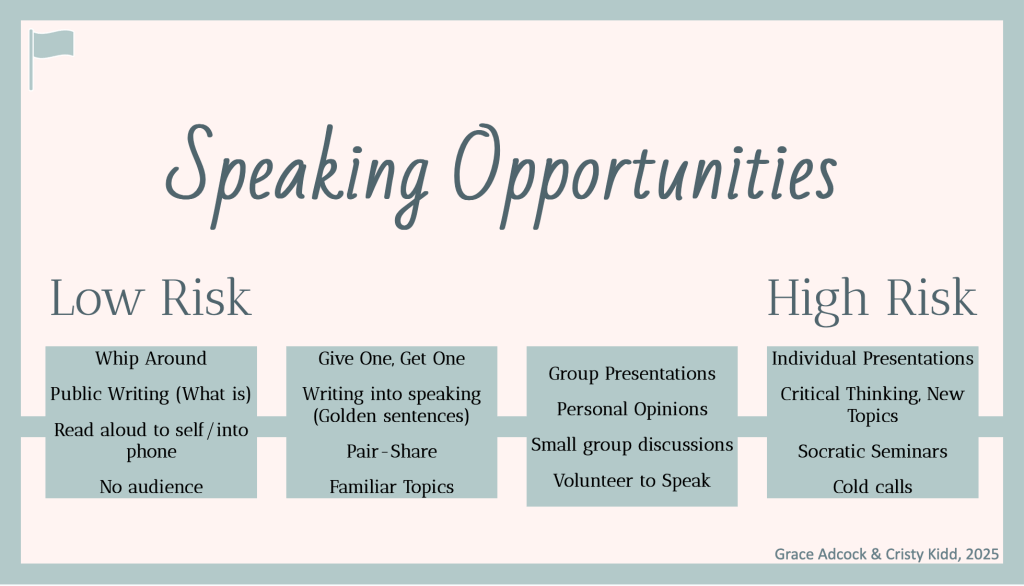
These opportunities, especially at the lower level, are not explicitly delineated or spiraled in the ERWC modules. But we know students need to be guided through a variety of activities. We canโ€™t expect them to be successful at the higher risk activities if they do not have the foundation from the lower risk ones; they work hand in hand to build upon each other.  Go back to the ERWC foundation of making decisions: intentionally choose module activities and build a progression. 

Here is a sample from the ERWC unit โ€œInto the Wildโ€;  We combined activities that exist in the module with our own to carefully plan a progression. 
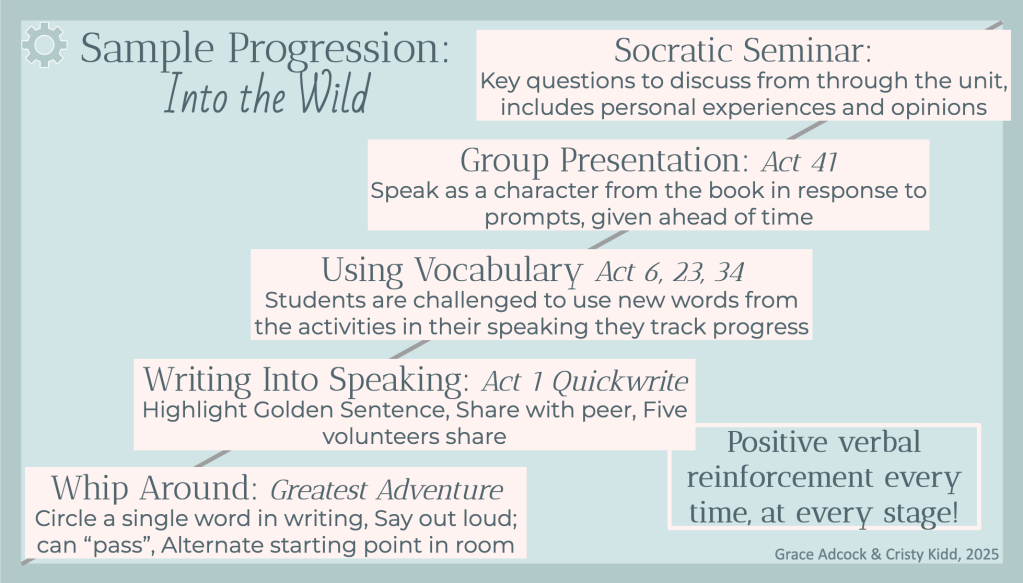
If after all your careful planning and spiraling, you encounter students who are still struggling, remember there are additional options: one-on-one presentations with you or speaking in front of a small group of trusted classmates, for example. 

As long as you are providing small opportunities for speaking and normalizing it each and every day you will see growth in studentโ€™s confidence and skills. Progress is the goal, it looks different for each student, and it can only be measured individually against their own growth. It is not a competition. Students โ€œwinโ€ only when the end game is encouraging them to find and use their voice. 


Biographies

Grace Adcock is an educator, wife, mother, and avid baseball fan from Redding, California, where she was raised and her family lives today. She attended CSU Monterey Bay, majoring in Human Communication (HCOM) and minoring in outdoor education and recreation. She then attended CSU Chico for credentialing and graduate studies. She holds a valid Single Subject English, Mild/Moderate Special Education, Multiple Subject, and Reading Specialist credentials, along with her masters in Special Education. Camping, attending baseball games, and traveling take up most of her spare time in the summer and over breaks. 

Cristy Kidd is an educator, a scholar, a wife, a reader, and a nerd, born in the San Francisco Bay Area and currently living in Redding. She has been teaching Communication Studies at the community college level for seven years, and has taught high school for five years, first as an English teacher at a traditional site and then at an alternative education independent study school. Outside of academia, she enjoys Dungeons & Dragons, is a certified yoga instructor, and loves live music and musical theatre.

Adopting a Mentoring Stance

By Christy Kenny-Kitchin

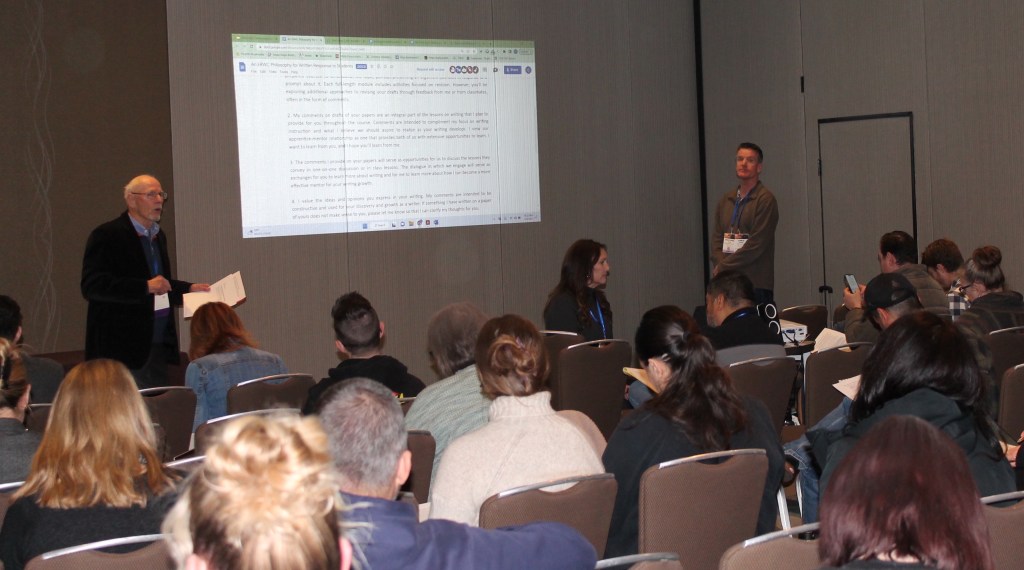
I recently presented at the CATE Convention in Monterey, California on taking a mentoring stance when responding to student writing. I worked with two professors from Cal State–Chris Street and Norm Unrau. We all shared on the importance of responding appropriately to student writing. We focused on how much our responses to our students affect our connection with them and, in turn, their ability, or perhaps desire to show up for us in class.

After Chris shared a less-than-kind comment he had received from a teacher when he was a student, we elicited responses from the audience about their experiences. Nearly every person had an experience in which one of their teachers had said something to them, perhaps a brief statement or a seemingly innocuous small, two-word response on a project that had changed the studentโ€™s perspective on their own learning.

I shared from the perspective of a secondary teacher that post pandemic, I had struggled greatly to connect with my students as I had done in the past and how classroom management was now a huge issue.

As if to prepare me for the presentation, the week prior to the conference, I decided to significantly change my approach to the teaching of writing. I had spoken to several colleagues at different schools and knew that the lack of skills–both academic and inter-personal–was what we might term โ€œthe new pandemic.โ€ I could see that critical thinking and writing skills were seriously lacking and, when I considered that the last time my seniors had had an uninterrupted year of schooling face-to-face with a writing teacher, they were freshmen. Their skills reflected this.

My classes were in the middle of writing the speech for the โ€œLanguage, Gender, and Cultureโ€ ERWC module. I decided to extend the amount of in-class time we spent on the assignment in order to provide daily instruction on every aspect of the writing process. I gave a mini-lesson each day and walked around the room to see each studentโ€™s progress. One after another said they did not need help or that they needed โ€œtime to thinkโ€ through their writerโ€™s block. I gave them space to write and continued to share lessons as a whole class, thinking they would absorb the information. By the second day, I had seen very little progress with any student in any class. So, I offered student-teacher writing conferences. Only a couple of people in each class approached. I then made it mandatory that they have a conference before moving on to their rough drafts.

As we sat in each conference, one on one, in front of the entire class, but talking softly, I was able to see what was lacking in their approach, and in their thinking about the topic. They saw me brainstorm with them, showing them the structure for their topic. They watched as I struggled with them to come up with the specifics of their topic then their issue, their question at issue, and finally their thesis statement for the speech. We worked on funneling down their ideas to something specific enough to be able to write a 2 to 3 page speech instead of what many of them had–a topic so broad that only a textbook could do it justice.

As each student sat before me, watching my thinking and hearing me say things such as, โ€œThis is definitely a topic that we can work with. Letโ€™s narrow it down so itโ€™s easy to approach,โ€ and โ€œI like where youโ€™re going with this. You have some really good ideas!โ€ I saw them light up. I continued in some conferences to say things like, โ€œI am struggling to figure out where to take this topic. Give me a second. Letโ€™s take a moment to brainstorm this one together.โ€

Not only did these conferences allow me to show each student a solid approach to their assignment, I could clearly see how each of them processed their thinking, which students had anxiety with either approaching a teacher or a big writing task, and who needed more support moving forward. But by responding kindly with my comments and showing them my thinking, we connected on a human level.

As I reflected on the conferences each day, I recalled how, prior to the pandemic, I had given each class an intro writing assignment in August in which they explained to me either a positive or a negative experience they had had in the past with an English class or teacher. With that assignment, I would call each of them up to have a brief conference to discuss their experience and answer any questions they had. I hadnโ€™t had a classroom management issue in years. What I didnโ€™t realize is that it was because they had seen me early in the year as a human who cared.

During this school year, the first full year of in-person learning, I had struggled with classroom management reminding me of my first few years as a teacher. I was ready to quit the profession.

However, in bringing back these student-teacher conferences, I noticed a significant shift in every one of my classes. Students were suddenly following every request and they are now more willing to show up–physically, mentally and emotionally. Some students are sharing their personal struggles with me rather than sitting in class, as Audre Lorde states, silently swallowing their tyrannies day by day until they โ€œsicken and die of them still in silence.โ€

This connection is not only what had been lacking for my students, but it is the exact thing I needed as an educator to keep me enlivened in this profession.

Christyย Kenny-Kitchin is an English teacher at Buena Park High School where she has also served as a Literacy Coach and Curriculum Specialist. She has taught English at the middle school, high school, and college levels. Having written one of the i3 modules (“The Daily Challenge”), she also worked as an academic coach to teachers for the i3 grant.ย Christyย has been leading ERWC professional learning workshops for over a decade.


Editor’s Note: Please see the new ERWC teaching resource, “Adopting a Mentoring Stance with Student Writers,” for more strategies for cultivating students’ writing lives and identities.

2023 ERWC Literacy Conference

Please consider submitting a proposal to present at this yearโ€™sย ERWC Literacy Conference, to be held June 20th in Sacramento and June 26th in Pomona. Cal State University pays travel costs for selected presenters. See theย Call for Presentersย here.ย 

The deadline for proposals has been extended to April 14, 2023.

Conference registration is now open! The $75 registration fee includes continental breakfast and a buffet lunch. Discounts available for administrators, literacy coaches, and counselors.

Building Better, Stronger Classroom Communities in 2023

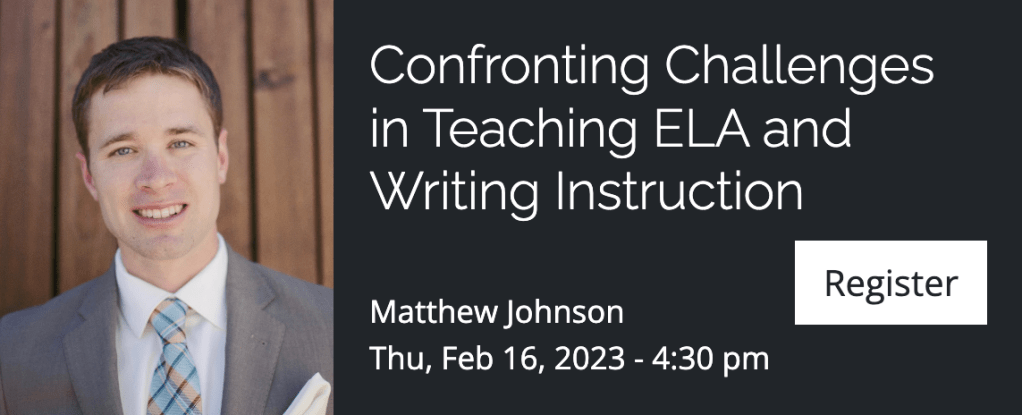
Editor’s Note: This post was first published on Matthew Johnson’s blog and is republished here with the author’s permission. The ERWC community is excited to announce that Matt will be the featured speaker for our February 16th webinar at 4:30 p.m. PST. Registration is free!


By Matthew Johnson

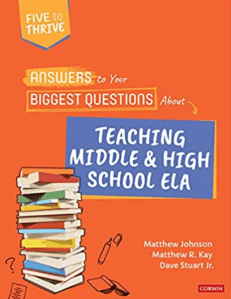
Regular readers of my blog know that Matt Kay, one of my co-authors ofย Answers to Your Biggest Questions About Teaching Middle and High School ELA, is on my pantheon of great writing teachers. Iโ€™m not sure there is a more remarkable and inspirational educator anywhere, and, if given the choice, he is probably the first teacher in the country whose class I would put my own children in.

At NCTE 2022 Matt Kay once again proved why he is one of the all-time greats when he made an argument for writing teachers to approach community building as thoughtfully as they approach designing a lesson or crafting a writing prompt. His reasoning went like this: The primary audience for studentsโ€“especially in a modern classroom that is full of group work, discussion, projects, and choiceโ€“is not the teacher; it is each other. As adolescents, they are constantly and somewhat obsessively watching, comparing and contrasting with, and performing for each other. If they have strong community and relationships, or in other words, their relationship with their primary classroom audience is strong, everything done in the classroom will benefit.

I have a hunch that most teachers reading this will likely know this already at some level. They will know how smoothly discussions and peer response and projects go in that section that has truly gelled and how difficult those things can be in the class that hasnโ€™t quite come together yet. What makes Kayโ€™s point different and important from the general argument that community is important is that he points out that even when we know that community is important, we also tend to quietly and often unconsciously downgrade it as a second tier concern. It is something to focus on during the first few weeks of the year or after the lessons are planned, email is cleared, and all papers have responses.

At NCTE Kay sought to remind us that community building is a top-tier concern, one that we should loudly proclaim as important and keep our eye on, not just during the first week, but throughout the whole school year.

Kay also gave a simple, effective recipe for how to build a strong, supportive community all year long:

  1. First, explain directly why community building matters. Donโ€™t assume that students know why sharing good news or engaging in a silly competition or having a cookie contest before winter break will help them.
  2. Then systematize it. Community-building is often the first thing to get bumped and it can be scattershot. Kay argues that when community building is dropped in favor of content or done haphazardly, the message is clear to students: it doesnโ€™t matter as much as other aspects of the classroom, which can cause them to disinvest from it. Kayโ€™s suggestion to avoid this is to ritualize it: โ€œ[When building community], make sure there is an every Monday we do this. Every Tuesday we do this. Every Wednesday we do thisโ€ฆโ€ By systematizing it and pinning specific community building elements to specific days we can show its value and protect against dropping it when things get busy.
  3. Then keep it up all year. Community building in the first few weeks is expected, but continuing it once the crush of our classโ€™s content comes upon us is not always easy. If we want community to run deep though our classes, we need to have the same commitment in week 34 that we have in week 1.

I have written a lot about community over the years because I feel that it is the secret sauce for what makes a learning communityโ€“and especially a writing learning communityโ€“truly great. And yet, truth be told, Iโ€™m not sure I explain its value enough after the first week, have it as organized as it could be, or am as dogged as I could be about ensuring it doesnโ€™t get bumped as the year pushes forward.

Kayโ€™s reminder was just what I needed, as I have a feeling that community will be critically important when we face the challenges of 2023, ranging from making it through this tripledemic winter of illness to the rise of AIs like ChatGPT.

Yours in Teaching,

Matt

If you liked thisโ€ฆ

Join my mailing list and you will receive a thoughtful post about finding balance and success as a writing teacher each week along with exciting subscriber-only content. Also, as an additional thank you for signing up, you will also receive a short ebook on how to cut feedback time without cutting feedback quality that is adapted from my book Flash Feedback: Responding to Student Writing Better and Faster โ€“ Without Burning Out from Corwin Literacy.

Matthew M. Johnson is a teacher, author, and literacy leader whose books include Flash Feedback and Answers to Your Biggest Questions About Teaching Middle and High School ELA with Matthew R. Kay and Dave Stuart Jr. You can follow Matt @a2matthew and chat with him live during the ERWC webinar on February 16th at 4:30 PST.

FREE WEBINAR REGISTRATION: https://writing.csusuccess.org/webinars

Watch the recording of the ERWC webinar with Matt Kay here.


SAVE THE DATE! The annual ERWC Literacy Conference will be June 20th in Sacramento and June 26th in Pomona. Registration opens in March. Watch for a Call for Presenters to be issued soon!

Our Shells – Or What Happened When the Octopus Left Its Shell

By Jonathon Medeiros

I can already hear the responses: Be more engaging. Control your students. You canโ€™t let them act that way. Work on your classroom management!

Sure, but let me think about my school day, one single day. I welcome each student out in the hall, hello, aloha, good morning, yes Iโ€™m well, you? The students enter a calm and uncluttered space, the rainbow on the whiteboard declaring that โ€œif you are kind, your day will be like a bright rainbow,โ€ courtesy of my 9 year old. They see the ever present note that โ€œbeing understood feels like loveโ€ and they know exactly how class will go. 

We will talk, share our kind attention, we will read, and write, and listen, and have time to quietly reflect, time to take a public academic risk, if we are ready. They always know I am there pushing them to think, to change, to struggle with difficult ideas that matter but that I am always there with them as a partner in the learning. This is not to imply that other classes do not do this, only that this classroom, the one I share with my students, is purpose built to be engaging, challenging, safe, and honest.

And who walks into this class each morning? Five students buried deep beneath hats, hoodies, and shades, earbuds in, screens in palms. Some others without the hoodies but still the devices. Some with no ability to talk on a given day. Some in surf shorts and cowboy boots. Some on time, many five, ten, twenty minutes late, but consistently so that one might say they are punctual. Some show up with smiles, some genuine, some in defense against the world of school, or the world in general. Some arrive at 8:05 with a full plate of fried chicken.

We arenโ€™t reading irrelevant, dead pieces of the canon and completing worksheets or meaningless essays. We investigate our places, the stories that are here, the ones erased and the reasons for the erasure of those stories. We learn about people’s beliefs and investigate our own; we think about and talk about how people in power try to keep that power. We grapple with the unkindess of the world and our kuleana, our reciprocal responsibility, in the face of that. And when one student is talking about how they feel marginalzed because they are queer, or because they have an accent, or they are from the Marshall Islands, another is numbing themselves with the videos on their phone.ย 

And my โ€œplease stop watching videosโ€ is met with โ€œfโ€“ you fag bitch!โ€ And โ€œplease join the circle and learn with usโ€ is met with lying across three chairs or hiding on the floor under a desk.

And I think about how the octopus used to have a shell. 

Adults sometimes use this metaphor to talk about hard to reach students, asking questions about getting them out of their shells. Early in its evolution, the shelled mollusk that became the octopus let its shell go, abandoning its most effective safety mechanism. Naked, the world became dangerous. 

Without a shell, the octopus heightened its attention to danger, sending its nervous development into overdrive, creating a creature that has more neurons in its limbs and body and skin than it has in its entire relatively large brain. The octopus is now a master of disguise, able to taste and see danger with its skin, a shapeshifting living movie screen that projects all the colors we can and canโ€™t imagine. All of these adaptations are defenses; its speed, its disguise, its jets, its sensing seeing skin, its clouds of ink, all of it developed to be the shell it abandoned. 

Now, hyper aware of danger, this being that puts so much energy, so much of its intelligence and creative ability, into defense spends it all in a blur and is dead by the time two years is up. 

And when I look across my school day, I do not think these students are building walls or hiding inside of shells. As they enter the classroom, they are on high alert, everything is potentially dangerous, sus. I think about the shells that the students have abandoned or have had stolen from them and the defenses they have developed to cope. 

I am the teacher in my classroom; I am a swimmer in the ocean, an interloper, and I am trying to be still so that the shell-less among us can somehow find a way to not see every moment at school as a potential danger or threat.

Jonathon Medeiros has been teaching and learning about Language Arts and rhetoric for sixteen years with students on Kauaสปi. He frequently writes poetry, memoir, and essays about education. He is the former director of the Kauaสปi Teacher Fellowship. Jonathon enjoys building things, surfing, and spending time with his wife and daughters. He believes in teaching his students that if you change all of your mistakes and regrets, youโ€™d erase yourself. Follow Jonathon on Twitter – @jonmedeiros or at jonathonmedeiros.com.

Editors’ Note: Jonathon’s post beautifully exemplifies the earnest reflection and relational teaching that characterize effective implementation of the ERWC curriculum. For more information on the ERWC and its theoretical foundations, please visit the ERWC Online Community.