Unmuting Potential: Rethinking Speaking Opportunities Within ERWC to Unleash Student Voices

By Grace Adcock and Cristy Kidd

October 20, 2025 
Picture a student in your classroom who has mastered speaking and listening. You probably saw someone who is actively listening, speaking with confidence, informed with facts and ideas, knows when to speak up and when to make space for others, considers counterarguments, and has audience awareness. 

We know, however, that there are barriers keeping students from growing into their potential: anxiety, practice (or lack thereof), past experiences, low confidence and devaluation of their ideas. We must break down these barriers so students can find and use their voice.

Creating Norms and Expectations
The first step is creating norms and expectations around speaking in your classroom. In the HIST (High Impact Strategy Tool Kit) many options already exist.
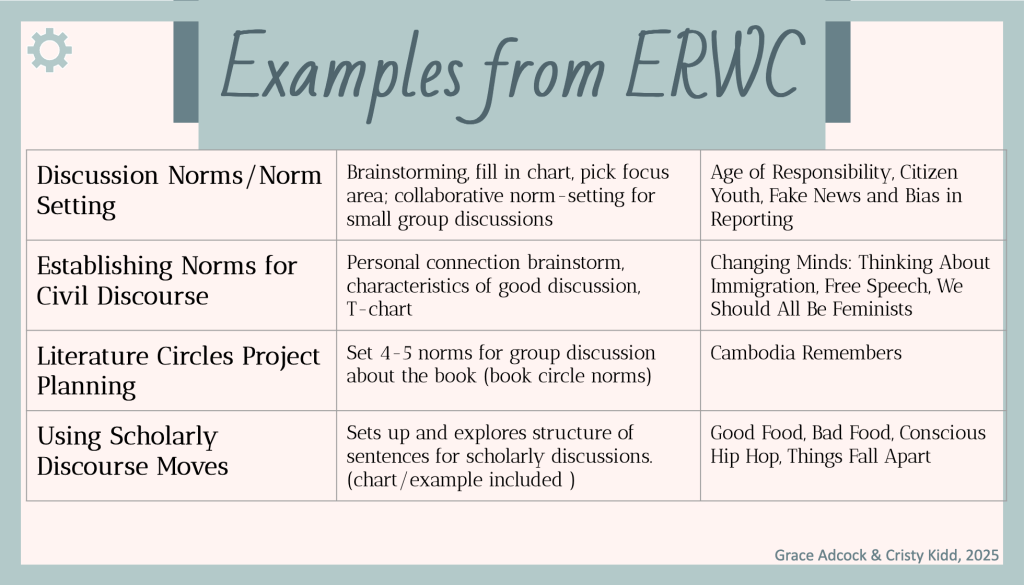
We found success in using one strategy, “Discussion Norms/Norm Setting,” as a cornerstone in our classrooms throughout the year to establish all speaking and listening norms. It provides space for students to share in the decision-making process around how discussions will work. Choose the norm setting activity that works best for you, use it early in the year as a foundation for your classroom discussions – revisit and reference it often. 


Responding and Modeling

Revisiting norms allows space and time to respond to situations where they have been broken and to model the expected behaviors.  It is important to shut down the harmful behaviors that impede a student’s ability to participate through reframing. Making sure students have had a say in the norms makes them easier to uphold. Reminding students their feelings and experiences are shared by others in the room helps build confidence. Modeling that even teachers get nervous or that speaking is not always easy for us helps to reinforce this. There are many examples in ERWC modules where teachers are asked to model and frontload expectations because it works and supports student learning. 

“Reminding students their feelings and experiences are shared by others in the room helps build confidence.”

Intentionally Planning

When we think about speaking opportunities we offer students we identify reports, speeches, presentations, and class or group discussions. As ERWC teachers, we spend time considering the activities we will keep or cut, the order in which we will present modules to our students, and when we will teach certain skills, but we don’t often consider how we spiral a progression of speaking and listening. 

Once we have set our norms, made efforts to conscientiously break down barriers, the next step is intentionally planning opportunities in the classroom. This starts with the low risk activities we already do: pair share, whip around, single word answers, etc. Not all speaking activities need to be formal; it is imperative to remember that speaking is something students do every day. We must make planned, intentional spaces to support their growth. Just as ERWC modules spiral and follow the arc, we need to spiral and scaffold speaking in our classrooms.   

Like Bloom’s taxonomy shows us a progression of complexity of tasks, the image below illustrates a continuum of low-risk speaking opportunities to high-risk ones. 
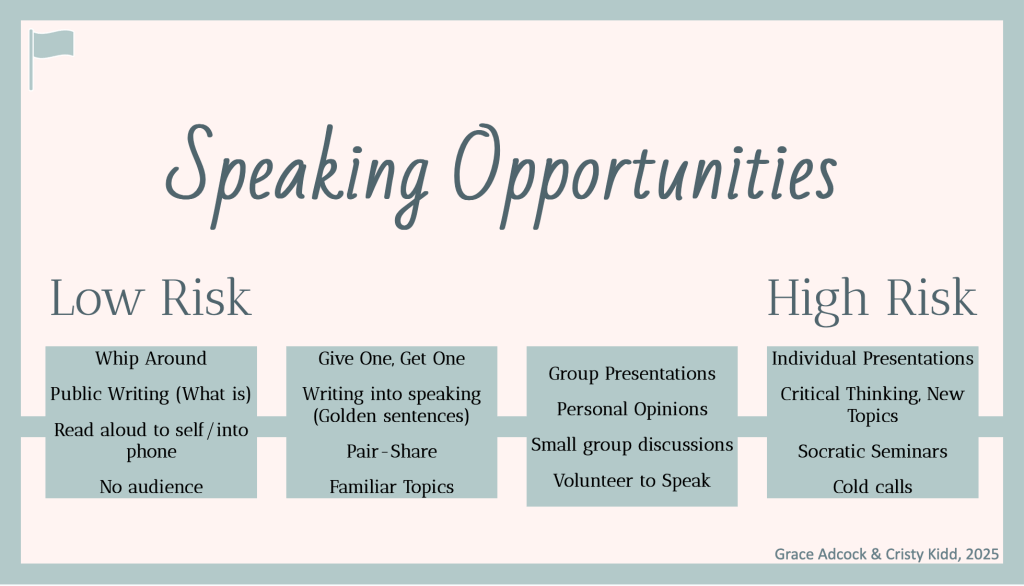
These opportunities, especially at the lower level, are not explicitly delineated or spiraled in the ERWC modules. But we know students need to be guided through a variety of activities. We can’t expect them to be successful at the higher risk activities if they do not have the foundation from the lower risk ones; they work hand in hand to build upon each other.  Go back to the ERWC foundation of making decisions: intentionally choose module activities and build a progression. 

Here is a sample from the ERWC unit “Into the Wild”;  We combined activities that exist in the module with our own to carefully plan a progression. 
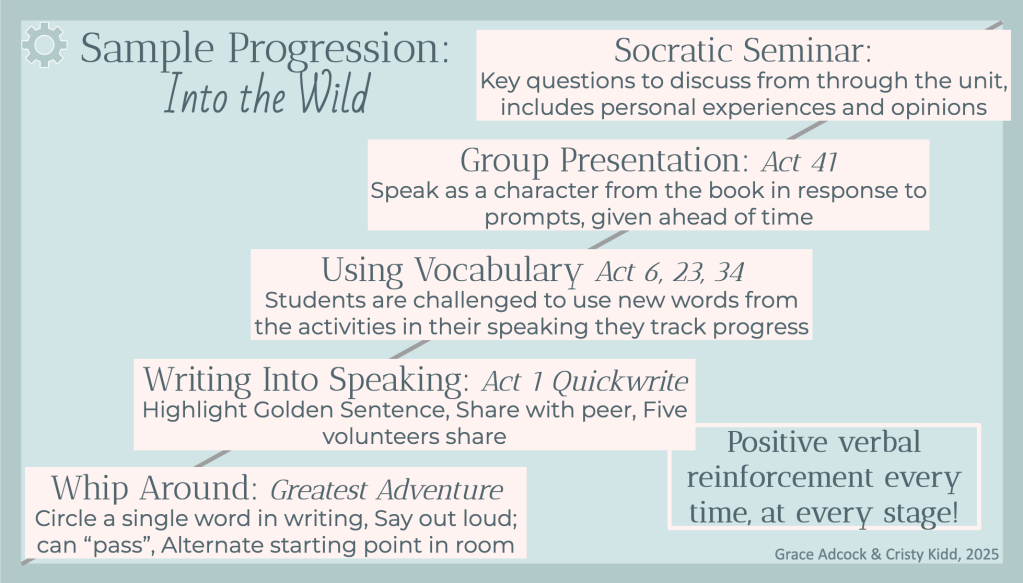
If after all your careful planning and spiraling, you encounter students who are still struggling, remember there are additional options: one-on-one presentations with you or speaking in front of a small group of trusted classmates, for example. 

As long as you are providing small opportunities for speaking and normalizing it each and every day you will see growth in student’s confidence and skills. Progress is the goal, it looks different for each student, and it can only be measured individually against their own growth. It is not a competition. Students “win” only when the end game is encouraging them to find and use their voice. 


Biographies

Grace Adcock is an educator, wife, mother, and avid baseball fan from Redding, California, where she was raised and her family lives today. She attended CSU Monterey Bay, majoring in Human Communication (HCOM) and minoring in outdoor education and recreation. She then attended CSU Chico for credentialing and graduate studies. She holds a valid Single Subject English, Mild/Moderate Special Education, Multiple Subject, and Reading Specialist credentials, along with her masters in Special Education. Camping, attending baseball games, and traveling take up most of her spare time in the summer and over breaks. 

Cristy Kidd is an educator, a scholar, a wife, a reader, and a nerd, born in the San Francisco Bay Area and currently living in Redding. She has been teaching Communication Studies at the community college level for seven years, and has taught high school for five years, first as an English teacher at a traditional site and then at an alternative education independent study school. Outside of academia, she enjoys Dungeons & Dragons, is a certified yoga instructor, and loves live music and musical theatre.
The Right to Read

By Carol Jago

Powerful forces are gathering to demand control over what is taught, what students read, and what can and cannot be spoken.

A recent report from PEN America called “Banned in the U.S.A.” reports an astonishing 1,586 book bans in 86 school districts and 26 states. California is not one of these states. Yet. Overwhelmingly, the majority of books being targeted explore issues of race, racism, sexual orientation, and gender identity.

“It is not just the number of books removed that is disturbing, but the processes–or lack thereof–through which such removals are being carried out,” the report states. “Objections and challenges to books available in school are nothing new, and parents and citizens are within their rights to voice concerns about the appropriateness and suitability of particular books. In order to protect the First Amendment rights of students in public schools, though, procedural safeguards have been designed to help ensure that districts follow transparent, unbiased, established procedures, particularly when it comes to the review of library holdings.”

The American Library Association, which has been tracking book challenges for 20 years, reports a surge the like of which they have never seen before. “What we’re seeing right now is an unprecedented campaign to remove books from school and public libraries that deal with the lives and experiences of people from marginalized communities,” said Deborah Caldwell-Stone, the director of the American Library Association’s office for intellectual freedom.

The struggle to control what students read seems to be driven by fear: parents’ fear that their children will be brainwashed. They want to protect their babies. But keeping young people ignorant of reality, particularly when it’s harsh, won’t keep them safe. In fact, blinders can prevent children from understanding what they see in the world around them and what they feel within themselves. Not talking about Bruno won’t make him disappear.

The danger is silence. Classroom discussion is essential to educating tomorrow’s citizens. And teachers, in concert with their school communities, are in the best position to make decisions regarding what to teach and how to approach controversial subjects in age-appropriate ways. Controversial readings and topics always make for the most engaging classes and most engaged students. “Argue the point, not the person!” I reminded my students again and again.

Teachers find themselves crippled by curricular caution. And self-censorship may ultimately have more of an impact than school board bans. Results of a survey conducted by School Library Journal suggest that censorship attempts are likely to have a long-lasting insidious effect on school library collections. Removed books can be counted. What about the books that are never purchased?

Terry Stout Anderson, a district coordinator for secondary English in a large Midwestern school district, writes: “I don’t want teachers in my district to play it safe, but I do want English teachers across our district to feel safe when engaging students in adventurous thinking and free inquiry.”

No book worth teaching is neutral or without troubling moments. And even the most perfect book adoption process still cannot protect us from a potentially raucous school board meeting. Professional communities like the National Council of Teachers of English, the California Association of Teachers of English, and ERWC can help us navigate these difficult times. Educators committed to bringing great literature into classrooms do not need to go it alone.

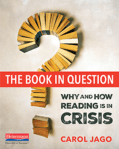
Carol Jago is a long-time California public school teacher and past president of the National Council of Teachers of English. She is associate director of the California Reading and Literature Project at UCLA and currently serves on the executive board of the International Literacy Association. Carol is the author of numerous books including The Book in Question: Why and How Reading Is in Crisis.


Looking for ways to promote civil discourse and facilitate meaningful conversations on sensitive topics in ERWC classrooms? Please see the recording of Matt Kay’s webinar: “Hitting for Contact: Consistent Success in Race Conversations” and.” The ERWC Theoretical Foundations for Rhetorical Reading and Writing, ERWC UCOP-approved course descriptions, and Introduction to ERWC 3.0 also offer rationales and research for ERWC’s inquiry-based approach to civil discourse.


Save the Date! The 2024 ERWC Literacy Conferences will be held June 17th in Sacramento and June 25th in Pomona.

How the ERWC Fosters Independent Learners

By Anne Porterfield

A key pedagogical strategy embedded in California State University’s Expository Reading and Writing Curriculum (ERWC) is for teachers to release control to students so that students can guide their own learning. Findings from a study of the ERWC, which was funded by an Investing in Innovation (i3) Validation grant, suggests that many of the teachers who taught it were successful in supporting students to take ownership of their learning.

According to some teachers, the texts and topics are highly engaging because they are relevant to students’ lives. For example, two popular modules–On Leaving I On Staying Behind and The Distance Between Us–include stories about immigration; some of the students saw their own families’ stories in those stories, which allowed them to enter the conversation with the text and one another.

In addition to the ERWC soliciting a high level of student engagement, teachers in the study reported that the ERWC prepares students for college. One way ERWC teachers in the study did this was by structuring discussions in ways that invited students to participate. This built students’ confidence and motivation to participate, allowing the discussions to become more student-led and inquiry-based. The hope is that, when students get to college, they will know how to engage in meaningful discussions with their peers without scaffolding.

Helping Students Set Meaningful Learning Goals

Despite all of the progress ERWC teachers saw their students make towards becoming independent learners, there is still one major area of growth: supporting students to set meaningful learning goals. The most prevalent concern among teachers is that learning goals are inauthentic for students. In other words, students just write down what they think the teacher wants to hear. 

ERWC Steering Committee member Dr. Ginny Crisco suggested some possible solutions in our forthcoming publication, which included teaching students how to look at data in order to develop learning goals and creating a climate of self-assessment and reflection. One tool teachers can use to do that is the Cycle for Cultivating Expert Learners, which includes the following components:

  • Emphasize a culturally sustaining and accessible inquiry approach to learning.
  • Practice mastery oriented goal setting  – focusing on both academic and academically related personal goals – to help students highlight how they are purposefully moving through a process of literacy development.
  • Offer choices for learning via engagement, action and expression, and representation, emerging from goals, that are also culturally sustaining and accessible.
  • Integrate formative assessment – that both students and teachers complete in relation to students’ work – to provide regular feedback about “where am I going?,” “where have I been?” and “where to next?” (Unrau 2019).
  • Evaluate student performance (and have them evaluate it) through summative assessment.
  • Cultivate constructive metacognition (Gorzelski et al 2016) through reflection across writing contexts and tasks.

Please see the ERWC Teaching Resource “Universal Design for Learning for the Expository Reading and Writing Curriculum” for more information on the Cycle for Cultivating Expert Learners.

Do you have suggestions for how to support students to take ownership of their learning goals? If so, please use the comment box below to share your ideas! 

Anne Porterfield is a Program Associate at WestEd and one of the authors of the new report Expanding the Expository Reading and Writing Curriculum: An Evaluation of an Investing in Innovation Validation Grant (2022). She tweets @anneporterfield.

References

Fong, A., Porterfield, A., Skjoldhorne, S., & Hadley, L. (2022). Expanding the Expository Reading and Writing Curriculum: An evaluation of an Investing in Innovation Validation grant. WestEd. https://www.wested.org/resources/expanding-the-erwc-evaluation/

Unrau, N. (2019). Formative assessment for ERWC. Curriculum Overview Document. Expository Reading and Writing Curriculum, 3rd Edition. Long Beach, CA: California State University. https://writing.csusuccess.org/content/formative-assessment